





 Portuguese
  English
  Spanish
  4 min of reading
  0 comments


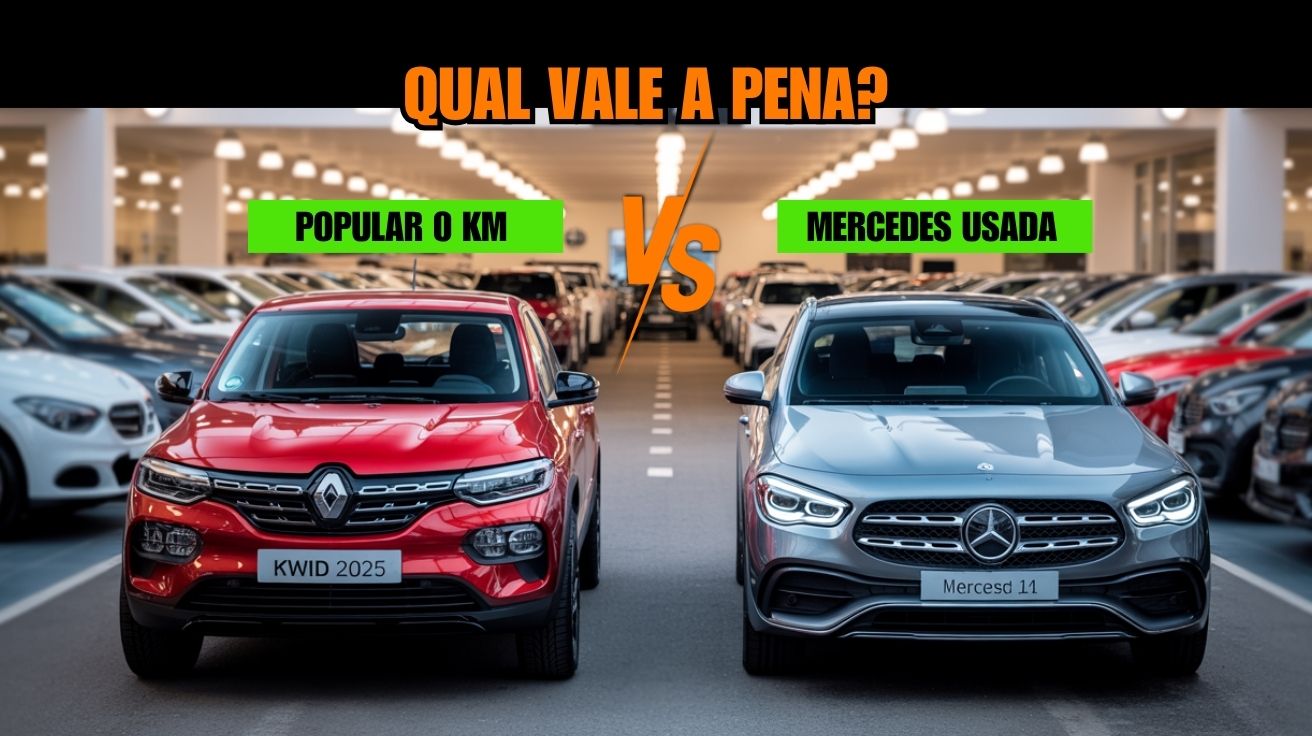
You Can Save or Get in a Trap: See the Hidden Risks of Swapping a Zero-Kilometer National Car for an Imported Luxury Used One.
A Business-Looking Deal May Hide Long-Term Financial Risks
Acquiring a used luxury car, like a Mercedes-Benz in the R$ 100 thousand range, seems like an unmissable opportunity.
However, automotive industry experts warn that comparing it to zero-kilometer national models, like the Renault Kwid 0 km, requires caution.
-
The government requests the Federal Revenue Service for a new system to automate the income tax declaration, reducing errors, time, and bureaucracy for millions of Brazilians.

-
Friends have been building a small “town” for 30 years to grow old together, with compact houses, a common area, nature surrounding it, and a collective life project designed for friendship, coexistence, and simplicity.

-
Pix in installments, international Pix, and contactless payment without internet: the Central Bank revealed the new features coming to the tool that is already used by almost every adult in Brazil.

-
This small town in Germany created its own currency 24 years ago, today it circulates millions per year, is accepted in over 300 stores, and the German government allowed all of this to happen under one condition.

According to engineer and automotive journalist Boris Feldman, the risk of future losses is significant.
What starts as a decision based on status or superior performance can quickly transform into a heavy financial burden, especially with maintenance, parts, and insurance.
Used Imported vs. New National: The Difference Goes Beyond Price
The doubt between buying a Renault Kwid 0 km or a used Mercedes is common among consumers seeking to combine economy and sophistication.
However, Feldman is adamant in stating: “Never buy a used imported car for the same price as a cheap national one, because you may regret it in the future.”
The main argument involves hidden maintenance costs.
A practical example: replacing a windshield in a Kwid can cost around R$ 400.
In the case of an imported Mercedes, the same service can exceed R$ 4,000, even if the car is depreciated.
This happens because parts retain the original value from when they were launched, when the vehicle cost over R$ 400 thousand.
Specialized Services Increase the Total Cost of Ownership
The problem is not limited to parts.
Specialized labor to repair luxury models also maintains high prices, regardless of the vehicle’s age.
“The labor of the mechanic specialized in the imported car will cost the same, whether the car is new or used,” emphasizes Feldman.
This scenario transforms what seems like initial savings into a potential financial nightmare.
Luxury models require specific technical care and original parts.
As they are less popular vehicles, many times the parts need to be imported, with long wait times and high costs, not to mention the difficulty in finding trustworthy workshops.
Cost-Benefit of the Kwid 0 km Gains Strength
The Renault Kwid 0 km, on the other hand, stands out as one of the most accessible and economical options in the Brazilian market.
According to the Fipe Table from June 2025, the Zen 1.0 model has an average value of R$ 58,648.
Meanwhile, complete versions like the Intense Pack Biton exceed R$ 80 thousand.
Still, the investment is lower than that of a used Mercedes and comes with factory guarantees, scheduled maintenance, and national support.
Another differentiator is fuel consumption: the Kwid delivers averages close to 15 km/l with gasoline.
Additionally, it has more accessible insurance and one of the lowest maintenance costs in the category.
With fixed reviews and a network of dealerships spread across Brazil, the car proves ideal for those seeking predictability and low daily costs.
Safety and Practicality: Evolution After Criticism
Despite past criticisms, mainly regarding safety, the Renault Kwid has undergone structural improvements.
After negative evaluations from Latin NCAP, the brand reinforced the structure and added items like electronic stability control and four airbags as standard, raising the vehicle’s standard in the category.
Produced in São José dos Pinhais (PR), the Kwid meets Brazilian consumer requirements.
The model appears better prepared for the urban scenario, with straightforward maintenance and coverage throughout the national territory.
The Temptation of Affordable Luxury Can Be Expensive
Many consumers dream of driving a prestigious model like the Mercedes-Benz.
The problem arises when this desire outweighs a rational analysis of costs.
“This is the problem for those who seem almost delusional to buy a Mercedes for the price of a zero-kilometer national car. The dream shatters the first time they take the car to the workshop,” warns Feldman.
In addition to pricey reviews, the lack of guarantees and high insurance increase the total cost of ownership.
In many cases, the buyer ends up spending more than they would pay for a new car and still faces difficulties when reselling in the future, as used luxury vehicles have lower liquidity.
A Conscious Choice of a Car Involves More Than Aesthetics or Power
Those facing the choice between a Renault Kwid 0 km or a used Mercedes should consider not only the purchase price but also the expenses throughout the vehicle’s useful life.
The Kwid offers factory warranty, low fuel consumption, affordable maintenance, and less risk of mechanical surprises.
The imported one, while offering comfort and sophistication, necessitates a robust financial plan to manage revisions, parts, and potential depreciation.
For those relying on the car in daily life or with a limited budget, opting for a new national vehicle is almost always more advantageous.
The illusion of affordable luxury can be costly and strain the family budget.
In light of this, it’s worth reflecting: do you prefer to invest in a new car with warranty and savings, or are you willing to bear the invisible costs of a used imported one that seems like a good deal?








Seja o primeiro a reagir!