





 Portuguese
  English
  Spanish
  5 min of reading
  0 comments


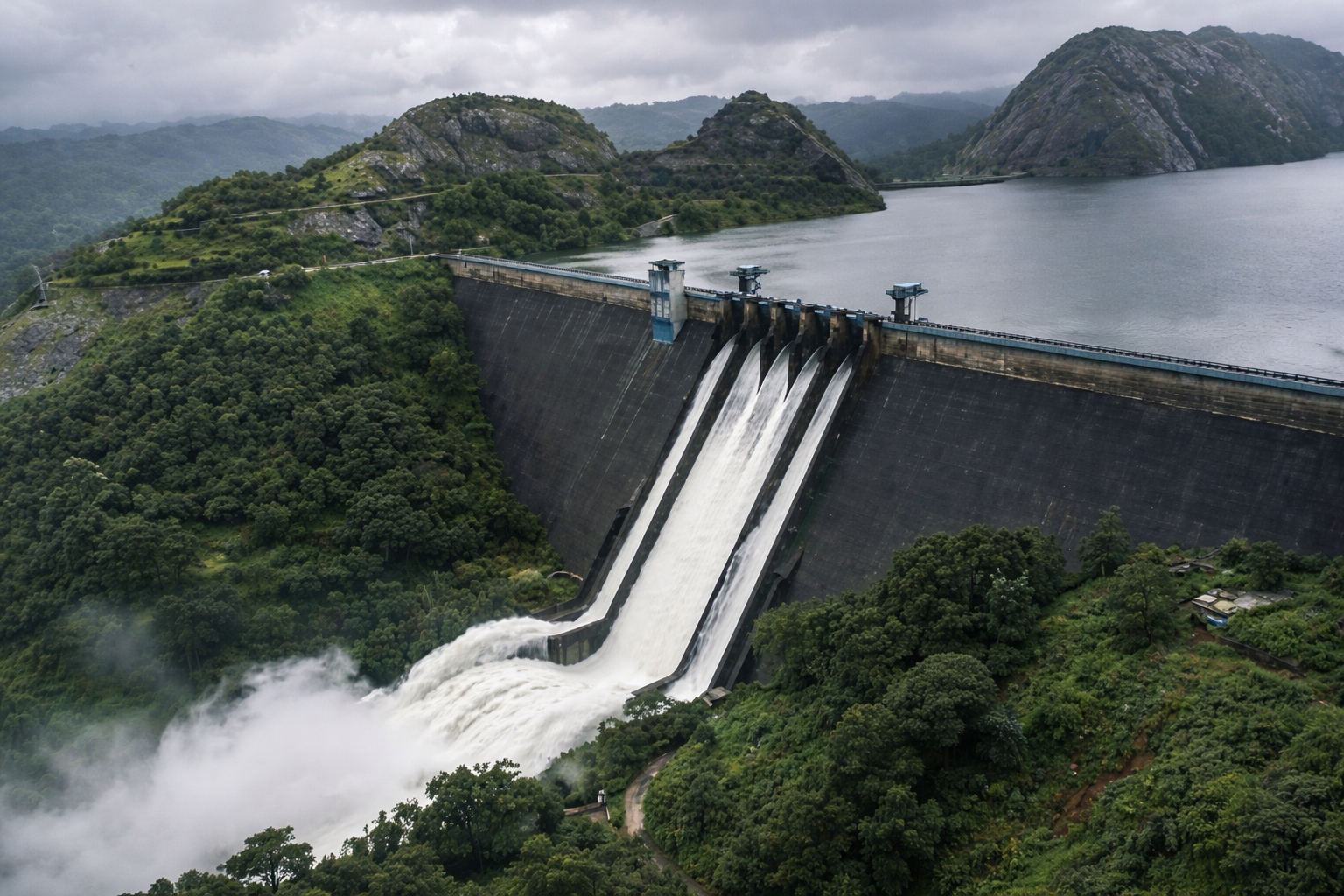
The Construction of a 19th Century Masonry Dam Still Supplies and Irrigates Entire Regions, but Aging, Tremors, and Extreme Rains Keep the Alert, with Risk of Sudden Surge, Sediments, and Dispute Between Kerala and Tamil Nadu.
The scene looks like another time, but it is now: a dam built in 1895 continues to hold a colossal volume of water in the 21st century. Mullaperiyar, in Kerala, does not attract attention for being new or gigantic in concrete. It calls attention for another reason: age, old material, and a fear that does not disappear.
If the structure fails, it wouldn’t be a slow flood. It would be a sudden, rapid surge with the strength to sweep away anything in its path.
And there’s a detail that makes everything more tense: the water it holds is essential for the neighboring region of Tamil Nadu, while Kerala presses for lower safety levels.
-
Friends have been building a small “town” for 30 years to grow old together, with compact houses, a common area, nature surrounding it, and a collective life project designed for friendship, coexistence, and simplicity.

-
This small town in Germany created its own currency 24 years ago, today it circulates millions per year, is accepted in over 300 stores, and the German government allowed all of this to happen under one condition.

-
Curitiba is shrinking and is expected to lose 97,000 residents by 2050, while inland cities in Paraná such as Sarandi, Araucária, and Toledo are experiencing accelerated growth that is changing the entire state’s map.

-
Tourists were poisoned on Everest in a million-dollar fraud scheme involving helicopters that diverted over $19 million and shocked international authorities.



The 19th Century Work Still Supports Irrigation and Supply
Mullaperiyar is not just an old dam on a distant map. It sustains routines.
The reservoir guarantees water for agriculture, human consumption, and energy-related uses indirectly in Tamil Nadu. At the same time, there are people living downstream in areas that would be hit first.
When a system like this functions for decades, it creates dependency. And dependency creates dispute.
Kerala advocates for lowering the maximum level of the reservoir. Tamil Nadu calls for higher levels to maintain agricultural supply. This tug-of-war keeps the issue alive and fuels public fear.
What is at stake is not just construction engineering. It is water as an asset, safety as a priority, and politics as the driving force of decision.
What Concerns Engineers in the Construction of Old Dams is Internal Infiltration, Silent Erosion, and the Risk of Failure That No One Sees with the Naked Eye
The material of Mullaperiyar says much about the type of risk on the table.
It was built with stone masonry and lime mortar, techniques common at the time. Unlike many modern dams, it was not designed with the same premises of project and monitoring today.
In old structures, experts usually look at three fronts. The first is natural deterioration, the kind that makes no noise.
With over 130 years, the constant action of water can favor infiltrations, internal erosion, and microfractures. In masonry dams, the mortar can lose strength over time, especially under continuous pressure.
There is also a phenomenon that haunts any technical team: “piping,” when water opens invisible internal tunnels. It is treacherous because it evolves from the inside, while everything outside appears normal.
It is the kind of problem that requires measurement, behavior reading, and firm maintenance, with no room for improvisation.
Moderate Tremors and Unusual Rains Test Old Structures and Pressure Spillways, Drainage, and Reservoir Margins
The second scenario is seismic.
Kerala is not described as one of the most seismic areas in India, but it has recorded moderate tremors. A dam designed before modern construction standards may not have been sized for certain dynamic loads.
A significant quake can generate fissures, compromise structural sections, or affect the support mass. And, in engineering, damage that starts small can expand over time.
The third scenario is hydrological and relates to the current climate.
According to construction specialists, extreme rains gain relevance because old projects did not account for certain volumes. If the water exceeds the capacity of the spillways, the risk of “overtopping” arises, when the water flows over the top.
In masonry structures, this overflow can be aggressive. Water can erode critical parts quickly and pave the way for a greater failure.
That is why the debate about safety is not limited to a single cause. It combines age, structural behavior, and extreme events.
If the Wall Fails, the Water Doesn’t Warn, the Wave Comes Quickly, Sediments Explode into the River, and the Impact on the Construction Can Cascade Through Other Structures
The rupture of a dam changes the clock for everyone around.
The first impact would be the formation of a gigantic flood wave, pushing millions of cubic meters of water in minutes. It is not “flooding.” It is kinetic force.
This mass of water advances down the Periyar River valley, destroying bridges, roads, and buildings in its way. And it reduces the response time to almost nothing.
Hydrological models cited in academic studies point out that towns downstream could be hit within a few hours, and some in less than an hour. This makes early warning the difference between escape and tragedy.
Then comes the part that many people forget: the reservoir holds sediments.
With a rupture, sediments accumulated over decades are released all at once. This can alter the course of the river, impact ecosystems, devastate agricultural areas, and reduce water quality for a long time.
And there is the domino effect.
Along the course of the river, there are other hydraulic structures. An intense wave can pressure smaller dams downstream and create a cascading sequence of failures. This kind of scenario rapidly amplifies damage and makes it difficult to contain.
Inspections, Reinforcements, and Sensors Exist, but the Challenge Is Transparency, Continuous Maintenance, and an Evacuation Plan That Works Anyway
On the other side of the debate, authorities and engineers responsible for maintenance state that the dam undergoes periodic inspections and reinforcements.
According to this argument, over the decades, strengthening work has been done, with improvements in concrete, internal drainage systems, and monitoring of hydrostatic pressure. The reading is straightforward: there is no evidence of imminent collapse.
And here lies the line that separates fear from risk management.
There is no scientific consensus indicating an inevitable or imminent rupture. What exists is a sum of factors that places Mullaperiyar at the center of the debate: advanced age, strategic importance, natural risks, and millions of potentially affected people.
Modern engineering has tools to detect millimeter deformations, internal infiltrations, and pressure variations. Sensors can indicate anomalies before they become critical.
The challenge is to ensure this monitoring is continuous, transparent, and accompanied by evacuation plans that leave the paper, because in a rapid wave scenario, minutes are worth a life.
After all, it is a historic structure holding an immense volume, with social, economic, and political consequences if the unexpected happens.
Would you trust a structure from 1895 to hold billions of liters near populated areas, or do you advocate for lower levels even at the impact on irrigation and supply?










-

-

-

3 pessoas reagiram a isso.