





 Portuguese
  English
  Spanish
  3 min of reading
  0 comments


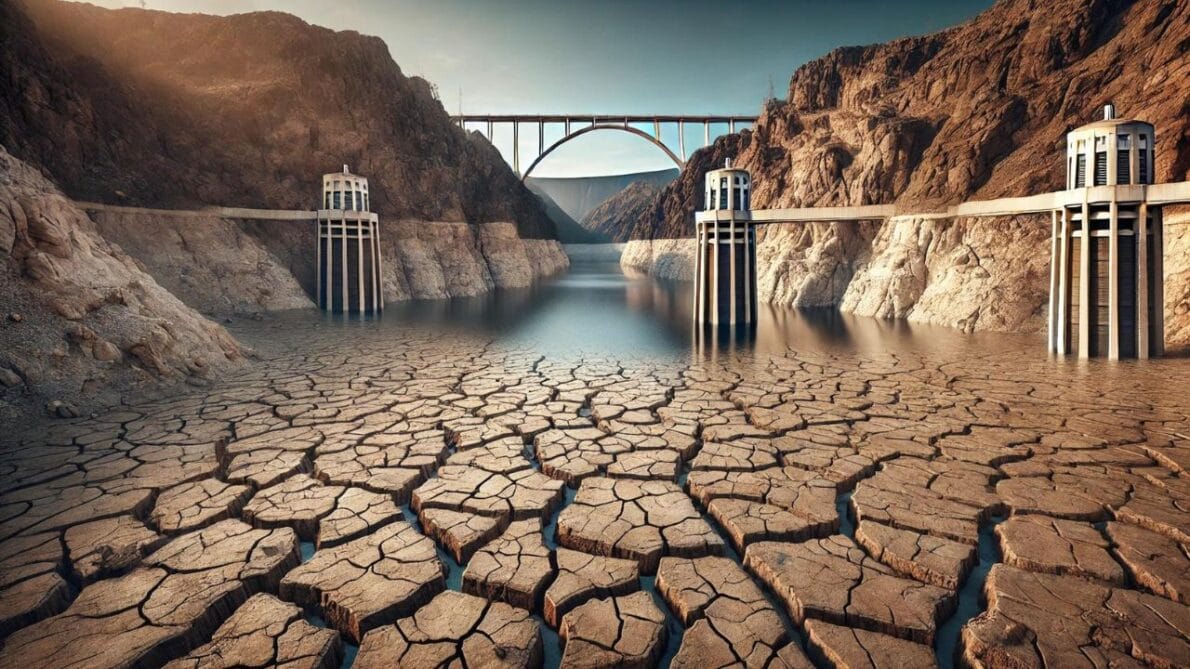
In July 2022, the Hoover Dam, the largest reservoir in the United States, reached a critical level, 53 meters below its maximum capacity. This was the lowest point since its first filling in the 1930s. But what happens when a dam dries up?
The situation is alarming. The critical level of Hoover Dam not only exposed rusted wreckage, submerged boats, and even human remains, but it also highlighted a bigger issue: water scarcity in the Western United States. This scenario is not unique to Hoover; several large reservoirs in the region are struggling with alarmingly low storage levels.
Water consumption by the population remains stable, but nature is not so predictable. Rain and snow patterns vary drastically, often leaving long periods of drought. And when these periods prolong, we face what we call severe droughts.
Longest Drought in a Thousand Years


A study revealed that the last two decades represent the driest period in over 1000 years for the southwestern United States, now referred to as “Mega Drought.” And this raises a question: why are dams, which are built to prevent water shortages, not fulfilling their role?
-
Florianópolis will receive a million-dollar BRT that will begin construction in 2026 with nearly 400 million in funding from the federal government and the Inter-American Development Bank, and the map already shows the routes for the exclusive bus corridors.

-
Without a blueprint, without an engineer, and using scrap from the dump, a father spends 15 years building an 18-room castle for his daughter, featuring tram tracks, 13 fireplaces, and over 700 m², which may now be demolished.
-
A megaproject worth R$ 89 billion is advancing in Iraq and promises to change the game in global trade by creating a new corridor between Asia and Europe, reducing traditional routes and repositioning the country as a logistics powerhouse.
-
Goodbye bedside table: floating shelves become a trend in 2026 by freeing up space in the bedroom, improving circulation, bringing visual lightness, and integrating technology without taking up floor space.


The Role of the Dam
Dams and reservoirs are vital for managing variability in water supply. However, complications arise when these reservoirs do not fill as expected. The constant demand for water requires urban planners to prepare for the worst scenarios. When a drought occurs, one cannot simply wait for the rains to return.
Water Storage and Reservoir Capacity
One solution is to store excess water during periods of abundance to ensure continuous operation during droughts. Smaller reservoirs, like those used in water treatment plants, typically hold only enough for one day’s supply, which is insufficient for prolonged drought periods.
It Is Necessary to Significantly Increase Storage Capacity
For a more effective solution, it is necessary to significantly increase storage capacity. We build large dams that can store trillions of liters of water, utilizing the natural topography to create enormous reservoirs. For example, if we place a moderate reservoir on your city river, it will be full for most of the year, but in the dry season, it can release water to supplement the supply.
Water Management and Planning
By increasing the capacity of a dam, we transform the water management of a region. With a larger reservoir, it is possible to offset deficits from months or even consecutive years of dry conditions. This maintains supply even under the worst conditions, practically eliminating the concept of drought.
In addition to ensuring a constant supply for cities, dams also play important roles in agriculture and hydroelectric power generation. However, empty reservoirs are not necessarily indicative of poor management; they are essential for the flexibility and security of the water system. They require continuous monitoring, maintenance, and sometimes rehabilitation.
Reflection on What Happens When a Reservoir Really Dries Up
Climate change introduces additional variability, and we cannot assume that future climate and precipitation patterns will follow historical ones. This leads to reflection on what happens when a reservoir really dries up. If the total precipitation feeding the basin decreases over time, the firm yield of a reservoir will also decline, raising concerns about the long-term sustainability of these resources.
Solutions for Water Scarcity
Many utilities develop long-term plans, anticipating future demands and supplies. Some solutions include campaigns to encourage reduction in consumption and avoid waste, as well as investments in costly infrastructures like aqueducts and desalination plants.
The water crisis affecting the American Southwest is a warning for the future. The prolonged drought at Hoover Dam, the largest reservoir in the United States, shows that we need to rethink our storage and water management strategies. Climate change is making water an increasingly precious resource, and adapting to this new reality is essential to ensure sustainable and continuous supply.








-

Uma pessoa reagiu a isso.