





 Portuguese
  English
  Spanish
  4 min of reading
  0 comments


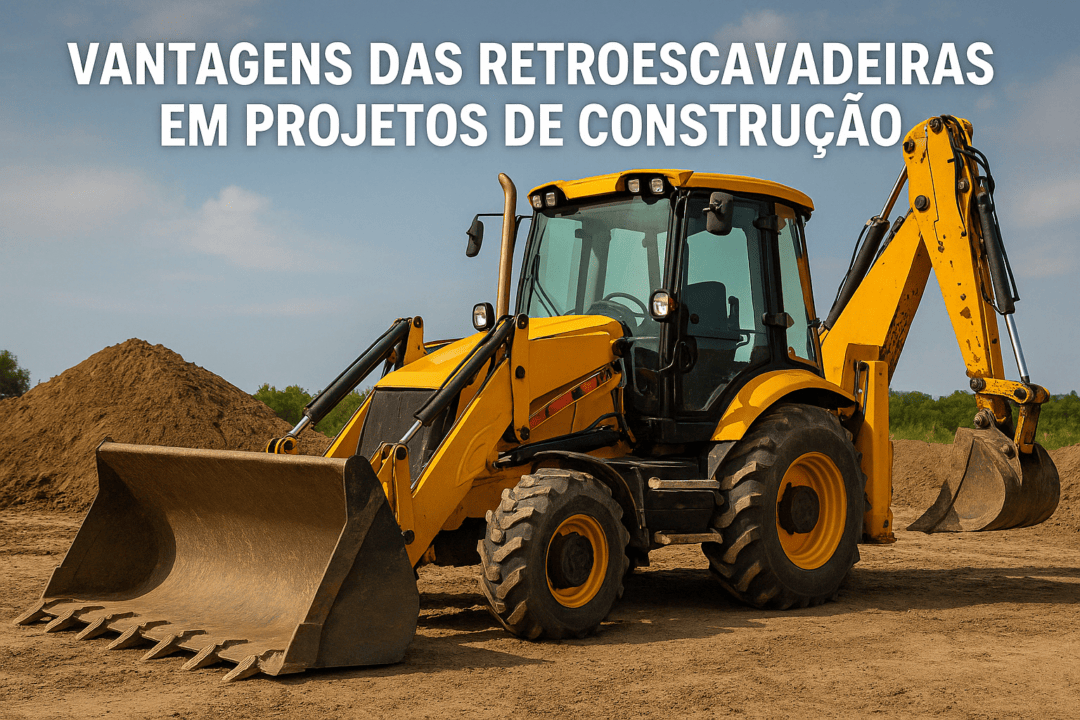
In Civil Construction Projects, Backhoe Loaders Are Essential Tools. They Stand Out for Their Versatility in Tasks Such as Excavation, Soil Leveling, Material Transport, and Light Demolitions
In the construction site, every minute counts. And when it comes to productivity and efficiency, backhoe loaders stand out as essential tools. Compact, versatile, and multifunctional, these machines are increasingly being used in projects that demand speed, precision, and mobility.
What Is a Backhoe Loader
Backhoe loaders are heavy machines used for loading and excavation tasks.
The key difference lies in their structure: a front loader bucket and a hydraulic arm with a bucket at the rear.
-
Made from recycled plastic, plastic wood is gaining space in the construction industry because it does not rot, resists moisture, and reduces maintenance costs over the years.

-
Florianópolis will receive a million-dollar BRT that will begin construction in 2026 with nearly 400 million in funding from the federal government and the Inter-American Development Bank, and the map already shows the routes for the exclusive bus corridors.

-
Without a blueprint, without an engineer, and using scrap from the dump, a father spends 15 years building an 18-room castle for his daughter, featuring tram tracks, 13 fireplaces, and over 700 m², which may now be demolished.

-
A megaproject worth R$ 89 billion is advancing in Iraq and promises to change the game in global trade by creating a new corridor between Asia and Europe, reducing traditional routes and repositioning the country as a logistics powerhouse.


This configuration makes the equipment suitable for both excavations and loading materials.
With this versatility, civil engineers, architects, and other construction professionals can adapt the use of the backhoe loader to different demands of the project.
Differences Between Backhoe Loaders and Excavators
Although similar in function, backhoe loaders and excavators have important differences.
The excavator has a longer hydraulic arm and a larger bucket, allowing it to reach greater depths and volumes of excavation. However, its size and structure make it difficult to access smaller areas.
In contrast, the backhoe loader, being more compact, can operate in tight spaces. It also has tires, allowing it to move on its own over short distances, unlike the tracked excavator, which requires transportation by trailer.
Another distinguishing feature is movement. The excavator can rotate 360 degrees, providing total freedom for its arm. The backhoe loader, on the other hand, must stabilize the equipment with side legs before operating the rear arm, which reduces its maneuverability during excavation but increases safety.
Precise Excavation in Small Areas
Due to its compact size, the backhoe loader can perform excavations with precision in trenches and foundations that require exact measurements. Surveyors and engineers utilize its reach and width specifications to calculate depth and volume without exceeding the project limits.
The precision in excavations prevents rework, accelerates construction progress, and reduces material and time waste.
Mobility and Ease of Transport
One of the major advantages of the backhoe loader is its ability to move. Since it has tires, it can travel short distances without the need for a winch or trailer. This brings agility to projects that require constant movement of equipment between work fronts.
In some cases, the backhoe loader itself builds ramps to load onto dump trucks and be transported to more distant areas. This type of operation, of course, must be done with caution.
Loading and Moving Materials
In addition to excavating, the backhoe loader loads materials. Its front bucket can move sand, gravel, soil, and smaller tools, serving as logistical support within the site.
For this function, it is important to consider the distance to be traveled and the weight of the materials. Even with capacity limitations, the backhoe loader is useful for internal transport of supplies.
Dual Function: Excavation and Loading
With two integrated systems – one for excavation and another for loading – the backhoe loader can replace the combined use of an excavator and loader in some situations. This represents savings in space and resources.
In smaller projects, it is a practical solution to perform both functions with a single piece of equipment.
Maneuverability in Urban Areas
Construction in cities demands compact and agile equipment. The backhoe loader, with its smaller design and ability to operate in tight locations, meets this type of need well.
It can enter narrow streets, access hard-to-maneuver areas, and operate safely in confined spaces. This makes it an ally in urban renovations, installation of water and sewage networks, and emergency repairs.
Adaptability with Accessories
Another important advantage lies in the possibility of adaptation. Backhoe loaders can be equipped with various accessories, according to the needs of the project.
Among the most common accessories are: buckets of varying sizes, hydraulic hammers, forks, augers, and telescoping arms. This allows for the customization of the equipment for rock excavation, mining, trench digging, earthmoving, and other specific functions.
Low Hourly Cost
Compared to larger excavators and frontend loaders, the hourly cost of a backhoe loader is lower. This makes a difference in the project budget, especially when tasks require versatile equipment with good cost-effectiveness.
When compared to larger machines, it has lower performance in volume. However, for smaller and localized demands, it delivers good results and significant savings.
Essential Equipment in Construction
Given so many advantages, it is clear that the backhoe loader is an essential tool in civil construction projects. Its ability to excavate, load, move independently, and adapt to different functions makes it a valuable resource on the job site.
In addition to efficiency and speed, it contributes to saving time and money in projects of various sizes. For all these reasons, the backhoe loader remains an intelligent and strategic choice in various types of construction.









Seja o primeiro a reagir!