





 Português
  Inglês
  Espanhol
  2 min de leitura
  17 comentários





Imagine an engine that does not require fuel to operate and can propel a rocket to 99% of the speed of light. It seems like science fiction, but this is the proposal of the helical engine, a new technology that could transform space exploration.
The helical engine is an idea developed by David Burns, an engineer at NASA. Unlike traditional engines that use propellant, this engine employs principles of relativity to generate thrust. It uses a helical particle accelerator to accelerate particles almost to the speed of light.
The operation of the helical engine is based on Einstein’s theory of relativity, which states that the mass of an object increases as it approaches the speed of light. The engine uses ions and electromagnets to accelerate particles in a helical loop. As the particle accelerates, its mass increases, generating thrust and thus propelling the spacecraft.
Advantages of the Helical Engine


Amazing Speed: Theoretically, it could reach 99% of the speed of light.
-
A bright yellow mushroom imported from Asia escaped from a cultivation farm in the United States in 2010 and is now aggressively spreading across 25 states, destroying entire communities of native fungi in American forests.

-
Buried under China, a colossal machine weighing 20,000 tons began operating as the largest neutrino detector on the planet and, in just 59 days, surpassed results that science took half a century to achieve.

-
Iran enters the center of a climate alert after the war emitted 5.6 million tons of CO2 in two weeks, surpassing the annual pollution of entire countries.

-
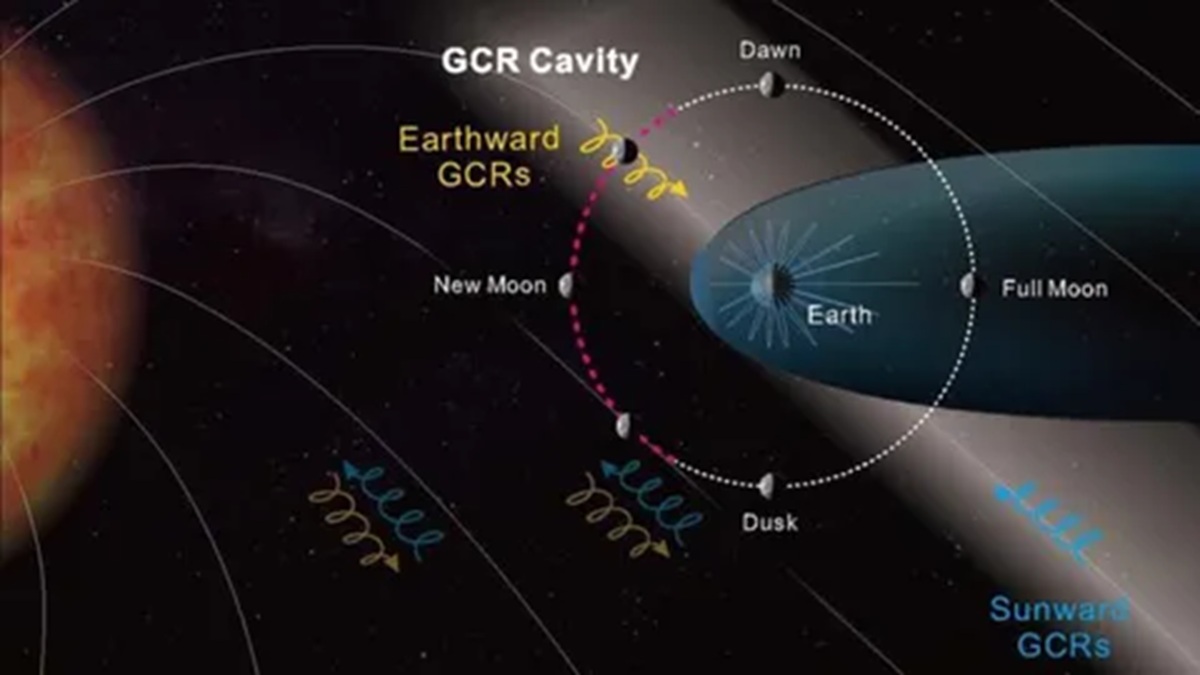
Lunar exploration may change after a Chinese probe finds a “cavity” of radiation that reduces the impact on astronauts by up to 20% at certain times on the Moon.

No Propellant: Drastically reduces space travel costs, making it more accessible.
Faster Trips: We could reach the Moon in 1.5 seconds, Mars in 13 minutes, and Neptune in just 4 hours.
Challenges and Limitations
Despite being a promising idea, the helical engine faces significant challenges. To test it on Earth, a tube 200 meters long and 12 meters wide would be necessary, along with 65 megawatts of power to generate just 1 newton of thrust – the equivalent force needed to press a keyboard button.
Therefore, the idea is for the engine to operate in the vacuum of space, where there is no gravity resistance. Even so, there is still much to be developed and tested to make this technology viable.
Future of Space Exploration
If this technology is successful, it could revolutionize space exploration, making it faster and more accessible. Besides saving on fuel, the helical engine would allow for more efficient and safer space exploration.
The helical engine is an innovation that could change the future of space travel. Despite the challenges, it is an exciting idea that brings us closer to reaching new frontiers in the universe.







Gostei dessa tecnologia do motor do foguete, ir até a lua em 2 segundos.
Agora tecnologia **** mesmo, deve ser dos freios do foguete, para pode parar antes de chegar na lua em menos de 2 segundos
Ainda não temos material resistente para suportar a aceleração e a frenagem do veículo, se vai colocar esses motores atrás, precisará colocar alguns na frente também para ajudar na frenagem.
Não tem atmosfera e não tem órbita
Impressive