





 Português
  Inglês
  Espanhol
  3 min de leitura



Floating House In Japan Draws Media Attention, Promising To Be A Solution For Floods. The “Property” Can Float Up To 5 Meters And Is Fully Waterproof.
The Ichijo Komuten, a real estate company, recently made headlines by presenting a floating house in Japan. According to the company, the flood-resistant “property” is not only able to stay waterproof during floods but also float.
Floating House In Japan Could Be The Solution For Floods
The loss of housing due to floods is an undeniable problem worldwide and, despite engineers and architects trying to find solutions, few have proven to be truly effective.
However, a renowned real estate developer in Japan claims to have found a solution focused on preventing people’s homes in the country from being flooded and swept away by floods.
-
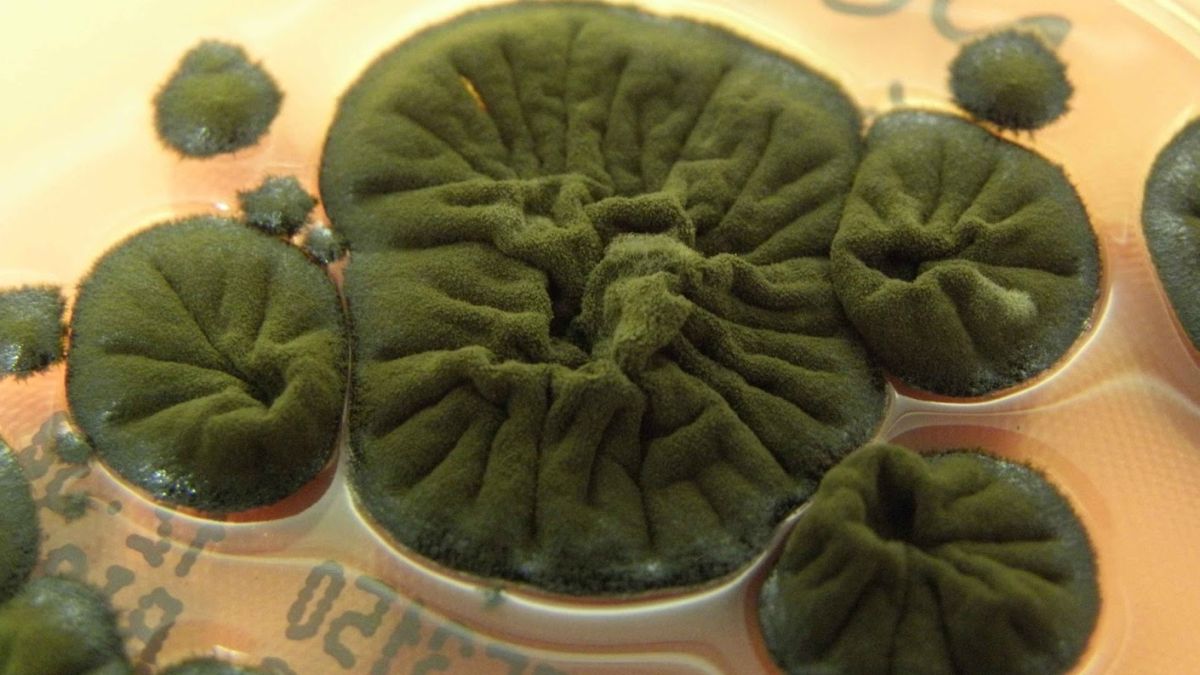
Found in one of the most radioactive places on Earth, this Chernobyl fungus may be doing something with radiation that no one has been able to explain to this day.
-
A bright yellow mushroom imported from Asia escaped from a cultivation farm in the United States in 2010 and is now aggressively spreading across 25 states, destroying entire communities of native fungi in American forests.

-
Buried under China, a colossal machine weighing 20,000 tons began operating as the largest neutrino detector on the planet and, in just 59 days, surpassed results that science took half a century to achieve.

-
Iran enters the center of a climate alert after the war emitted 5.6 million tons of CO2 in two weeks, surpassing the annual pollution of entire countries.




Its floating and flood-resistant house was recently featured on a popular Japanese TV show and since then has been receiving a lot of attention online. The TV channel TBS recently visited one of Ichijo’s testing sites, where the company’s new flood-resistant house was being subjected to a simulated flood.
Although it looks like a regular property, when the water began to rise around it, the floating house in Japan began to lift off the ground, eventually floating a few centimeters above it. Other solutions are always swept away by severe floods; however, Ichijo’s latest invention features a locking system that prevents this.
The floating house is connected to a series of iron bars that come out of the ground with thick cables, ensuring that the house stays in the same place while the floodwater passes beneath and around it. As the waters recede, the floating house returns to its original position.
New System From Japan Costs Only US$ 5,700
The floating house in Japan also has special openings that close in case of flooding, and the plumbing also has special valves that prevent water from entering the inside of the house. Electrical equipment like air conditioning is positioned in the upper half of the property to ensure that water does not reach them.
According to engineers at Ichijo Komuten, most houses flood when the water reaches window level; however, since their floating house can rise up to 5 meters above the ground, it is unlikely that water will reach the windows, and everything else is sealed.
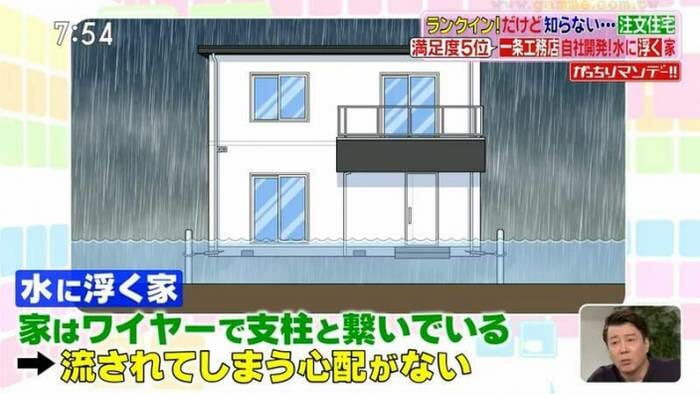
Japanese media reports that clients who wish to build a new house with Ichijo Komuten can opt to have this system embedded for an additional cost of only 770,000 yen, equivalent to US$ 5,700, which seems quite reasonable if it really works as advertised.

Ichijo Komuten is one of the largest housing companies in Japan and over the past two years has set three Guinness World Records, including being the largest factory for pre-produced housing materials and also the most successful custom home company.
Underground Temple To Prevent Floods
Impressive engineering was used in the construction of the Shutoken Gaikaku Hosuiro project, an underground drainage system covering an area of 6.3 km in Kasukabe, Saitama, located on the outskirts of Tokyo. The construction of this ingenious complex took 17 years, from 1992 to 2009, costing over US$ 3 billion.
It is seen as the largest underground rainwater diversion channel in the world, built to prevent overflow from the rivers in the Saitama and Tokyo regions caused by storms and typhoons. Its capacity is 670,000 tons, and the pumping is only activated after ten hours of heavy rain.







-

-

2 pessoas reagiram a isso.