





 Portuguese
  English
  Spanish
  2 min of reading
  0 comments


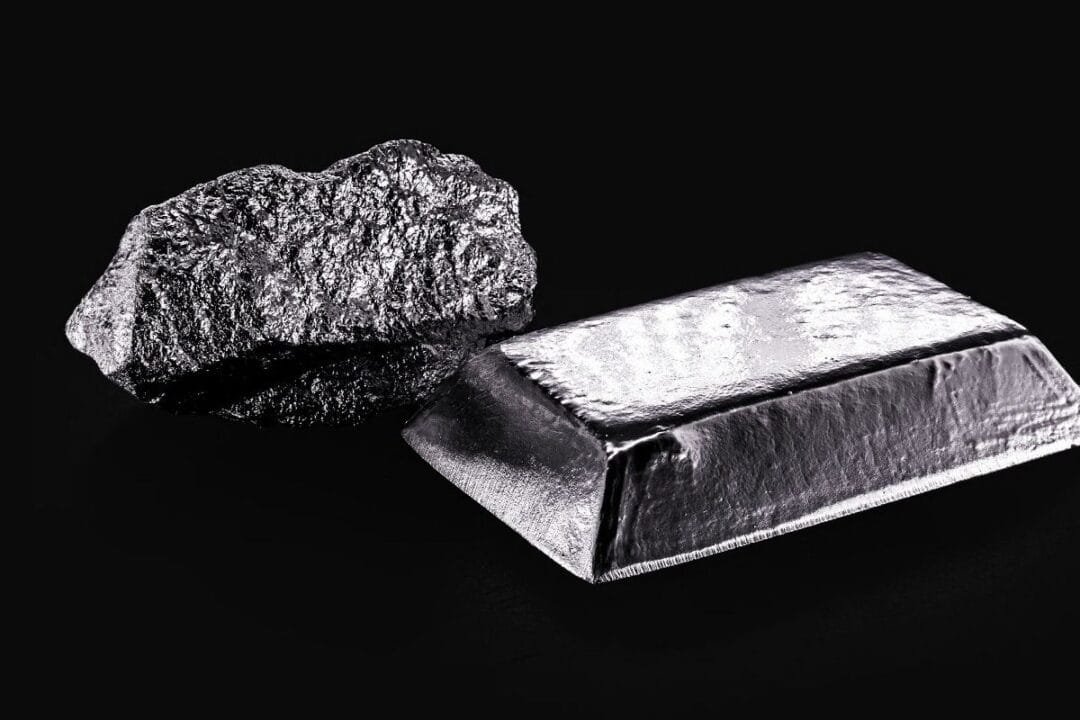
Priced at US$ 5,400 an Ounce, Metal Used in Automotive Catalysts Is 1,000 Times Rarer Than Gold. South Africa and Russia Dominate 90% of Global Production.
The rhodium, the most expensive metal in the world, has seen a rise of 15% in 2025 and is now worth US$ 5,400 an ounce — 80% more than gold. Essential for reducing pollutant gas emissions, it is a key component in the race for sustainable technologies. With reserves concentrated in South Africa and Siberia, its scarcity (0.000037 parts per million in the Earth) explains the record appreciation.
Why Is Rhodium 1,000 Times Rarer Than Gold?
According to the Royal Society of Chemistry, rhodium exists in 0.000037 parts per million in the Earth’s crust, compared to 0.0013 for gold. Extracted as a byproduct of nickel and copper refining, only 405 tons are exported annually by South Africa, the largest global producer.
Rhodium Price vs. Gold: Quotation Hits US$ 6,000 and Attracts Investors

In March 2025, the metal reached US$ 6,000 an ounce (Trading Economics), driven by demand for automotive catalysts. Compared to gold (average of US$ 3,000), rhodium’s appreciation is propelled by:
-
Larger than entire cities in Brazil: BYD is building a 4.6 km² complex in Bahia with a capacity for 600,000 vehicles per year, but the discovery of 163 workers in conditions analogous to slavery has shaken the entire project.

-
With an investment of R$ 612 million, a capacity to process 1.2 million liters of milk per day, Piracanjuba inaugurates a mega cheese factory that increases national production, reduces dependence on imports, and repositions Brazil on the global dairy map.

-
Brazilian city gains industrial hub for 85 companies that is equivalent to 55 football fields.

-
Peugeot and Citroën factory in Argentina cuts production by half and opens a layoff program for more than 2,000 employees after Brazil drastically reduced purchases of Argentine vehicles.


- 90% Reduction of NOx Gases in vehicles;
- Applications in hypoallergenic jewelry and optical instruments;
- Lack of a futures market, with trading restricted to the Hong Kong Stock Exchange.
Present in 80% of global catalysts, rhodium converts carbon monoxide (CO) and nitrogen oxides (NOx) into less polluting gases. According to the International Energy Agency, this technology prevented the emission of 200 million tons of CO2 in 2024.
Atomic Number 45 and Resistance That Defies Corrosion
Discovered in 1803 by William Wollaston, rhodium (symbol Rh) has:
- Atomic Number 45 (45 protons/electrons);
- Atomic mass of 102.9 u;
- Corrosion resistance even at 600°C;
- Hardness superior to platinum, used in metal alloys.
Russia and South Africa: The Giants Behind 90% of Global Rhodium
Russia extracts the metal from a single deposit in Siberia, while South Africa accounts for 75% of global production. Geopolitics directly affects the market: sanctions on Russia in 2023 explained part of the 30% increase during that period.
With the green transition, rhodium is expected to maintain its status as the most valuable metal on the planet. Its application in low-carbon technologies and geological scarcity suggest new highs — and a challenge: how to ensure supplies without predatory mining.









Seja o primeiro a reagir!