





 Portuguese
  English
  Spanish
  5 min of reading
  0 comments



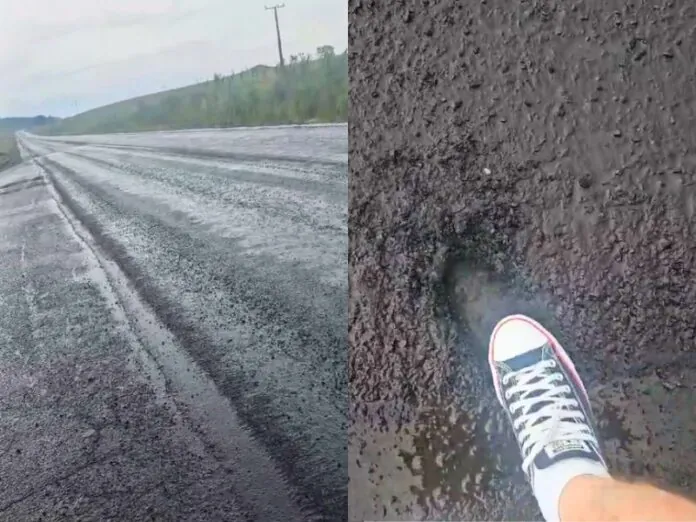
Drivers traveling along SC-350, between Caçador and BR-153, report that the newly applied asphalt is crumbling upon touch. Videos show the pavement easily disintegrating, generating indignation and questions about the quality of the work.
Drivers traveling along the stretch between Caçador and BR-153 have expressed dissatisfaction with the condition of the pavement.
Photos and videos sent to the RBV Portal show the construction material crumbling, raising questions about the durability of the new asphalt.
In one of the videos, a driver demonstrates the asphalt disintegrating when scraped with his foot and comments: “This is the situation of the paving being done on our road. Look at that disgrace, it was supposed to be new asphalt, but it doesn’t even hold half a centimeter.”
-
Florianópolis will receive a million-dollar BRT that will begin construction in 2026 with nearly 400 million in funding from the federal government and the Inter-American Development Bank, and the map already shows the routes for the exclusive bus corridors.

-
Without a blueprint, without an engineer, and using scrap from the dump, a father spends 15 years building an 18-room castle for his daughter, featuring tram tracks, 13 fireplaces, and over 700 m², which may now be demolished.

-
Larger than entire cities in Brazil: BYD is building a 4.6 km² complex in Bahia with a capacity for 600,000 vehicles per year, but the discovery of 163 workers in conditions analogous to slavery has shaken the entire project.

-
With an investment of R$ 612 million, a capacity to process 1.2 million liters of milk per day, Piracanjuba inaugurates a mega cheese factory that increases national production, reduces dependence on imports, and repositions Brazil on the global dairy map.

In light of the complaints and the repercussions of the images, the State Department of Infrastructure and Mobility clarified in a statement that the material shown in the images refers to the first layer of newly applied micro-surfacing, which was still in the curing process at the time the images were taken.
The department explains that this technique is used to seal cracks after the most damaged areas have been repaired with Hot Mixed Bituminous Concrete (CBUQ).
According to the department, the micro-surfacing is applied in two layers, totaling 1.5 cm in thickness, with the goal of waterproofing the asphalt and extending its lifespan.
Additionally, the statement highlights that different paving techniques are being applied along the 130 kilometers of the stretch, according to the needs of each segment.
Revitalization Works and Investments in SC-350
The revitalization works on SC-350 between BRs 116 and 153 were announced by Governor Jorginho Mello (PL) in April 2024, with an investment of approximately R$ 150 million.
The works began in mid-last year, with pothole repairs and mowing of the road margins, in addition to the preparation of the construction site.
In early February, the Regional Infrastructure Coordination explained that the works between Caçador and BR-153 were temporarily halted but were expected to resume within 15 days.
The road revitalization includes the execution of milling services (removal of the old asphalt), paving with a new asphalt layer, and reinforcement of horizontal and vertical signage.
Additionally, the more critical sections of the road are being restructured to improve drainage and avoid water accumulation, which can compromise the durability of the paving.
Recurring Problems and History of Poor Conditions
It is important to highlight that, according to reports, SC-350 has previously been pointed out as one of the worst highways in Santa Catarina.
In November 2024, the National Confederation of Transport (CNT) classified the highway as “poor” due to its precarious conditions. This data reinforces the urgent need for improvements in the region’s road infrastructure.
Drivers who have used the highway for years report that the structural problems of SC-350 are recurring.
Many stretches have undergone various pothole repairs over the past decades but without a definitive solution.
Drivers claim that, in many cases, the asphalt gives way quickly, forming new cracks and potholes just a few months after the interventions.
SC-350 is an essential highway for the flow of agricultural and industrial production in the state, and it is also one of the main connections between municipalities in the region.
The deterioration of the road poses risks not only to passenger vehicle drivers but also to truck drivers transporting heavy loads who depend on good traffic conditions.
Micro-Surfacing: Solution or Problem?
The micro-surfacing technique used on SC-350 is a common solution in road works to seal cracks and waterproof the pavement.
However, it is essential that this technique is applied correctly and that the curing period is respected to ensure its effectiveness and durability.
Improper application or insufficient curing time can result in problems such as the crumbling of the asphalt, as observed by drivers.
Experts in road infrastructure emphasize that micro-surfacing is a viable technique when well applied, but that, in some cases, it may present failures if not executed according to technical standards.
Additionally, there are questions about whether this approach is sufficient to resolve the structural problems of SC-350, or if a complete resurfacing would be necessary in some sections.
Coordinator Juan Bonelli da Silva informed that the recycling technique will be carried out on about 24 kilometers of the stretch, where the asphalt is more deteriorated.
The process consists of removing the damaged material and reintroducing it into the track with the addition of cement, increasing the durability of the pavement.
After this stage, the works will proceed to the final phase, with painting of horizontal signage, installation of reflective strips, and safety devices. The estimated time for the resumption of work is approximately two weeks.
User Safety and Expectations
User trust in highways directly depends on the quality of the works carried out. Issues such as the crumbling asphalt not only compromise the safety of drivers but also generate distrust regarding the appropriate use of public resources.
It is essential that the competent authorities closely monitor the execution of the works and ensure that the techniques employed are appropriate for each specific situation.
The expectation of drivers traveling along SC-350 is that the ongoing works will result in a safe and durable highway.
Additionally, many are calling for greater oversight of the quality of services provided by contracted construction companies to prevent problems from recurring in the future.
As the revitalization works proceed, drivers using SC-350 hope that current issues will be resolved and that the highway will provide safe and adequate conditions for traffic.
Transparency in communication about the methods used and the progress of the works is crucial to keep the population informed and confident in the ongoing improvements.








-

-

3 pessoas reagiram a isso.