





 Portuguese
  English
  Spanish
  5 min of reading
  0 comments


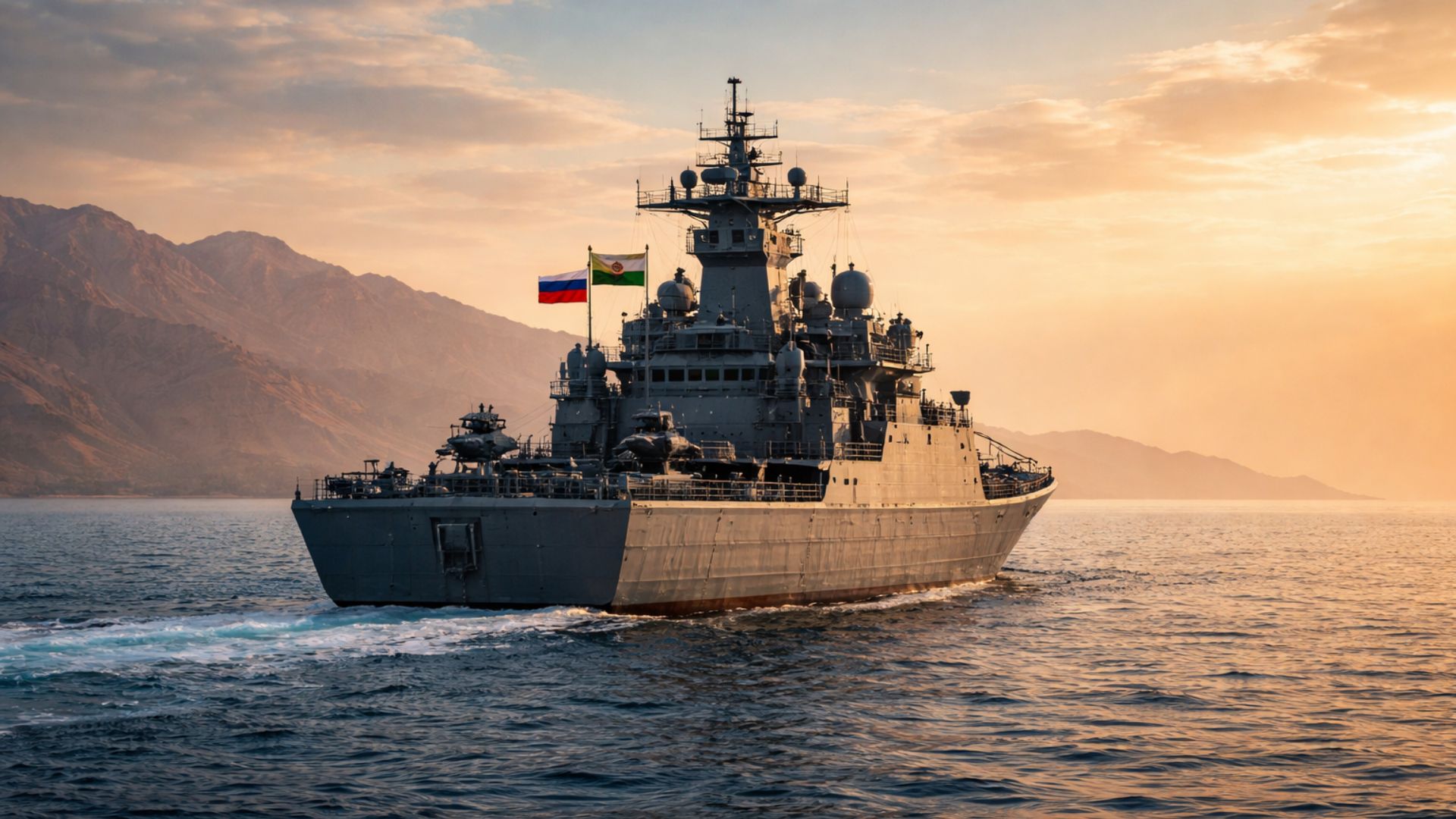
Russian Naval Movement in Iranian Waters Reinforces Strategic Treaty Signed in 2025 and Expands Military, Energy, and Economic Coordination Between Tehran and Moscow. Joint Exercise, High-Level Meetings, and Bilateral Committee Indicate Acceleration of Commitments Supervised Directly by the Iranian Presidency.
A Russian Navy helicopter carrier entered southern Iranian waters to participate in a joint naval exercise, a movement that Tehran and Moscow present as part of the increased operational coordination and military experience exchange between the two forces.
The ship’s passage occurs as the Iranian government claims to accelerate the implementation of the Comprehensive Strategic Partnership Treaty, signed on January 17, 2025, in Moscow, by Presidents Masoud Pezeshkian and Vladimir Putin, with an expectation of expanded cooperation in civil and military areas.
Naval Exercise in the Sea of Oman Expands Military Cooperation
According to Iranian state media, the Russian ship took part in a combined activity planned to enhance interoperability and maritime security, in a context of strengthening bilateral contacts and the so-called maritime diplomacy advocated by officials from both countries.
-
Friends have been building a small “town” for 30 years to grow old together, with compact houses, a common area, nature surrounding it, and a collective life project designed for friendship, coexistence, and simplicity.

-
This small town in Germany created its own currency 24 years ago, today it circulates millions per year, is accepted in over 300 stores, and the German government allowed all of this to happen under one condition.

-
Curitiba is shrinking and is expected to lose 97,000 residents by 2050, while inland cities in Paraná such as Sarandi, Araucária, and Toledo are experiencing accelerated growth that is changing the entire state’s map.

-
Tourists were poisoned on Everest in a million-dollar fraud scheme involving helicopters that diverted over $19 million and shocked international authorities.


According to local Iranian media, the exercise was held in the Sea of Oman and in the northern Indian Ocean, and concluded with the departure of the helicopter carrier after days of maneuvers directed at communication between units, operational procedures, and coordination in a naval environment.
This movement occurs amid signs of deepening military dialogue between Tehran and Moscow, which have expanded cooperation fronts even under Western sanctions, while Russia seeks to consolidate partners outside the Euro-Atlantic axis and Iran tries to diversify its strategic arrangements.
Implementation of the Strategic Treaty Under Weekly Supervision

In Tehran, the Iranian president received the Russian Minister of Energy, Sergey Tsivilyov, and stated that his administration has a strong determination to implement the treaty signed with Putin, describing bilateral cooperation as “excellent and constantly expanding”.
The meeting, reported on February 18, 2026, by the state agency IRNA, was presented as another step in intensifying the relationship, with the Iranian Presidential Palace highlighting that the pace of interactions has increased and there is guidance to accelerate commitments.
Recalling previous talks with Putin, Pezeshkian stated that the meetings produced important and strategic decisions that, according to him, protect common interests and open new prospects for the relationship between Tehran and Moscow on different fronts.
In the same meeting, the president stated that he intends to execute the agreement “with strength, speed, and precision”, adding that implementation is ongoing in all planned areas, including transportation, energy, oil and gas, agriculture and food, defense, and security cooperation.
Pezeshkian also declared that he monitors the progress of the treaty weekly and has instructed ministers and technical teams to do the same, focusing on unlocking projects and fulfilling what was agreed upon in the bilateral arrangements.
Energy, Oil, and the 19th Bilateral Economic Committee
Tsivilyov brought a message from Putin to Pezeshkian and presented a summary of the 19th Joint Meeting of Iran-Russia Economic Cooperation Committee, held in the Iranian capital, a topic that the Iranian government has been treating as a central axis of the relationship.
From the Russian side, state media indicated that the Energy Minister’s visit was connected to the economic agenda and discussions of projects in energy, transportation, and trade, in addition to reviewing documents signed in previous committees, with working groups preparing a final protocol.

In statements reported by IRNA, Tsivilyov classified 2025 as a productive year for advancing cooperation between the two countries and stated that Putin considers relations with Iran highly important for Russia’s strategy in the region.
This institutional framework, with committees and technical groups, has been pointed out by Tehran and Moscow as a tool to keep projects underway, especially in areas sensitive to sanctions, such as supply chains, logistics, energy contracts, and payment mechanisms.
Treaty of 2025 Expands Ties in Defense and Economy
The treaty signed in Moscow in January 2025 has been described by officials from both countries as a milestone to deepen ties in trade, science, and culture, alongside cooperation in defense, at a time when both face international restrictions.
The signing of the agreement was highlighted in the international press, which pointed to the rapprochement as part of a strategy of two sanctioned governments to expand economic and political alternatives, in addition to strengthening bilateral channels in multiple areas.
In the military sphere, recent news shows that the relationship includes exercises and operational contacts, while reports point to negotiations and defense agreements, a topic that both usually address with language of cooperation and coordination instead of formal alliances.
The combination of naval agenda, high-level meetings, and economic committees has been used by Tehran and Moscow to signal continuity, especially when the regional scenario imposes additional pressure and both governments seek to show predictability in the relationship.
By presenting the naval exercise as a planned action aimed at maritime security, the official narrative from Iran and Russia seeks to separate the maneuver from isolated events in the news, reinforcing the idea that cooperation would advance regardless of external fluctuations.
Meanwhile, the diplomacy of both countries continues to emphasize sectors such as oil and gas, energy, and transportation as practical pillars of the treaty, as they are areas with direct impact on the economy and the potential to generate measurable results in the short term.
With the presence of the helicopter carrier and the public reaffirmation of the treaty, the strategy communicated by Tehran and Moscow is to combine controlled military demonstrations with economic and bureaucratic decisions, maintaining visible and institutionalized cooperation.
If the Iranian government claims to monitor the treaty weekly and Russia considers Iran a priority partner, what concrete outcomes should this rapprochement produce in practice, especially in the areas of energy and defense, in the coming months?









-

-

2 pessoas reagiram a isso.