





 English
  Francês
  Alemão
  Italiano
  Japonês
  Norueguês
  Portuguese
  Spanish
  6 min of reading
  0 comments


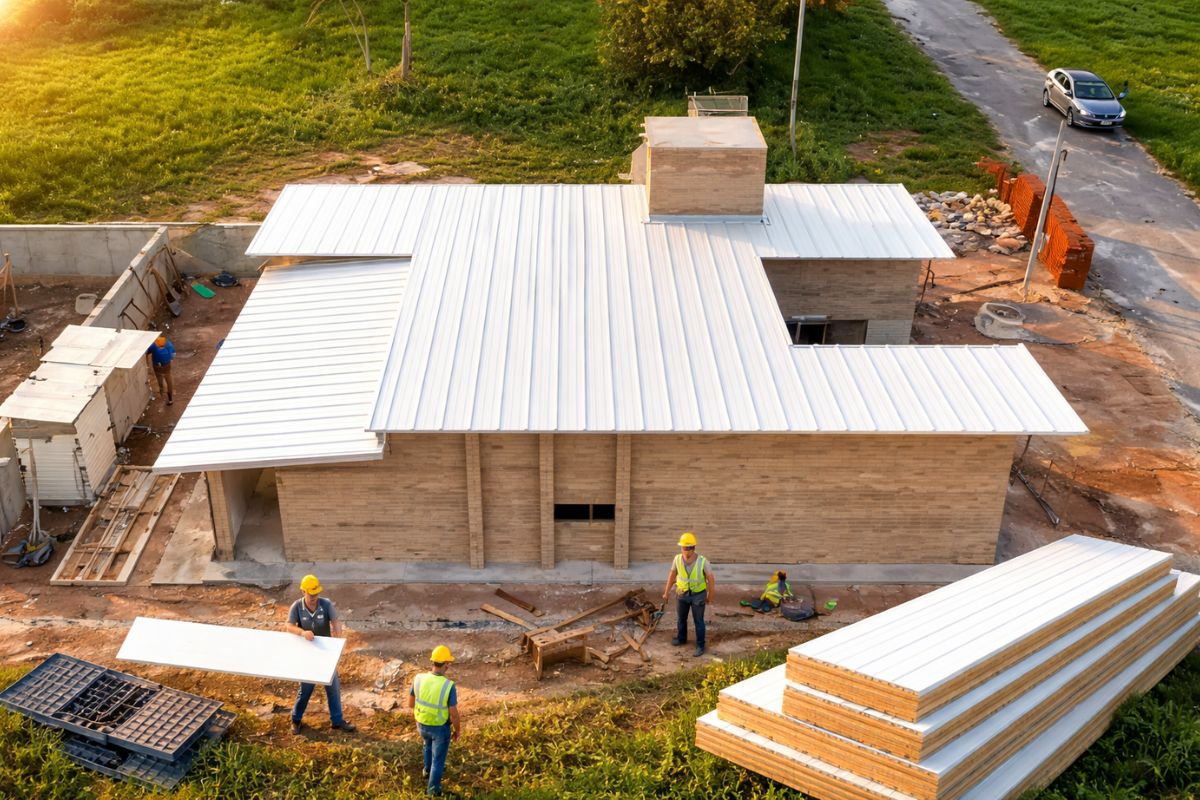
The sandwich tile has gained space as an alternative for those who want to cover the house faster, spend less on structure, and avoid the long sequence of steps required by a conventional roof. In one of the examples shown in the base, the solution helped generate savings of about R$ 22 thousand, nearly 50% of the cost of the covering.
In addition to the impact on the wallet, the sandwich tile changes the logic of construction because it concentrates several functions in a single solution. It can reduce the need for wood, eliminate steps such as slabs and part of the ceiling, require less slope, and drastically shorten the execution time of the roof.
When comparing this system with traditional ceramic roofing, the difference appears in almost everything. The sandwich tile requires less structure, less labor, less time, and less wall to overcome the slope, which helps explain why it has been seen as a smarter choice for low-cost construction.
In the end, the change is not just in the material. The sandwich tile serves as a solution that simplifies the entire covering, reduces rework, and allows the house to reach the stage where it really starts to take shape as a home more quickly.
-
For 45 years, Spain and Morocco have been trying to connect Europe to Africa through a project of just 14 kilometers in the Strait of Gibraltar, and an active tectonic fault on the seabed continues to make the project nearly impossible.

-
Goodbye expensive water tank: residents replace traditional system with a cheaper and more efficient solution that reduces water consumption and reuses rainwater.

-
Mexico is building a 300-kilometer railway corridor that connects the Pacific to the Atlantic in just seven hours and wants to compete directly with the Panama Canal, which is already facing water scarcity issues.

-
The largest tunnel module factory in the world was built from scratch on a beach in Denmark to produce 89 concrete blocks and will be demolished after the project: each structure weighs up to 10 times the Eiffel Tower and will be installed on the bottom of the Baltic Sea with an accuracy of 12 millimeters in a tunnel that will halve the travel time between Hamburg and Copenhagen.

Why the sandwich tile can significantly reduce the cost of covering
In a conventional roof with ceramic tiles, the covering does not depend only on the tile. It usually requires framing with purlins, battens, lines, and rafters, as well as reinforced concrete slabs, shoring, plaster ceilings, finishing, and painting. All of this increases costs and prolongs the construction.
With the sandwich tile, a good part of these steps is eliminated. According to the base, it combines in a single system the functions of covering, lower finishing, thermal insulation, and part of acoustic performance. When several services cease to exist at the same time, the cost of the roof decreases significantly.
Lower slope also reduces wall costs
Another significant point is the slope. While a ceramic covering works with slopes starting at 30%, the sandwich tile can be installed with about 5% slope. This directly changes the amount of wall needed to form the roof’s slope.
In practice, this can mean much less masonry. The base mentions that, in a conventional solution, the construction may need up to a third more wall area just to meet the slope of the covering. And the cheapest wall continues to be the one that does not need to be built.
Sandwich tile accelerates the work impressively

The time gain appears as one of the strongest arguments. In one cited case, a 120 m² house was covered in just 8 hours. In another, the covering of a larger house with four bedrooms was completed in about a week along with the structure.
This speed changes the rhythm of the construction site. Covering the house quickly means protecting the work, moving on to other stages sooner, and reducing the total execution time, which is essential for those who want to build while spending less and without seeing the schedule drag on.
Less wood and simpler structure are in the account
The sandwich tile also significantly reduces the need for wood. According to the base, it eliminates 100% of the battens, 100% of the purlins, and, in many cases, also dispenses with wooden lines, leaving the structure concentrated basically on the rafters.
These rafters can be made of wood or metal, with an average spacing of 1.5 m to 2 m, depending on the manual’s orientation and the type of support. In one of the reports, savings on wood reached nearly 90%. This helps explain why the roof structure is much leaner than in the traditional ceramic system.
Covering can dispense with conventional slab and ceiling
One of the biggest impacts of the sandwich tile is the fact that it replaces the slab, which is usually one of the most expensive, time-consuming, and risky steps of the covering. If the slab requires shoring, calculations, and waiting, the metal tile comes ready to fulfill this function of upper closure.
Additionally, the underside of the piece can function as internal finishing. This reduces the need for additional ceiling, although the base also explains that for those who want to reinforce acoustic insulation or change the appearance, it is still possible to install plaster ceiling later.
Thermal insulation is one of the main attractions
The sandwich tile is made up of two metal sheets with an insulating core between them. This filling can be made of PIR, PU, rock wool, glass wool, or EPS, with PIR being pointed out in the base as the best option available on the market today.
This filling helps to better retain heat and cold compared to other tiles. Therefore, the sandwich tile does not only attract attention for its structural savings but also for the thermal comfort it can offer inside the house.
Rain noise can be solved with simple reinforcement


Despite the advantages, the base also points out a point of attention. Since the sandwich tile is metallic, rain can reverberate more in the environment. For those who do not like this noise, the suggested solution is to install a separate plaster ceiling.
In this case, the additional cost reported is about R$ 30 per m² for common plaster or R$ 60 per m² for drywall. It is also possible to place rock wool between the ceiling and the tile, with a cited cost of R$ 5 per m². Even with this reinforcement, the logic presented is that the sandwich tile still continues to generate savings in the overall covering.
Less leakage and more wind resistance
Another strong argument in favor of the sandwich tile is waterproofing. Since it works with large panels, there are fewer joints and, consequently, fewer places prone to leakage. The base describes it as one of the coverings that least leak.
Moreover, because it is screwed to the structure, it tends to withstand gales better. A firmer attachment reduces the risk of tile displacement and helps make the covering safer and more stable over time.
Installation is simple and can reduce specialized labor
The installation also appears as an advantage. According to the base, the system is simpler to execute and can be assembled even with a mason and helper, as long as they follow the manual correctly. This reduces the dependence on specialized labor, such as that of a carpenter in a traditional roof.
The size of the pieces helps in this gain. The tiles can reach 1 meter in width and up to 12 meters in length. When a single piece covers large sections of the house, the work proceeds quickly with fewer cuts, fewer fittings, and less complication.
Sandwich tile is not a solution only for houses
The base reminds us that the sandwich tile is not used only in residences. It also appears in warehouses, parking lots, supermarkets, gas stations, gyms, and different types of industrial structures.
This detail reinforces the economic logic of the material. If sectors that cover huge areas rely on this system to reduce costs and simplify the structure, it helps explain why it is also gaining strength in houses.
Choosing changes the way of thinking about construction
Ultimately, the sandwich tile does not represent just a tile exchange. It changes the reasoning of the project, the structure, and the very sequence of the construction, because it eliminates steps, reduces materials, and accelerates the covering.
For those who want to build while spending less, this choice can make a big difference. When the roof ceases to be a long, expensive phase full of parallel services, the construction breathes better and the budget feels the positive impact.
Would you use sandwich tile in your house to save on the roof or do you still prefer traditional covering?









Seja o primeiro a reagir!