





 Portuguese
  English
  Spanish
  5 min of reading
  11 comments


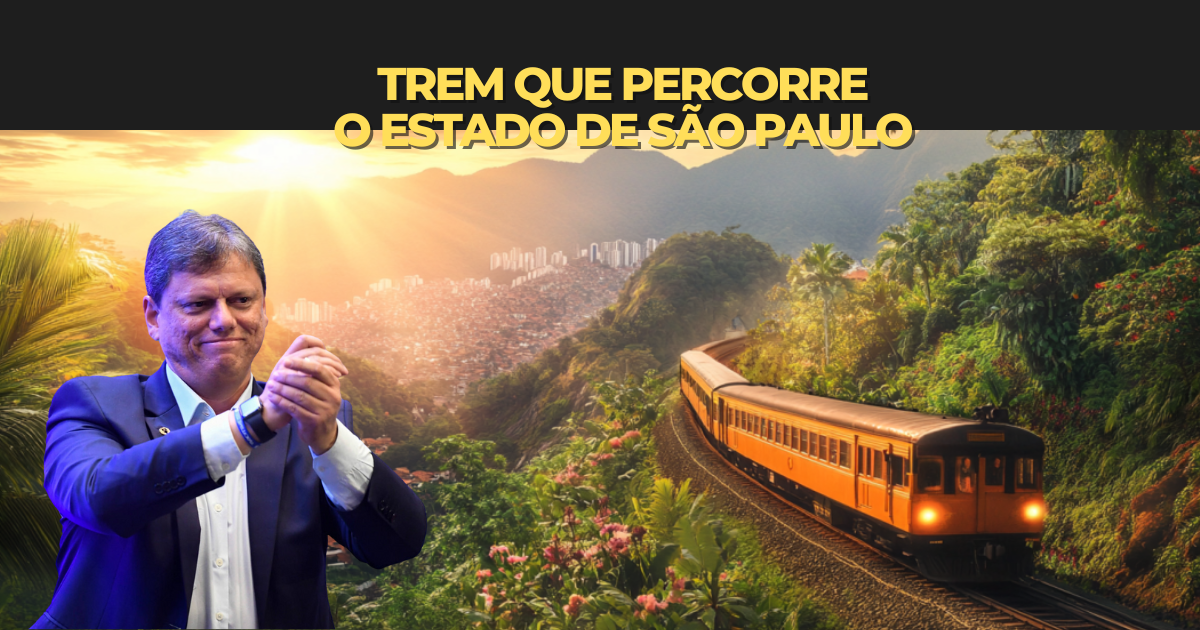

State of São Paulo Launches Most Ambitious Railway Tourism Project in Brazil, Planning the Largest National Network with Over a Thousand Kilometers of Tracks and 23 Circuits.
The State of São Paulo has just taken a bold step towards the future of railway tourism in Brazil, and the promise is ambitious: to create the largest network in the country, covering over a thousand kilometers of tracks.
This initiative arises in a scenario where tourism increasingly integrates with the history and culture of cities, transporting visitors along routes that connect landscapes and memories.
With substantial investment and the goal of expanding the sector over the next decade, the project promises to transform tourism in São Paulo, making the sector take off and literally bringing many Brazilians and tourists into new experiences aboard old and new trains.
-
A new Brazilian shopping center worth R$ 400 million will be built in an area equivalent to more than 4 football fields, featuring 90 stores, 5 cinemas, a supermarket, a college, and parking for 1,700 cars, potentially generating 3,000 jobs.

-
Larger than entire cities in Brazil: BYD is building a 4.6 km² complex in Bahia with a capacity for 600,000 vehicles per year, but the discovery of 163 workers in conditions analogous to slavery has shaken the entire project.

-
With an investment of R$ 612 million, a capacity to process 1.2 million liters of milk per day, Piracanjuba inaugurates a mega cheese factory that increases national production, reduces dependence on imports, and repositions Brazil on the global dairy map.

-
Brazilian city gains industrial hub for 85 companies that is equivalent to 55 football fields.


The Railway Tourism Program of the State of São Paulo, launched on November 6, projects a network that seeks not only to expand tourist routes but also to establish a new standard of railway tourism in the country.
This program involves the expansion of 23 railway circuits, connecting to highways and other means of transport, in addition to financial incentives and workforce training.
The ultimate goal is to revitalize tourism and strengthen the sector with projects that range from regional tourism to cultural initiatives, such as the creation of the Revolution Museum in Cruzeiro, in the interior of São Paulo.
Economic Impact and Growth Potential
According to the Tourism Economy Intelligence Center, railway tourism in São Paulo already generates about R$ 150 million annually.
The expectation, however, is even more grandiose: projections indicate that, with the realization of the expansion, revenue in the sector could reach R$ 1.8 billion over the next ten years.
This financial movement could even foster new job opportunities and strengthen the local economy, as well as enhance the historical and cultural heritage of the state.
This program has the support of the Secretariats of Tourism and Travel, Partnerships and Investments, Environment, Infrastructure and Logistics, Metropolitan Transportation, Culture, Economy, and Creative Industry.
The project is part of SP Nos Trilhos, an initiative with more than 40 actions focused on the development of railway transport, encompassing urban trains, VLTs (light rail vehicles), and intercity trains, as well as the expansion of metro lines and the development of freight trains.
Investments in this program are estimated at an impressive R$ 194 billion.
Expansion of Railway Circuits and Regional Tourism
São Paulo already has some operational railway circuits that attract tourists and connect historical and cultural cities.
Among the existing circuits, the São Paulo-Paranapiacaba Express stands out, which carries passengers from São Paulo to the district of Paranapiacaba in Santo André; the Republic Train, which connects Salto to Itu; and the Guararema Train.
The expansion proposed by the Railway Tourism Program includes the creation of new routes, such as the Mantiqueira Express, which is expected to connect Cruzeiro to the Tunnel of the Revolution of 1932 and link to the tourist train of Passa Quatro in Minas Gerais.
This new line, in addition to boosting tourism, will also serve as an invitation to revive Brazilian history, as the tunnel was the site of significant historical events during the Constitutional Revolution of 1932.
Roberto de Lucena, State Secretary of Tourism and Travel, highlights the positive impact of the project, stating that “tourist trains transform urban and rural landscapes, benefiting the municipalities they pass through.”
This is one of the key points of the project: by enhancing railway tourism, São Paulo not only revitalizes railway transport but also contributes to the development of cities and regions, promoting the integration between tourism and strengthening the local economy.
Sustainable Tourism and Cultural Appreciation
In addition to the economic attractions, the initiative also aims for a positive environmental impact.
The expansion of railway tourism contributes to a more sustainable form of tourism by utilizing a mode of transport with lower pollutant emissions compared to highways and the aviation sector.
Moreover, by offering circuits that pass through natural and historical areas, the project reinforces the preservation and appreciation of São Paulo’s cultural and environmental heritage.
This project interacts with a growing demand for experiences that combine leisure, culture, and environmental awareness, reflecting modern tourists’ desire for more immersive and authentic itineraries.
With over 1,000 kilometers of tracks planned to cross the state, the expectation is that the program will inspire other states to invest in similar projects, expanding the reach and value of railway tourism throughout Brazil.
Opportunities for the Future and Investment in Infrastructure
With railway infrastructure being expanded and revitalized, the tourist network also represents an opportunity for the creation of direct and indirect jobs in the tourism and transport sectors.
For professionals in the field, the growth of this sector opens doors for new trainings and career development related to tourism and railway operations.
In terms of infrastructure, the Railway Tourism Program could even encourage future public-private partnerships, attracting investors interested in the long-term potential of the railway sector in the state.
How to Sign Up for Job Opportunities and Training: Information about vacancies and qualifications for professionals in the tourism sector will be disclosed by the government of São Paulo.
For more details, follow the updates on the official state government portal.
This innovative project promises to transform tourism in the state of São Paulo and potentially serve as a model for railway tourism in Brazil.
Will this new scenario attract more tourists, positively impact the local economy, and create new job opportunities?








Excelente notícia! O governador Tarcísio de Freitas é nota 10! 😃👏
Bom seria voltar o trem que fazia são José do Rio preto verso são Paulo aí sim seria ótimo 😂😂😂😂
Vai sim em Botucatu roubaram todos os trilhos até a cidade de Avaré