





 English
  Francês
  Alemão
  Italiano
  Japonês
  Norueguês
  Portuguese
  Spanish
  11 min of reading
  0 comments


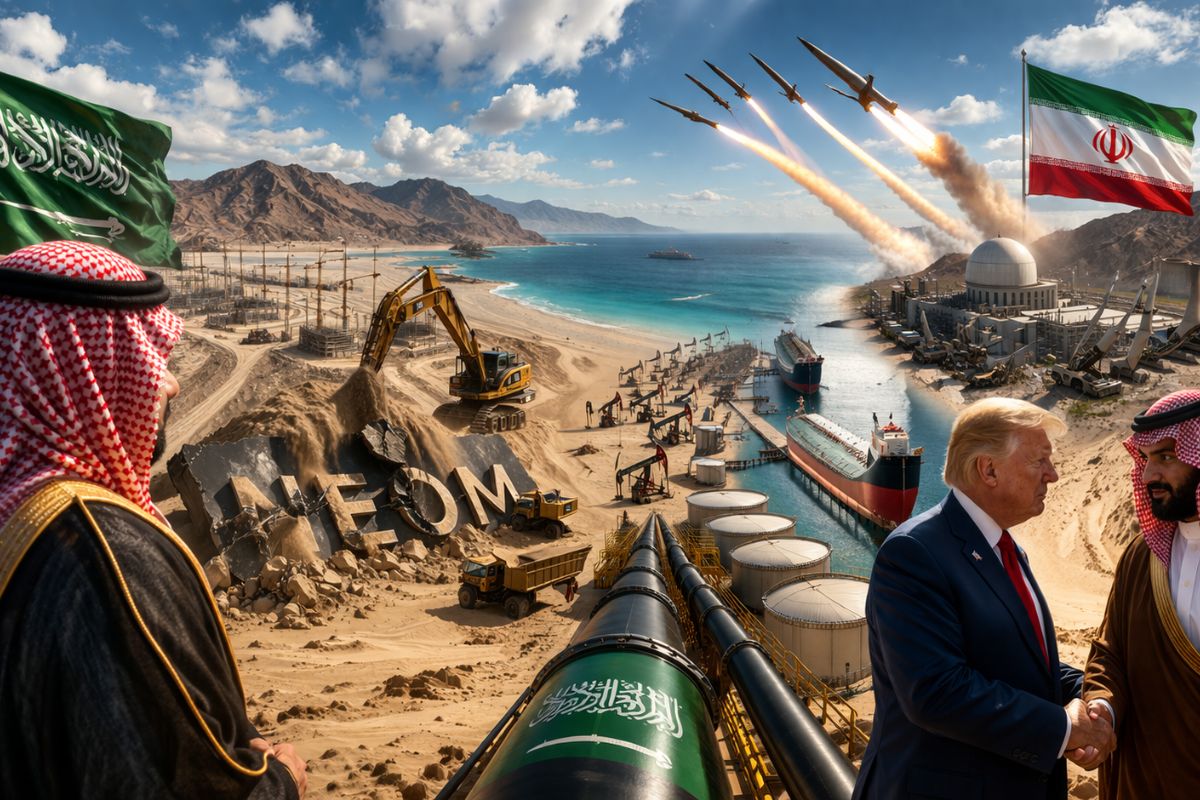
Saudi Arabia enters a critical phase as it sees its largest future project lose momentum while the regional war threatens oil, drives away investors, and pressures its economy from all sides
Saudi Arabia is going through a dramatic turning point. The country that tried to sell the world an image of accelerated modernization, futuristic cities, and limitless economic power now finds itself forced to shift its attention to war, the defense of its infrastructure, and the survival of its own financial stability. What seemed to be a showcase of transformation has turned into a race against the collapse of priorities.
At the center of this shock is the contradiction that defines the Saudi moment. On one side, the promise of a new economic model capable of reducing dependence on oil and transforming the kingdom into a global hub for technology, tourism, and entertainment. On the other, the escalation of a conflict that threatens energy routes, destroys investor confidence, and pushes Riyadh into increasingly risky decisions. The war has ceased to be an external problem and has begun to pressure the heart of the Saudi project.
The grand promise that began to lose ground
For years, NEOM was presented as proof that Saudi Arabia did not just want to get rich from oil, but to rewrite its position in the world.
-
Archaeologists discover Roman vase buried for over 2,000 years with more than 175 intact gold and silver coins, revealing a desperate strategy to protect wealth during the collapse of the Empire.
-
With 241 meters, 48 thousand tons, and a structure designed to accompany aircraft carriers at sea, the Chinese ship that refuels fleets in motion was born to push Beijing away from the coast and has become the hidden gear of its naval projection.
-
“Discreet” city in the interior of SP stands out among the smartest in Brazil thanks to a national ranking.
-
With 27,800 tons, 230.8 meters in length, and space for 18 helicopters, the Canberra class functions as a floating amphibious airbase and gives Australia the capability to operate at sea for more than 45 days.

The megaproject symbolized the ambition of Crown Prince Mohammed bin Salman to build a new era for the kingdom, with technological cities, monumental infrastructure, and a more attractive international image for investors and partners.
However, this plan required a basic condition: stability. Without regional security, political predictability, and long-term confidence, a project of this scale begins to lose support. A billion-dollar utopia in the desert depends less on impressive models and more on a reliable environment for those investing in it.
This is precisely where the current crisis hits hard at the heart of the Saudi strategy. Instead of concentrating energy on building the future, the kingdom needs to look to the sky, to military risks, to the protection of refineries and pipelines, and to the geopolitical impact of a war that could spiral out of control. The consequence is direct: the shine of NEOM weakens at the same pace as insecurity grows.
The war changes everything for Saudi Arabia
The major breaking point is that Saudi Arabia is no longer just a tense spectator of regional turbulence. The country finds itself pushed to a historic crossroads, where each step could cost billions and compromise years of economic planning.
Publicly, the discourse is one of caution, defense, and a search for containment. This stance serves to avoid external wear and reduce the image of direct involvement.
But behind the scenes, the scenario described at the base points to another logic. The internal reading would be that the conflict could also represent a rare opportunity to decisively weaken Iran.
This is the most dangerous bet of all. When a country begins to see war as both a threat and an opportunity, its margin for error shrinks drastically.
Saudi Arabia tries to prevent violence from destroying its economy, but it also seems to consider that the current chaos could create space to alter the regional balance in its favor.
Mohammed bin Salman plays the most risky game of his trajectory
Mohammed bin Salman built his political image around the idea of strength, modernization, and control. NEOM, Vision 2030, and investments in major events were central pieces of this project.
All of this served to sustain a clear narrative: that Saudi Arabia was leaving behind its traditional dependence on oil and entering a new phase.
Now, this script is under brutal pressure. The military escalation threatens to turn years of propaganda and planning into a concrete economic problem. If the war drags on, the cost ceases to be merely strategic and becomes structural.
The dilemma for Mohammed bin Salman is evident. If he retreats too much, he risks seeing a regional rival survive, reorganize forces, and keep the peninsula under constant threat.
If he hardens and pushes the conflict to the limit, he could ignite the environment that would support his own agenda for internal transformation. In either path, the potential price is extremely high.
The weight of war on Vision 2030
Vision 2030 was born to reduce the vulnerability of Saudi Arabia to oil fluctuations and reposition the country as a center for business, tourism, innovation, and entertainment.
To achieve this, the kingdom needed to attract external capital, stimulate new economic activities, and convince the world that it offered enough stability for major long-term bets.
However, wars do exactly the opposite. They scare off investors, increase operational costs, elevate logistical risks, and disrupt schedules. Instead of a safe environment for tourism, sports, and technology, what emerges is a scenario of uncertainty, attacks, and regional fear.
This impact is already appearing concretely in perceptions about events and businesses linked to the country. When races, investments in entertainment, and grand projects coexist with the possibility of missiles and drones, the image built over the last few years begins to crack. No branding can hide a region under permanent risk.
NEOM becomes the biggest collateral victim
No symbol better expresses this turning point than NEOM itself. The project that was sold as the ultimate showcase of the new Saudi era now also represents the extent of the fragility of the plan when the regional scenario deteriorates.
The grandeur that once impressed now weighs as a problem. Gigantic works, extensive timelines, dependence on international investments, and rising costs make NEOM particularly sensitive to any external shocks. When instability advances, these projects cease to seem visionary and begin to appear excessively vulnerable.
The greatest political tragedy for the Saudi project is precisely this: its most ambitious work depends on the type of stability that war destroys first. It is not just about delays in schedules or budget increases. It is about the loss of confidence in the entire logic that sustained the enterprise.
When foreign capital hesitates, the desert ceases to be synonymous with the future and begins to evoke the risk of isolation. NEOM, in this context, does not just seem postponed. It starts to symbolize the difficulty of keeping a billion-dollar fantasy afloat in a region dominated by uncertainties.
The Saudi economy enters a zone of extreme pressure
Even before the new escalation, the fiscal situation already required attention. The data indicates that the Saudi government had been facing deficits and suffering from excessive spending on megaprojects and very aggressive investments. This means that Saudi Arabia was already walking on delicate ground before being pushed further by the war.
With the conflict, the problem grows larger because two pressures begin to act together. The first is the need to spend more on defense, security, and protection of strategic assets. The second is the risk of seeing precisely the investment flows that would help sustain the modernization plan diminish.
This is the kind of trap that threatens any ambitious national project. The country spends more to avoid immediate losses, but this extra spending erodes the financial base of the future it claimed to be building. If the war continues to drain resources and inhibit investors, the bill will become heavier and heavier.
The crisis, therefore, is not just military or diplomatic. It is economic, structural, and symbolic. Saudi Arabia tries to preserve its narrative of a rising power, but the current scenario exposes that this rise depends on premises that are now shaken.
Oil returns to be the central anchor of survival
Amid the turmoil, Saudi Arabia turns to what it has always had strongest: oil. When the economic diversification environment weakens, the energy resource returns to the center of the resistance strategy.
The logic is simple. If the country wants to prevent even greater disorganization, it needs to maintain the flow of exports and protect its position as a vital supplier. Therefore, the movement around the East-West pipeline and the port of Yanbu gains decisive character. The intention is to circumvent maritime threats, preserve part of the export capacity, and prevent the energy crisis from deepening further.
But even this alternative has limits. The structure faces bottlenecks, does not solve all logistical problems, and does not eliminate exposure to new threats at strategic transport points. Still, it shows how Saudi Arabia tries to buy time and prevent the war from destroying its main source of support.
In the end, when the future fails, oil returns to being the emergency cushion. This is revealing because it temporarily dismantles the promise that the kingdom would already be in another historical phase.
The Strait of Hormuz and the fear of a greater collapse
The threat over the Strait of Hormuz amplifies the drama because it affects not only Saudi Arabia but the functioning of the global energy market. Any serious disturbance in this route provokes immediate fear of shortages, price hikes, and commercial disorganization.
For Riyadh, this risk has a double effect. On one hand, it reinforces the strategic importance of the country as a supplier and as a central actor in the attempt to prevent a greater shock. On the other, it brutally exposes its vulnerability to a war that could interfere precisely with the most sensitive axis of its economy.
The fear is not limited to crude oil. There is also the problem of refined products, port capacity, and crossing through other threatened areas.
This means that Saudi Arabia is not only dealing with the challenge of continuing to export, but with the much more complex task of preventing its logistical infrastructure from being crushed by a prolonged conflict.
The foreign investor sees risk where they once saw opportunity
During the peak propaganda phase of Saudi modernization, the central promise was clear: Saudi Arabia would be too big to be left out. The international investor was invited to participate in historic works, technological projects, tourist hubs, and a billion-dollar market with direct state support.
Now, this narrative loses strength because risk enters the center of the equation. No investor looks only at models or political speeches. They analyze security, predictability, governance, and the probability of return. When drones, missiles, and regional tension become part of the picture, the calculation changes rapidly.
Foreign capital hates prolonged uncertainty. And that is exactly what war offers. Even if Saudi Arabia preserves much of its economic capacity, the reputational damage already weighs heavily. Projects that required almost blind confidence in the future are now being reviewed with more caution.
The effect of this is devastating for any strategy based on non-oil expansion. Without continuous investment, megaprojects delay, become more expensive, and begin to seem more like propaganda than concrete transformation.
The central contradiction of Riyadh has been exposed
The current moment lays bare the main contradiction of the Saudi project. Saudi Arabia wants to be both a hard regional power, capable of decisively influencing the geopolitical game, and a major safe center for investors, tourists, and global businesses.
In times of relative peace, these two ambitions can coexist with controlled tension. In times of open or prolonged war, they clash.
This is the most important fissure of the crisis. To redesign the regional order, the kingdom seems willing to tolerate enormous risks.
But to sustain Vision 2030, it would need exactly the opposite: predictability, stability, and a secure horizon. The force that can bring strategic victory is the same that can destroy the economic base of the modernization promise.
This contradiction helps explain why the situation seems so explosive. There is no simple solution. Every move that reinforces geopolitical muscle can weaken economic confidence. Every gesture of prudence, in turn, can be read as a renunciation of the chance to neutralize a historical rival.
The greatest Saudi fear is not just war, but an unfinished war
There is one particularly important point in the logic presented: the worst-case scenario for Saudi Arabia would not necessarily be the confrontation itself, but an incomplete outcome. An injured Iran, but not neutralized, with a desire for revenge and the capacity to maintain indirect attacks over time, would represent a strategic nightmare.
This type of outcome would prolong insecurity for years. Instead of a decisive victory or stable peace, a kind of dangerous limbo would emerge, marked by retaliations, sabotage, pressure on infrastructure, and constant fear. For the Saudi economy, this would be corrosive.
A poorly concluded war transforms the present into a permanent threat to the future. And this may be the core of Riyadh’s decision. The kingdom seems to assess that if the confrontation has already opened a critical phase, exiting it without resolving the threat could be worse than facing even greater costs now.
This reading helps to understand why Saudi Arabia would go so deep into this game. The problem is that the difference between strategic calculation and historical error can be minimal when the entire region is under extreme tension.
What is really at stake for Saudi Arabia
The debate is not just about NEOM, oil, or a military dispute. What is at stake for Saudi Arabia is the ability to sustain its own narrative of power in the 21st century.
If it can navigate the crisis, preserve its vital structures, and emerge regionally strengthened, the kingdom may try to sell the image that it weathered the storm and proved its centrality.
But if the conflict erodes investments, implodes international confidence, and completely stalls its megaprojects, the political bill will be gigantic.
In this case, NEOM will cease to be just a delayed project. It will become a symbol of a time when Saudi Arabia promised an economic revolution but was pulled back by the brutal weight of Middle Eastern geopolitics.
This is what makes the moment so decisive. It is not just about protecting assets or managing immediate damage. It is about whether the kingdom will be able to keep its future plan alive or if it will be forced to admit that, in the face of war, old oil and the logic of survival continue to dictate more than any grand vision.
Saudi Arabia enters a phase where every decision carries military, economic, and political implications at the same time. The country sees its grand showcase of modernization lose strength just when it needs stability the most to keep it standing.
At the same time, it intensifies a regional bet that could even expand its influence but also threatens to destroy the environment necessary to sustain its internal transformation.
In the end, the crisis reveals a harsh truth: there is no futuristic city capable of thriving when war begins to compete for the same budget, the same strategic territory, and the same attention of power.
NEOM shrinks, oil returns to the center, investors pull back, and Saudi leadership finds itself facing a choice that could redefine not only the kingdom’s destiny but the balance of the entire region.
In your view, is Saudi Arabia making a necessary strategic calculation or risking its economy on a bet that is too big?



Seja o primeiro a reagir!