





 Portuguese
  English
  Spanish
  5 min of reading
  0 comments


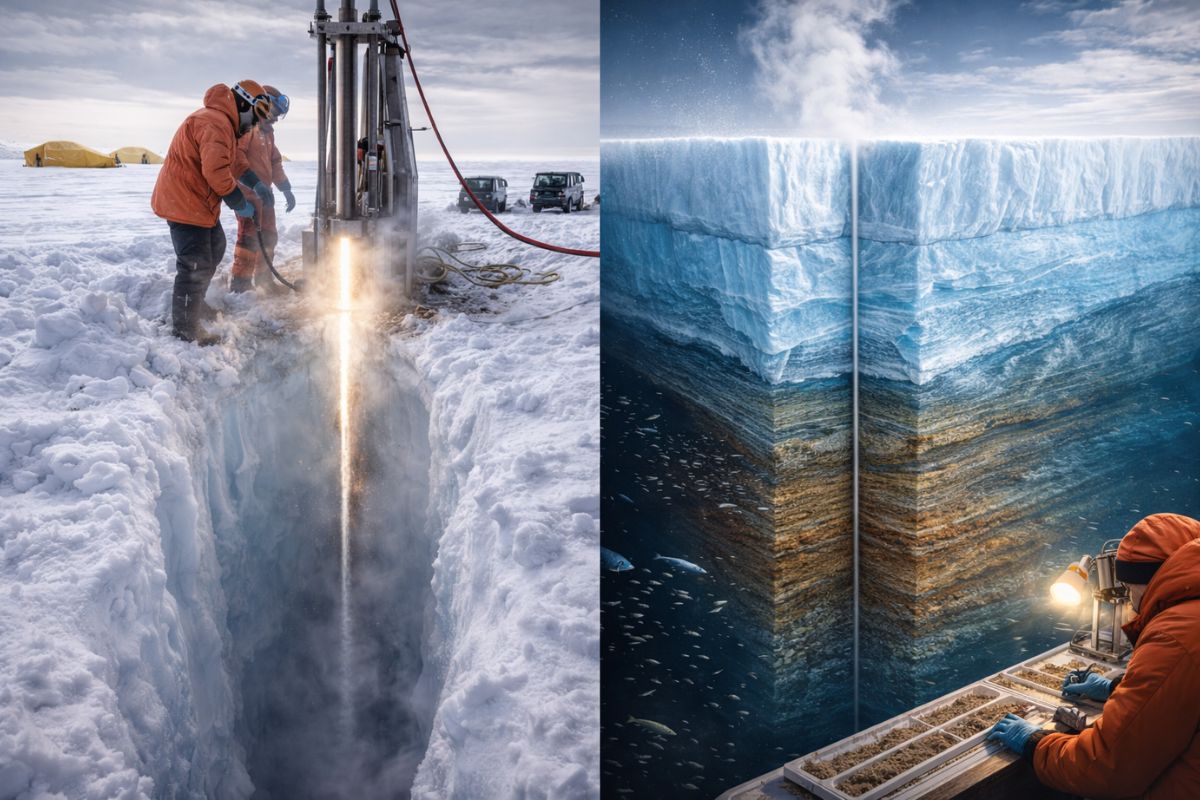
An international team of the SWAIS2C project drilled through the West Antarctic ice sheet and recovered 218 meters of sediments with microfossils that record 23 million years of climatic history, including periods when the ocean occupied the place where there is now half a kilometer of solid ice
An international team camped for nearly ten weeks on the ice of Antarctica has just completed the deepest drilling ever done beneath an ice sheet on the continent. Scientists from the SWAIS2C project melted 523 meters of ice using water heated to 75°C and then continued drilling 228 meters into the rock below, recovering 218 meters of ancient sediments that appear to record about 23 million years of climatic history of Antarctica.
According to Antarctica New Zealand, what these sediments reveal is extraordinary. Within the samples, researchers found microfossils of marine organisms that need sunlight to survive, meaning that there could not have been a thick layer of ice above them when they were alive. In other words, where there are now 523 meters of ice in Antarctica, at certain periods in the past there was open ocean. The discovery could reshape what we know about future sea level rise and the risks to 680 million people living in coastal areas.
How scientists drilled half a kilometer of ice in Antarctica with hot water

The drilling site is located at Crary Ice Rise, an ice elevation anchored in rock more than 700 kilometers from the nearest research station, Scott Base. Everything had to be transported across the ice by tractors: fuel, food, equipment, and the custom drilling system.
-
Scientists create a new propulsion system that allows satellites to use the air from Earth’s atmosphere as fuel to operate in space with lower costs and longer operational time.
-
Student creates revolutionary filter that removes up to 96% of microplastics from water using cheap magnetic technology and could change the future of drinking water in homes.
-
Scientists have excavated a giant cave beneath the snow of Antarctica to create a natural refrigerator at minus 50 degrees that operates without electricity and can preserve the Earth’s climate memory for entire centuries.
-
Radio has been in more than half of Brazilian households for decades, and in 2024, for the first time in history, the number of households without a device surpassed those with a device, with a decrease of 2.3 million in a single year.


A camp with 29 people lived in tents on the ice of Antarctica, working in uninterrupted shifts for nearly ten weeks.
The process began with a hot water drill that melted a narrow tunnel through the 523 meters of ice, using water heated to approximately 75 degrees Celsius. After the ice was crossed, the team lowered over a kilometer of pipes and drilling tools until reaching the sediments accumulated over millions of years.
Previous attempts in similar environments in Antarctica had only managed to recover less than ten meters of sediments. The 218 meters obtained by the SWAIS2C project overwhelmingly broke this record.
The microfossils that prove Antarctica was once open ocean

As each three-meter section was removed, the team opened, photographed, and recorded the content at the camp itself. Some layers looked as expected under a modern ice layer: compacted, sandy material typical of glaciers that grind rocks.
Other layers were completely different, with fossil remains of marine organisms and fragments of shells that belong to sunlit seawater.
These organisms need light to survive. If they were alive at that point, there could not have been hundreds of meters of ice above them. The conclusion is straightforward: this part of Antarctica, which is now covered by half a kilometer of solid ice, was once open ocean during certain periods in the past.
Preliminary dating based on the microfossils suggests that the record spans the last 23 million years, a period that includes several warm intervals when global temperatures were more than 2°C above pre-industrial levels.
Why 2 degrees of warming put Antarctica at risk
The acronym SWAIS2C stands for Sensitivity of the West Antarctic Ice Sheet to 2°C. This number is not arbitrary. International climate agreements consider a warming of 1.5 to 2°C as the maximum limit before the risks of sea level rise, extreme heat, and loss of ecosystems become much more difficult to control.
The West Antarctic ice sheet contains enough ice to raise global sea levels by 4 to 5 meters if it were to melt completely.
This total melting would not happen overnight, but over centuries. The problem is that the tipping points that trigger irreversible ice retreat can be activated at temperature levels close to the current emissions trajectory.
The sediments found in Antarctica show that this has happened before, during warm periods in the past when the Earth reached temperatures similar to those we are heading towards. It is this connection between the past and future that makes the discovery so relevant.
What the mud from Antarctica has to do with coastal cities and property insurance
At first glance, a remote drilling camp in Antarctica seems disconnected from everyday life. In practice, the data extracted from these sediments directly influences decisions that affect millions of people.
More accurate estimates of future sea level rise help cities decide where to build levees, whether to retreat from exposed areas, and how to plan infrastructure in the coming decades.
This data feeds flood maps that determine insurance costs and financing risks for properties near the coast. Ports, power plants, subway tunnels, and sewage treatment plants need to know how often they may become submerged.
At least 30 centimeters of sea level rise by 2100 are already considered practically inevitable, and in high emissions scenarios, the total could reach between 1 and 2 meters. The sediments from Antarctica help calibrate these projections with real data from the geological past.
What happens now with the sediments removed from Antarctica
The samples were transported to New Zealand and will be divided among research teams in about ten countries.
Researchers supported by institutions such as Victoria University of Wellington, ETH Zurich, and several other universities will use dating techniques, chemical analysis, and microfossil study to verify the chronology of the 23 million years recorded in the sediments and reconstruct past ocean temperatures in Antarctica.
Years of laboratory analyses will be needed to extract all the information contained in this Antarctic mud cylinder. The results will be incorporated into polar ice sheet and sea level models that support national climate risk assessments worldwide.
The International Continental Scientific Drilling Project, which funded the operation in Antarctica in its first project on the continent, already classifies the material as a crucial geological record for understanding how this vulnerable ice sheet responded to warm periods in the past.
What the 23 million-year-old mud says about the future
A sediment core taken from beneath half a kilometer of ice in Antarctica has become one of the clearest pieces of evidence that the frozen continent has not always been frozen.
Where there is solid ice today, there was once open ocean. And the conditions that allowed this in the past are not so distant from those that global warming may produce in the coming decades.
The question that scientists are trying to answer now is: how quickly will the ice respond this time?
Did you know that Antarctica was once open ocean? Do you think discoveries like this change the way we think about climate change, or are the data still too far from our reality? Leave your comments and share this article with those interested in science and climate.







Seja o primeiro a reagir!