





 Portuguese
  English
  Spanish
  5 min of reading
  0 comments


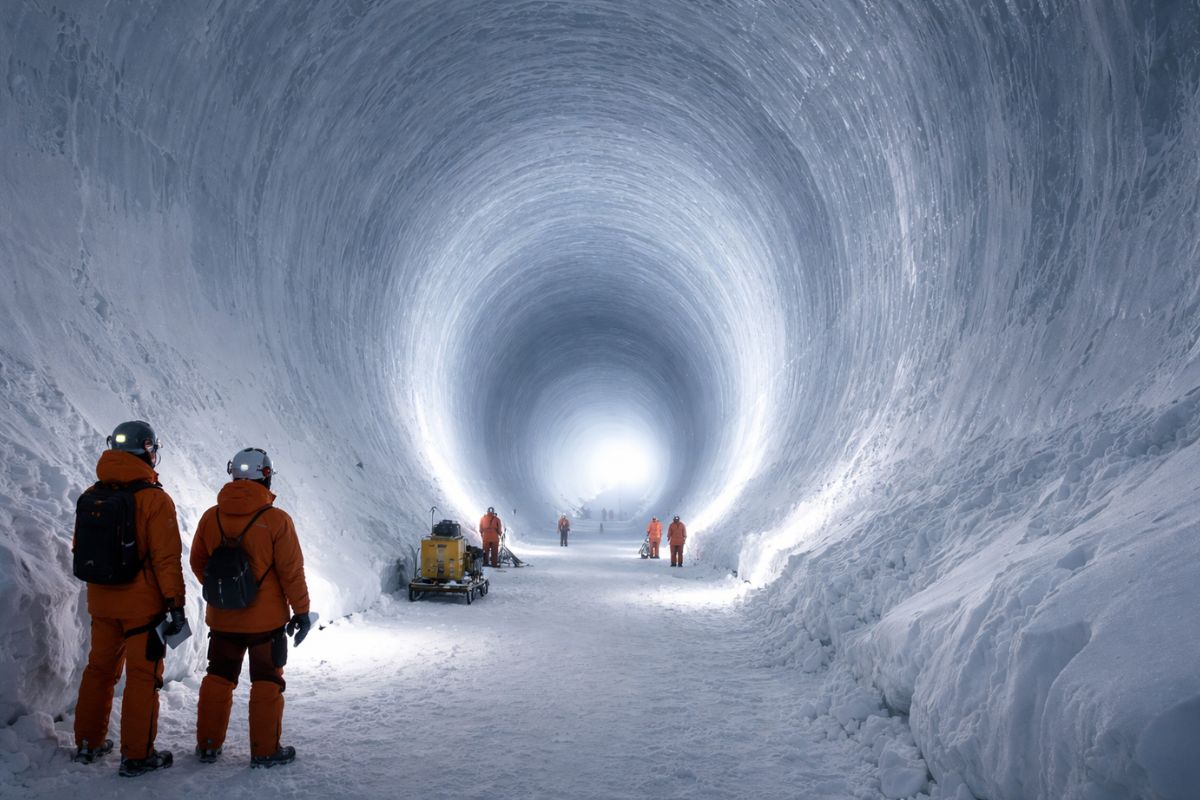
The Ice Memory Foundation inaugurated the first global sanctuary for ice cores under the snow of Antarctica near the Concordia Station, where samples from the Alps rest at minus 52 degrees Celsius without electricity, preserving ancient air bubbles that record the Earth’s climate history for scientists of future generations
Hidden nine meters deep under the snow of Antarctica, scientists carved a vault unlike any other on the planet. It does not store gold, seeds, or documents. Inside a 35-meter-long cave dug into the compacted snow of the Antarctic plateau, rest ice samples extracted from disappearing mountain glaciers. The natural temperature of the site is approximately minus 52 degrees Celsius, which eliminates the need for any mechanical refrigeration system or electricity.
According to CNRS, the sanctuary was inaugurated in January by the Ice Memory Foundation, near the Franco-Italian Concordia Station, and is the first global archive designed to preserve the memory of the Earth’s climate for centuries. The first samples to occupy the vault under the snow of Antarctica are two ice cores from the Alps: one from the Col du Dôme of Mont Blanc in France, and the other from the Grand Combin in Switzerland. About 1.7 tons of ice traveled from Europe to the Antarctic plateau on a refrigerated route by ship and cargo plane.
What is the cave under the snow of Antarctica and how does it work

The cave was excavated in the compacted snow of the Antarctic plateau, about nine meters below the surface. With 35 meters in length, the space houses rows of ice cores stored in thermal boxes.
-
The digital brain of Brazil’s most advanced fighter jet is from Rio Grande do Sul: a company from the state developed the panoramic display, the helmet visor, and the encrypted communication system that equip the F-39E Gripen produced in the country.

-
Scientists detect a rare and frightening phenomenon in the Pacific Ocean that could trigger a devastating Super El Niño as early as 2026, and American experts say it is one of the strongest ever recorded in history.
-
Researchers from Embrapa have discovered how to transform the saline water found in 140,000 wells in the Brazilian Semi-Arid region into a tool for producing food in an area where agriculture has always relied solely on rainfall.
-
China inaugurates a ghost factory that operates in the dark 24 hours a day without any human workers and produces 10 million smartphones a year using 97% of equipment developed by the company itself.


The extreme natural cold of the plateau keeps the internal temperature around minus 52 degrees Celsius year-round, without the need for electricity, mechanical refrigeration, or constant maintenance.
This is the principle that makes the sanctuary under the snow of Antarctica radically different from the industrial freezers that until now stored most ice cores in Europe.
Mechanical freezers consume large amounts of electricity and are exposed to blackouts, political crises, and human errors.
Passive storage in Antarctica eliminates these risks. Even if the outside world collapses, the vault continues to function because it relies solely on the physics of the coldest inhabited place on the planet.
Why store mountain ice under the snow of Antarctica

Ice samples extracted from high mountain glaciers capture tiny bubbles of ancient air, along with dust, volcanic ash, and traces of pollution accumulated over centuries.
These bubbles allow scientists to directly read past greenhouse gas levels and temperature fluctuations, providing data that enhance climate models used to plan flood defenses, guide agricultural decisions, and steer long-term energy policies.
The problem is that these glaciers are disappearing. Since 2000, mountain glaciers have lost between 2% and 39% of their ice in different regions of the world.
The World Meteorological Organization warns that nearly half of the planet’s glaciers could vanish by the end of the century if warming continues.
The sanctuary under the snow of Antarctica exists to preserve these samples before the glaciers that originated them disappear, taking with them irreplaceable climate records.
Where the first samples came from and what will be next

The first ice cores to occupy the vault under the snow of Antarctica came from the European Alps. One was extracted from the Col du Dôme of Mont Blanc in France, and the other from the Grand Combin in Switzerland.
The 1.7 tons of ice traveled from the Italian port of Trieste on a refrigerated route, first by research ship and then by cargo plane, until arriving at the Concordia Station in December 2025.
Over the next decade, the sanctuary will receive samples from threatened glaciers in other regions of the world. Ice cores from the Andes, the Pamir Mountains, Svalbard, and other vulnerable areas are expected to join the alpine samples.
The idea is to build under the snow of Antarctica a complete archive of the Earth’s atmosphere over thousands of years, accessible to scientists from any country through international standards linked to the Antarctic Treaty.
The Antarctic Treaty and the rules for accessing the ice vault
The project was approved by the parties of the Antarctic Treaty System in 2024, after detailed environmental assessments.
The sanctuary treats the ice cores as a global common resource, not as the property of a single country.
Access will be governed by international standards, with samples released only for scientific projects carefully evaluated by independent committees.
This international governance is essential to ensure that the archive under the snow of Antarctica does not become hostage to national or political interests.
The project was born in 2015 as an initiative of CNRS, the French research agency, in partnership with institutes from Italy and Switzerland.
Prince Albert II of Monaco, whose foundation helped fund the construction, called the glaciers pillars of the Earth system that support millions of people far beyond the polar regions.
Why the project director says we are the last generation that can act
Anne Catherine Ohlmann, director of the Ice Memory Foundation, stated that we are the last generation with the opportunity to preserve these records.
If the mountain glaciers disappear before their ice cores are extracted and stored, the information contained in them will be lost forever. There is no technology capable of recreating a bubble of air trapped a thousand years ago inside a layer of ice that has melted.
Global data shows that 2025 was among the three hottest years ever recorded, with temperatures approximately 1.4 degrees Celsius above the 19th-century average. The pace of warming shows no signs of slowing down.
The sanctuary under the snow of Antarctica is, at the same time, a scientific response to the problem and a message for future generations: somewhere on the coldest plateau on the planet, the atmosphere of the past is frozen, waiting for someone to come learn from it.
A vault that holds the air the world breathed centuries ago
A 35-meter cave under the snow of Antarctica, maintained at minus 52 degrees Celsius without a single watt of electricity, now houses ice samples that contain air bubbles thousands of years old.
It is science’s boldest bet to preserve the memory of the Earth’s climate before the glaciers that hold this information disappear for good.
The eternal cold of Antarctica does for free what industrial freezers do while spending fortunes on energy.
Did you know there was an ice vault under Antarctica? Do you think preserving the memory of the climate is a priority or are there greater urgencies? Leave your thoughts in the comments and share this article with those interested in science, climate, and the future of the planet.






Seja o primeiro a reagir!