





 Portuguese
  English
  Spanish
  8 min of reading
  0 comments


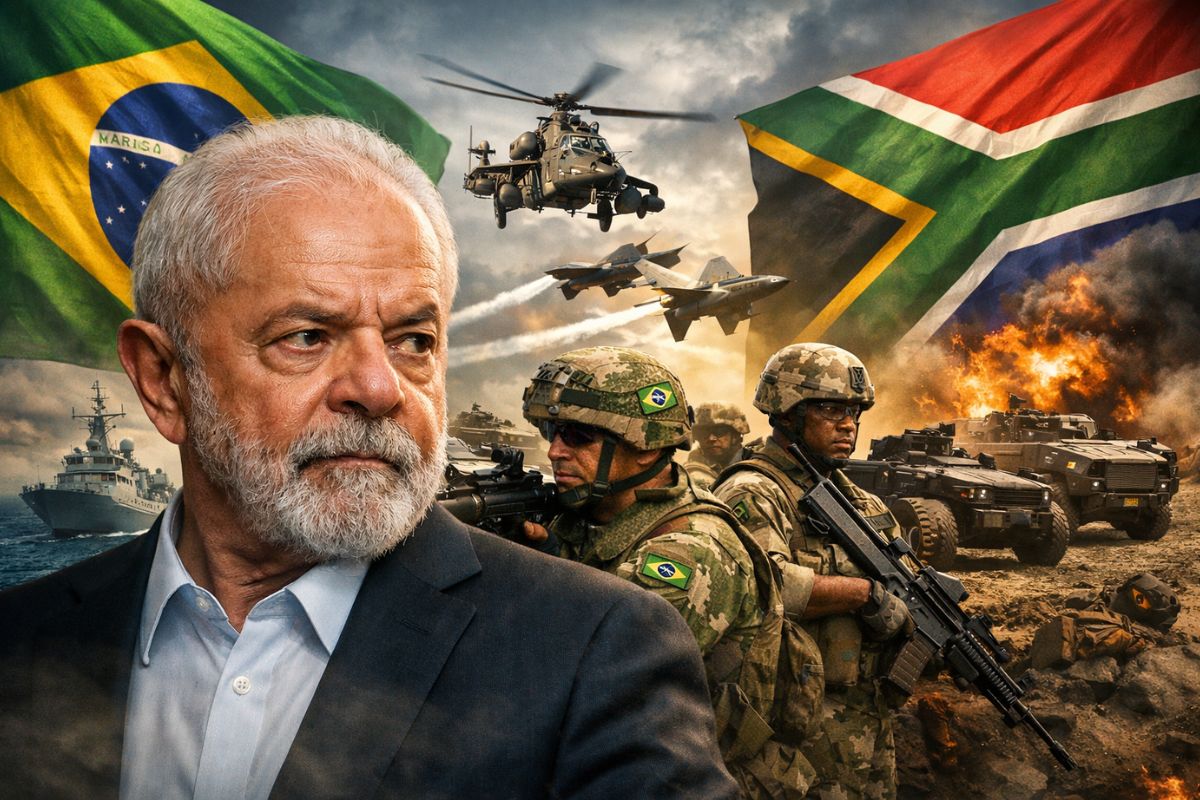
When Defending That Brazil Strengthen Its Defense Capacity and Produce More with Strategic Partners, Lula Used the Visit of Cyril Ramaphosa to the Planalto to Link Security, Industry, Commerce, and Diplomacy, at a Time When Regional Crises, External Tensions, and Global Disputes are Putting Sovereignty Back at the Center of the Debate.
Lula made the official visit of South African President Cyril Ramaphosa to the Palácio do Planalto in Brasília a stage for a message that blended strategic concern, defense of sovereignty, and international coordination. By saying that, “if we do not prepare, someone will invade us”, on this Monday (March 9, 2026), the Brazilian president placed the defense issue at the center of an agenda that also involved commerce, industrial cooperation, and diplomacy.
The speech did not come in isolation. It appeared at a meeting that brought together two of the leading emerging economies of the Global South and that, in addition to protocolary gestures and the military ceremony, opened the space for a broader discussion about the role of Brazil and South Africa in an international scenario marked by conflicts, geopolitical pressure, and a struggle for productive autonomy.
Lula Uses Defense as Political and Strategic Message
The strongest point of the agenda was how Lula treated defense not as a war speech, but as a necessity for prevention. By affirming that Brazilian thinking about defense is of dissuasion, the president sought to make it clear that his argument is not based on military escalation, but rather on the idea that a vulnerable country loses the capacity to protect its territory, its interests, and its sovereignty. It was in this context that the warning about invasion arose, in a phrase that elevated the tone of the meeting and gave Ramaphosa’s visit a much greater political weight than that of a simple bilateral meeting.
-
Larger than entire cities in Brazil: BYD is building a 4.6 km² complex in Bahia with a capacity for 600,000 vehicles per year, but the discovery of 163 workers in conditions analogous to slavery has shaken the entire project.

-
With an investment of R$ 612 million, a capacity to process 1.2 million liters of milk per day, Piracanjuba inaugurates a mega cheese factory that increases national production, reduces dependence on imports, and repositions Brazil on the global dairy map.

-
Brazilian city gains industrial hub for 85 companies that is equivalent to 55 football fields.

-
Peugeot and Citroën factory in Argentina cuts production by half and opens a layoff program for more than 2,000 employees after Brazil drastically reduced purchases of Argentine vehicles.


The reasoning presented by Lula was direct: Brazil cannot depend solely on external goodwill or a stable international environment to ensure its security.
When he highlights that the country does not have a nuclear bomb, does not have an atomic bomb, and uses drones for agriculture and technology, what he does is build a contrast between the defensive profile Brazil claims and the need to be minimally prepared in light of a more unstable world. The central message was that peace, without the capacity for protection, can turn into fragility.
This positioning gains even more weight because it was presented in front of an African head of state with whom Brazil seeks to deepen strategic relations.
It was not a casual speech for the internal audience. It was a message with diplomatic dimensions, issued alongside a relevant partner, in the Palácio do Planalto, with ministers, an official delegation, and an environment full of institutional symbolism. Lula turned a state visit into geopolitical signaling.
By announcing that the defense ministers of both countries should meet later the same day to advance the topic, the president gave practical consequences to the speech. This indicates that cooperation in defense has ceased to be just a generic hypothesis and has taken a concrete place on the bilateral agenda.
What was at stake there was not just a protocol exchange of interests, but the attempt to build convergence around self-capacity, coordination, and shared production.
The Partnership with South Africa is Based on the Idea of Productive Autonomy
When Lula stated that Brazil and South Africa do not need to buy “from the lords of arms” and can produce, he shifted the conversation from the military area to the industrial terrain. The speech brings a vision of defense linked to national production and cooperation among countries that wish to reduce external dependency in sensitive sectors. It is not just about buying equipment, but about mastering technological, industrial, and strategic capacity.
At this point, the partnership with South Africa appears as more than a political gesture. Both countries are significant economies in their continents, have diplomatic tradition, act in multilateral forums, and are interested in expanding their decision-making space in an increasingly competitive international system. By advocating that the two combine their industrial potential, Lula signals that for him, defense is also a front for productive development and strengthening national industry.
The logic embedded in this proposal is clear. Countries that produce more internally and cooperate with each other in strategic areas tend to depend less on external suppliers, suffer less from restrictions imposed by third parties, and gain more autonomy to formulate long-term policies. In practice, defense ceases to be just an expense and comes to be treated as a pillar of economic and technological sovereignty.
This helps explain why the speech about invasion was accompanied by a discourse about production. Lula did not set one thing against the other. On the contrary: he directly associated national security and industrial capacity.
In this reading, the country can only protect itself consistently when it can also manufacture, develop, and cooperate in critical sectors. The meeting with Ramaphosa served precisely to give body to this vision.
The International Environment Helped to Harden Lula’s Speech
The defense of a more urgent reinforcement in this area happens at a moment when the Planalto sees the perception of regional risk growing. The capture of Nicolás Maduro by U.S. forces in January reignited the debate in Brasília about defense capacity and modernization of the Armed Forces. This backdrop helps to understand why Lula chose a stronger tone than usual when publicly addressing the topic.
Although the Brazilian president has insisted on the idea of dissuasion and not confrontation, the international context pressures governments to reassess their vulnerabilities. In other words, Lula’s speech is not limited to an abstract concept of sovereignty.
It responds to a scenario where abrupt changes, acts of force, and geopolitical realignments have begun to directly influence the regional debate. The warning, therefore, was political but also circumstantial.
On the South African side, Ramaphosa maintained a discourse focused on condemning war and advocating for a ceasefire, with an emphasis on protecting civilians and vital infrastructure. This position reinforces that both governments attempted to balance two messages at the same time: on one hand, the need to prepare their countries; on the other, the advocacy of peaceful solutions to international disputes.
This combination demonstrates that the approach in the strategic area does not negate the public diplomatic line of rejection to the escalation of conflicts.
This balance is important because it prevents cooperation in defense from being read merely as militarization of the bilateral relationship. What was seen at the Planalto was something more complex: an attempt to articulate defense, industry, diplomacy, and autonomy around a common vision of the Global South. Lula hardened the speech without abandoning the rhetoric of peace.
Ramaphosa’s Visit Was Much Beyond the Military Agenda
Despite Lula‘s speech about defense dominating attention, Cyril Ramaphosa’s official visit had a much broader scope. The central agenda of the meeting included the expansion of bilateral trade, a topic treated as a priority by both governments.
The shared assessment is that the economic relationship between Brazil and South Africa is still below the potential of two emerging economies with relevant political weight in their continents.
In 2025, the exchange between the two countries totaled US$ 2.3 billion, a figure deemed below what Brasília understands as the real capacity of this partnership. This is precisely why the agenda of the visit also included the Brazil-South Africa Business Forum, organized by ApexBrasil in partnership with the Ministry of Foreign Relations. The presence of the private sector gave the meeting a practical dimension, geared towards investments, trade, and the opening of new fronts of cooperation.
Two memorandums were signed during Ramaphosa’s stopover in Brasília. One of them dealt with cooperation in tourism, focusing on training and technical assistance. The other established an understanding between ApexBrasil and the South African Department of Trade, Industry, and Competition to stimulate sustainable trade and investments.
These agreements show that the rapprochement between the two countries is not limited to the political field, but seeks concrete developments in the economy.
The agenda also included multilateral and environmental topics. Lula requested South Africa’s support for participation in the Loss and Damage Fund, a climate mechanism created by the UN to compensate countries vulnerable to the effects of climate change.
By bringing this subject into the conversation, the Brazilian president further widened the scope of the visit, connecting defense, development, trade, and climate within the same diplomatic framework.
Lula Tries to Strengthen the Global South Axis Amid New Tensions
Another important aspect of the meeting was Lula‘s effort to value South Africa’s presence in international forums. While commenting on the G20, the president stated that the group is not the same without the African country. The statement came at a time of tension between Pretoria and Washington, after the South African exclusion from the next summit in Miami by Donald Trump’s decision.
In this context, Lula’s speech functioned as a political gesture of support and also as a defense of a less concentrated international architecture.
The rapprochement between the two leaders is expected to continue throughout 2026. Lula stated he will meet with Ramaphosa again on April 18 in Barcelona, at the fourth meeting for the defense of democracy, at the invitation of Spanish Prime Minister Pedro Sánchez.
Moreover, the two are also expected to see each other at the G7, BRICS, and G20, even if without defined dates for all these commitments. This indicates that the conversation in Brasília was only a step in a broader diplomatic alignment.
In this sense, Ramaphosa’s visit held both symbolic and strategic value at the same time. There was a military honor ceremony, the meeting at the Planalto ramp, public gestures, and the traditional protocol between heads of state.
But behind the formality, there was a clear political movement: to consolidate a bridge between Brazil and South Africa on issues ranging from the economy to defense, through climate, democracy, and rebalancing of international relations.
The result was a meeting where Brazilian presidential diplomacy sought to combine firmness and cooperation. Lula tried to show that Brazil wants peace, but does not want passivity; wants trade, but does not want dependency; wants partnership, but also wants self-capacity. This was the strongest synthesis left by the South African visit to the Planalto.
By placing defense at the center of a visit marked also by trade, climate, and diplomatic engagement, Lula sent a message that sovereignty, industry, and international cooperation can walk together.
The phrase about invasion gave dramatic weight to the moment, but the content of the meeting revealed something greater: the attempt to reposition Brazil and South Africa as strategic partners in a more tense and unpredictable global scenario.
It remains to be seen how far this discourse will turn into concrete measures, especially in industrial cooperation and defense. In your assessment, did Lula do well to harden the tone and demand more preparation from Brazil, or does this kind of speech amplify unnecessary tension?








Seja o primeiro a reagir!