





 Portuguese
  English
  Spanish
 4 min of reading
  0 comments


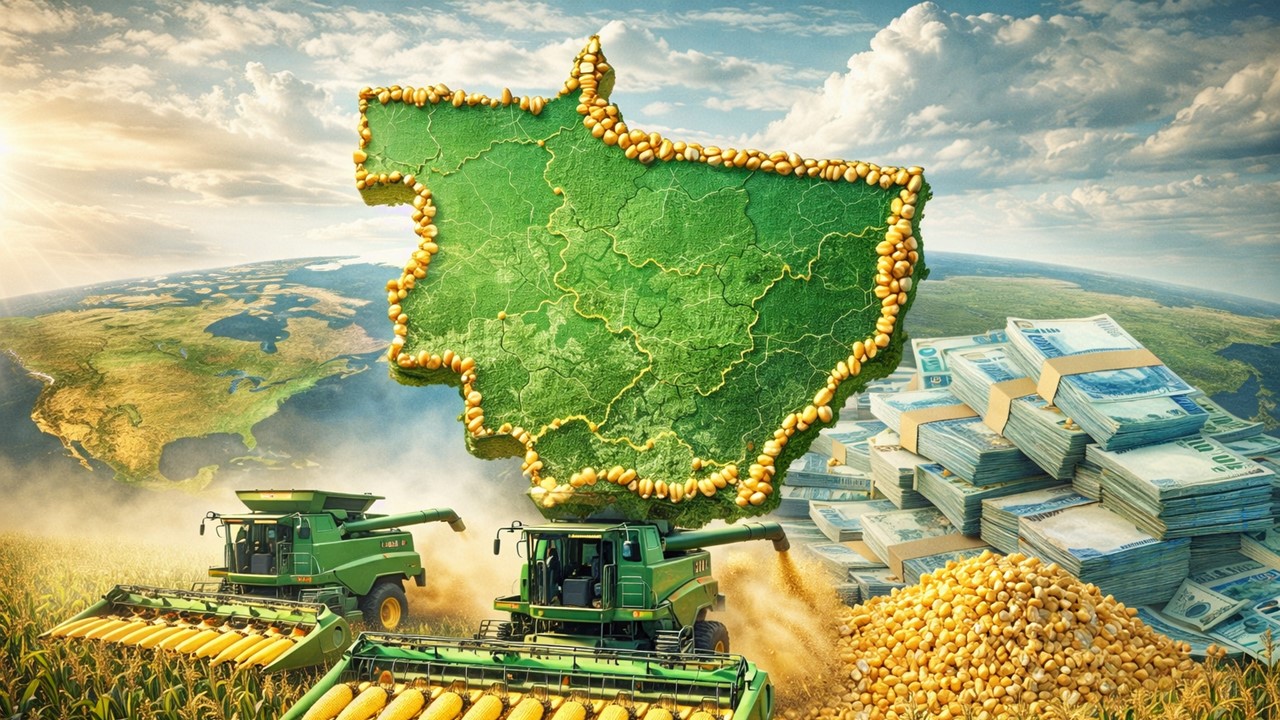
Record Production, Agricultural Efficiency, and Billions in Revenue Place the Brazilian State on a Par with the Great Global Powers of Corn.
If Mato Grosso were a country, it would hold an impressive position in the global agricultural landscape. Considered in isolation, the state would produce more corn than entire nations, trailing only the United States and China in the world ranking. This data helps to size the strength of the agribusiness in Mato Grosso and reveals why the state has become one of the pillars of food security and Brazilian exports.
The True Size of Corn Production in Mato Grosso
According to consolidated data from the National Supply Company and the Mato Grosso Institute of Agricultural Economics, Mato Grosso has been recording annual corn productions ranging from 45 to 55 million tons, considering the first and second harvests (safrinha).
For comparison, countries traditionally strong in corn production, such as Argentina and Ukraine, produce similar or even smaller volumes in normal years. This places the Brazilian state at a level rarely achieved by a single subnational unit in the world.
-
Unemployment rises again to 5.8% at the beginning of 2026, raising alarms about the end of temporary positions and its impact on the Brazilian job market.

-
Document organization can cut invisible costs in small businesses, a simple step that prevents waste, rework, and losses in daily operations.

-
While Russia dominates the global wheat market, Brazil emerges as an unexpected competitor in the Cerrado, offering grain available in July and August when stocks in the Northern Hemisphere are at their lowest point of the year.

-
China returned almost 20 Brazilian ships with soybeans, but now everything could change: the country that buys 80% of the grain is considering relaxing regulations after impurities held up shipments of thousands of tons and caused million-dollar losses.

Where Mato Grosso Would Rank Worldwide
Based on international numbers from the United States Department of Agriculture, the global corn producer ranking is typically led by:
- United States
- China
- Brazil
When looking only at countries, Brazil appears as the third largest producer. However, when isolating Mato Grosso, the scenario changes: the state alone would produce more corn than any other country outside the U.S. and China, surpassing established agricultural economies.
In practice, this means that Mato Grosso, by itself, would have enough production to rank among the three largest corn producers on the planet.

How Much Money This Production Generates
In addition to the physical volume, the economic impact is equally significant. Considering an average price of corn that varies between R$ 60 and R$ 75 per 60 kg sack, the annual gross revenue from corn in Mato Grosso can easily exceed R$ 70 billion, depending on the harvest and market conditions.
This amount places corn as one of the main sources of income for the state agribusiness, rivaling crops like soybeans and strengthening chains linked to export, animal feed production, and the protein industry.
In comparison, this revenue exceeds the annual GDP of many Brazilian municipalities and approaches the total economy of smaller countries.
Planted Area vs. Productive Efficiency
One of the most striking points is that Mato Grosso is not only large in area but also extremely efficient. The state plants corn on about 7 to 8 million hectares, most of which during the second harvest, right after soybean harvest.
When compared to the total agricultural area of some medium-sized countries, the area planted with corn in Mato Grosso is smaller, but productivity is high due to intensive use of technology, adapted seeds, advanced management, and integration with the soybean calendar.
This means that the state can produce massive volumes without needing areas equivalent to those of entire countries, reinforcing the idea of agricultural efficiency.

Why Mato Grosso Became a Global Corn Power
The state’s prominence did not happen by chance. Among the main factors are:
- Consolidation of the safrinha, which transformed corn into a strategic crop
- Technological advances in seeds and management
- Favorable climate for large-scale production
- Highly capitalized and professionalized producers
- Expansion of logistics, with increasing access to northern ports
This combination has allowed corn to transition from being merely a complementary crop to taking a central role in the state’s rural economy.
The Impact on Brazil and the Global Market
The performance of Mato Grosso has direct repercussions for Brazil. The state accounts for a significant portion of national corn exports, helping the country maintain its status as one of the main global suppliers of the grain.
In years of full harvest, Mato Grosso’s production helps stabilize domestic prices, supply the meat chain, and ensure Brazil’s competitiveness in the international market.
For importers, Mato Grosso is already seen as a relevant “origin,” almost as if it were an independent exporting country within Brazilian territory.
A State with the Weight of an Agricultural Country
When the numbers are laid out, the comparison stops being an exaggeration and becomes just a didactic way of explaining reality. Mato Grosso not only produces a lot of corn — it produces on a global scale, with efficiency and economic impact comparable to that of major agricultural nations.
In a world increasingly focused on food security, states with this productive capacity gain strategic relevance. And Mato Grosso, without a doubt, already occupies this space.









-

2 pessoas reagiram a isso.