





 Portuguese
  English
  Spanish
  4 min of reading
  0 comments


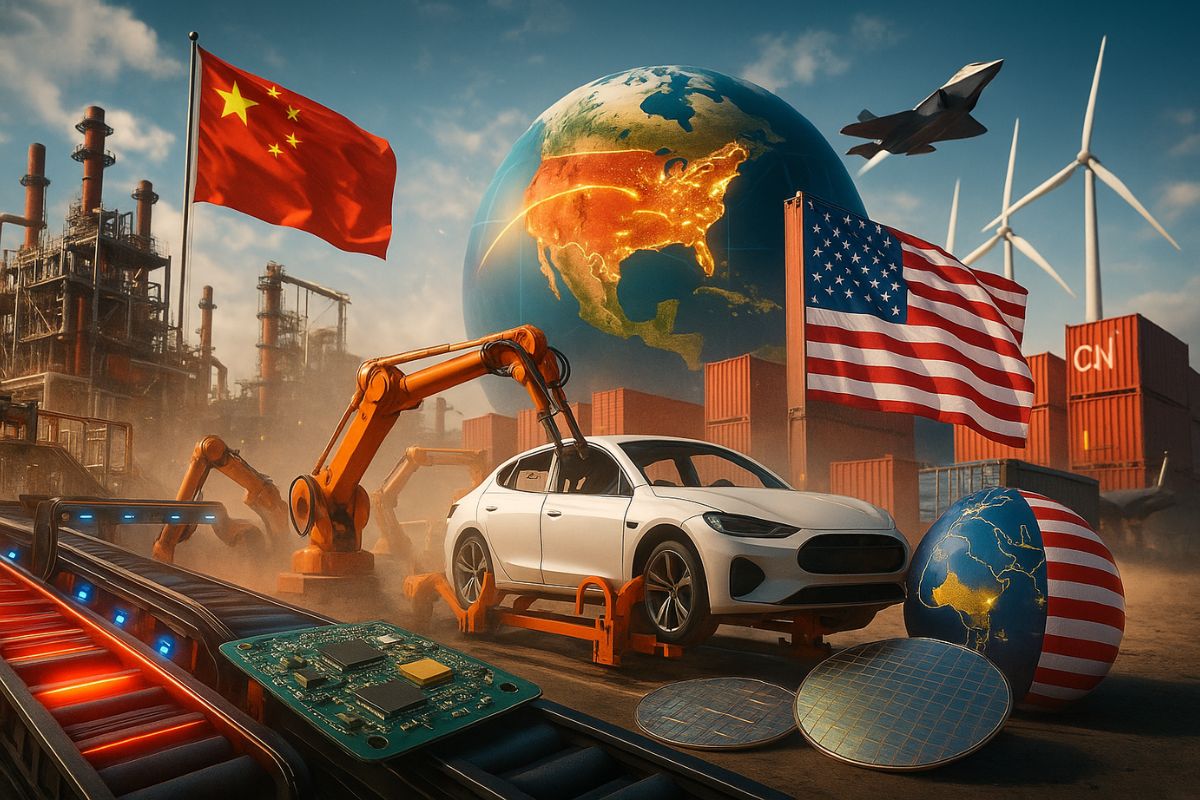
The Industrial Dispute That Exposes Chinese Dominance in Rare Earth Refining Redefines Costs, Deadlines, and Strategic Decisions in Sectors Like Electric Cars, Smartphones, Wind Turbines, and Defense, With Immediate Effects on Prices and Production Timelines.
The logic of the value chain has shifted. Mining is no longer the biggest obstacle, and the bottleneck has become transforming ore into oxides, alloys, magnets, and high-performance compounds. It is at this point that Chinese dominance becomes nearly irreplaceable, as it concentrates capacity, know-how, and the scale that connects the mine to the motor of an electric vehicle or the haptic vibrator of a smartphone.
According to G1, even with new mines outside Asia, most of the raw material still follows the same technical and financial path: it goes to China, is refined, and returns to the end customer. The Silent Advantage Has Become a Lever of Power, with gradual adjustments in exports sufficient to radiate delays and cost pressures across entire markets.
Why Refining Is the Bottleneck
Rare earth refining combines dozens or even hundreds of chemical steps, sensitive to the type of ore and cross-contamination.
-
The government requests the Federal Revenue Service for a new system to automate the income tax declaration, reducing errors, time, and bureaucracy for millions of Brazilians.

-
Pix in installments, international Pix, and contactless payment without internet: the Central Bank revealed the new features coming to the tool that is already used by almost every adult in Brazil.

-
Mercado Livre has just started selling medications with delivery in up to three hours to your door, and this move could completely change the way Brazilians buy medicines on a daily basis.

-
In Dubai, rising tensions from the war in the Middle East are causing super-rich individuals to leave the Gulf and direct their fortunes to a new financial refuge in Asia.


It is an energy, water, and environmental control-intensive process, operated with process engineering and operational discipline that have been accumulated over decades.
Without this link, ore remains ore, not a component.
The centralization of this step creates structural dependency. Companies that manage to source alternative ore still face hurdles in industrial conversion.
Without a refining contract, there is no delivery, and without delivery, the timelines of automakers, turbine manufacturers, and electronics suppliers become misaligned.
How Dominance Converts into Industrial Policy
In practice, Chinese dominance allows for modulating export volumes and compositions, influencing availability and timelines without explicitly breaking contracts.
Small pullbacks already trigger repricing at the most sensitive ends, such as high-performance permanent magnets used in traction motors and generators.
This power operates through costs and through timing.
Where some batches are lacking, there is replanning of shifts, prioritization of lines, and postponement of launches.
This is not a spectacular embargo, it is a disciplined drip, communicating the risk of dependency and pushing rivals to costly choices.
Replicating Capacity Outside China Is Costly and Slow
Refining projects in new hubs face three recurring barriers. First, increasing capex for complex chemical plants.
Second, lengthy environmental licensing, as the process generates waste requiring strict control.
Third, technological risk: the process recipe changes according to the ore’s geochemistry, and transferring know-how is not trivial.
Even public and private initiatives with financial backing face escalating costs and lengthy timelines.
The result is a vulnerability window where demand is growing faster than alternative refining capacity.
Most Exposed Sectors and the Cascading Effects
The electric traction automotive industry relies on rare earth magnets in high-efficiency motors.
Wind turbines use large amounts of these materials in low-maintenance generators.
Consumer electronics combine magnetic microcomponents and special alloys in massive volumes. Defense adds reliability requirements that increase replacement costs.
When refining tightens, it first stretches the lead time, then raises contract prices, and finally, restricts product mix.
Projects are rescheduled, and entire chains operate with higher safety stocks, tying up capital and making the system less efficient.
Chips, Materials, and the Hidden Interdependency
The race for semiconductors has exposed another layer. Materials, alloys, catalysts, and equipment in critical nodes of the chip ecosystem also orbit chains with refined inputs from China.
Even with design and lithography outside the country, part of the ingredients remains connected to the Chinese hub, which expands the radius of refining influence over the digital economy.
Restrictions on one side generate defensive substitutions on the other, but each change implies qualification, testing, and certifications, a slow and costly process for those needing to ensure yield and reliability.
Attempts to Diversify and Their Limits
Governments and companies are betting on public purchases, price guarantees, strategic reserves, and consortia to unlock projects.
It works to initiate the curve, but does not eliminate the issues of scale, waste, and process engineering. As long as the learning economy remains concentrated in China, the cost spread persists.
Diversification is possible, but it requires years of horizon and a portfolio of routes. Without real refining redundancy, the risk of bottlenecks returns with every demand cycle.
What to Monitor Going Forward
Three signs deserve attention. First, export dynamics and contract deadlines for compounds and magnets.
Second, evolution of refining projects outside China, with commissioning milestones and ramp-up.
Third, industrial policies that align environmental licensing, financing, and anchored purchases to accelerate scale without losing risk control.
In the meantime, Chinese dominance continues to set the pace.
Those who depend on magnets and special alloys need to plan stocks, contracts, and technological routes with conservative scenarios, accepting resilience costs as part of the price of operating in 2025.
The debate is not just about ore, but about the ability to turn raw materials into industrial performance.
As long as Chinese dominance in refining dictates price, timing, and availability, global supply chains will remain vulnerable.
The efficient response combines real refining diversification, smart contracts and product design with less critical dependence, without the illusion of an instant solution.
In your assessment, is the fastest way to reduce the risk of Chinese dominance to accelerate refining projects outside Asia or redesign products to use fewer critical magnets and alloys?









-

Uma pessoa reagiu a isso.