





 Portuguese
  English
  Spanish
  3 min of reading
  0 comments


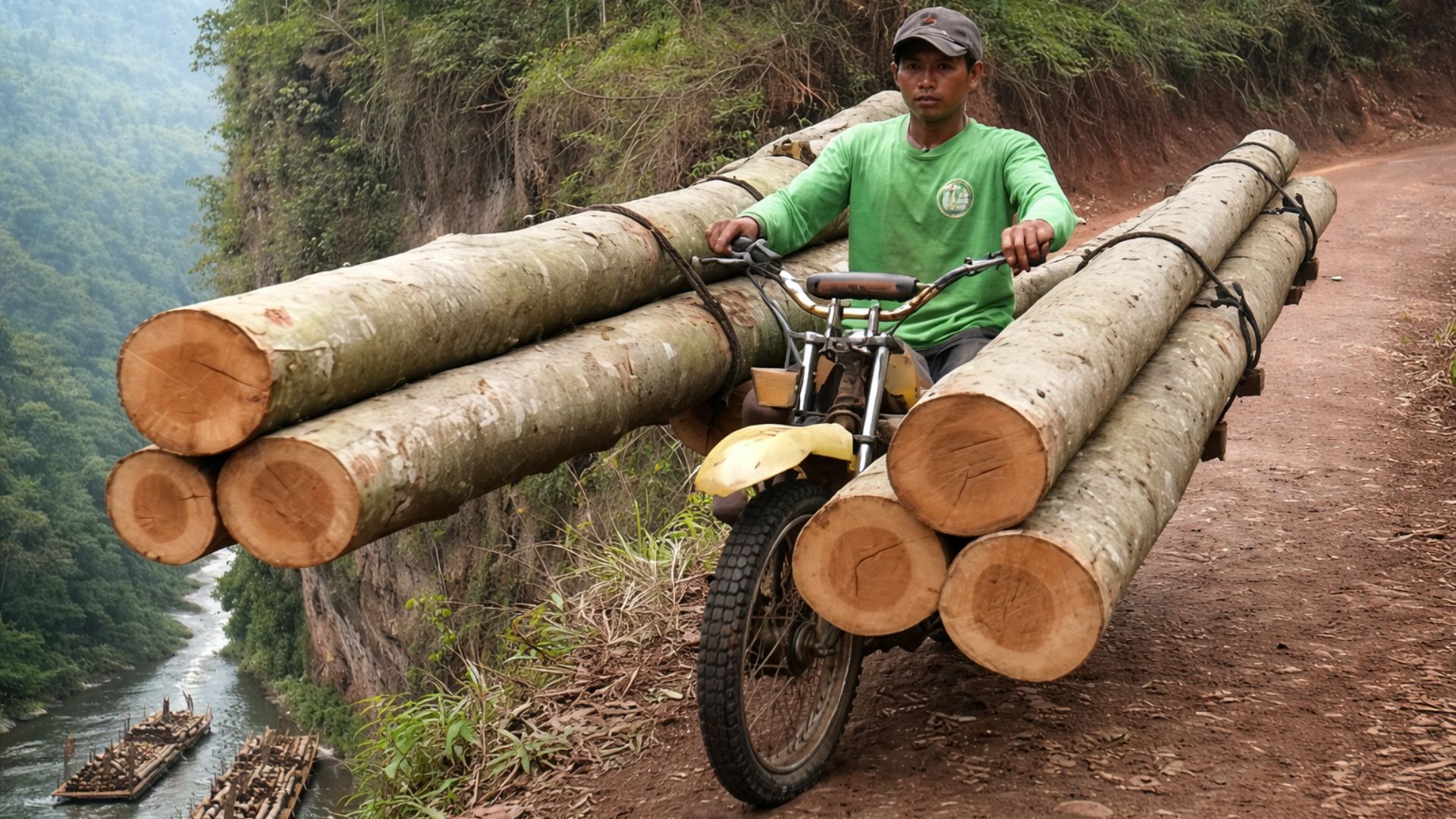
The Tekniq Episode Reveals How Simple Solutions, Built with Wood, Bamboo and Empirical Engineering, Keep Entire Logistical Chains Operating Where Modern Machines Do Not Reach
In rural and mountainous areas of Indonesia, logistics follow very different paths from those seen in industrialized countries. Without access to paved roads, heavy trucks or modern machines, entire communities depend on artisanal solutions to transport wood, agricultural products, and mainly, sugarcane. This scenario is explored in a recent episode of the Tekniq channel, which documents lesser-known production processes outside Southeast Asia.
Right from the start, the episode makes it clear that these solutions are not one-off improvisations. On the contrary, they are part of consolidated systems developed over decades to meet the geographical limitations of the Indonesian archipelago. Steep mountains, dense forests, and narrow rivers have shaped a logistics system based on reinforced artisanal motorcycles, bamboo rafts, and highly specialized human power.
The information was released by the Tekniq channel, which specializes in recording traditional engineering and logistics techniques, as part of an episode dedicated to the transportation of heavy loads in rural regions of Indonesia.
-
Friends have been building a small “town” for 30 years to grow old together, with compact houses, a common area, nature surrounding it, and a collective life project designed for friendship, coexistence, and simplicity.

-
This small town in Germany created its own currency 24 years ago, today it circulates millions per year, is accepted in over 300 stores, and the German government allowed all of this to happen under one condition.

-
Curitiba is shrinking and is expected to lose 97,000 residents by 2050, while inland cities in Paraná such as Sarandi, Araucária, and Toledo are experiencing accelerated growth that is changing the entire state’s map.

-
Tourists were poisoned on Everest in a million-dollar fraud scheme involving helicopters that diverted over $19 million and shocked international authorities.


Artisanal Motorcycles Transport Wood in Rural Areas of Indonesia

First of all, the episode follows Indonesian workers specialized in transporting logs using artisanal motorcycles. Unlike conventional motorcycles, these vehicles are adapted or built manually to withstand extremely heavy loads. Thick wooden structures, extended supports, and improvised reinforcements allow entire logs to be carried along narrow and uneven trails.
Moreover, the success of this transport depends less on the vehicle itself and more on the skill of the operator. The drivers control the load’s balance on steep terrain, adjust their speed on dangerous descents, and choose routes with millimeter precision. In many cases, a single motorcycle carries enough wood to supply small local sawmills.
At the same time, this model drastically reduces logistics costs. Without relying on large-scale fuel, industrial parts, or complex maintenance, artisanal motorcycles have become the primary alternative for transporting wood in areas where trucks simply cannot reach.
Bamboo Rafts Ensure River Transport in Interior Indonesia

Next, the episode of Tekniq shifts to the rivers of interior Indonesia, where bamboo rafts continue to be an essential element of regional logistics. Built with local bamboo, ropes, and traditional techniques, these vessels utilize the country’s extensive river network to transport wood and agricultural products.
Despite their simple appearance, the rafts follow clear principles of buoyancy and weight distribution. Bamboo, lightweight and water-resistant, ensures stability even when large volumes are carried. Additionally, the construction cost is low, and repairs can be quickly made at the river’s edge.
In this way, rivers function as true natural logistical routes. In regions where roads are non-existent or impassable during rainy periods, river transport maintains a continuous flow of goods between producing areas and commercial points.
Sugarcane Logistics Depend on Human Labor in Indonesia

Finally, the episode shows how sugarcane logistics in inland Indonesia rely almost entirely on human labor. Cutting, loading, and transporting sugarcane require precise coordination, especially because the product needs to reach processing points quickly to avoid losses.
In this context, artisanal motorcycles and bamboo rafts integrate into the system, connecting isolated plantations to mills and processing centers. Even without modern technology, efficiency is maintained thanks to practical knowledge accumulated by generations of rural workers.
Thus, the episode highlights that far from major urban centers, Indonesian logistics continues to function with simple, robust solutions that are perfectly adapted to the environment. An invisible system for many, but essential for maintaining local economies and active production chains.











-

-

-

-

-

-

39 pessoas reagiram a isso.