





 Portuguese
  English
  Spanish
  5 min of reading
  0 comments


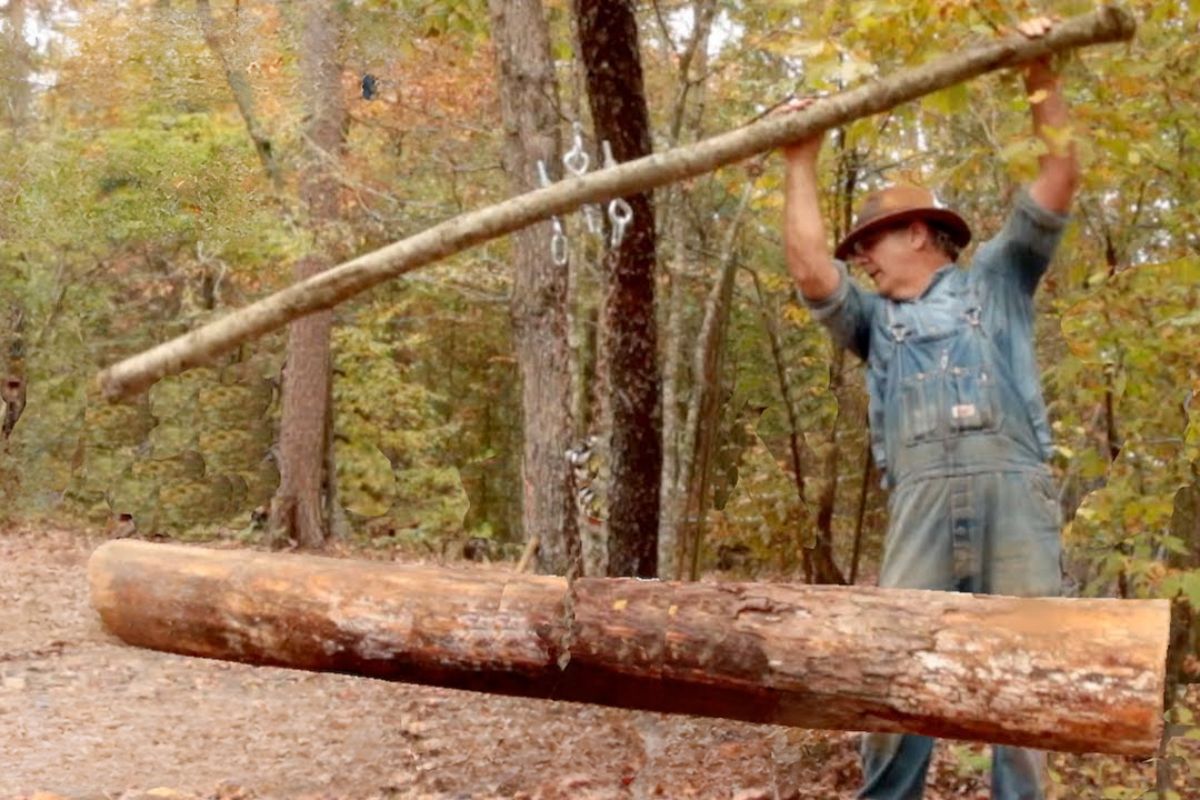
ON A RURAL PROPERTY IN THE COUNTRYSIDE, THE PRODUCER DEMONSTRATES THAT WOOD AND CHAINS, ORGANIZED ON A POST WITH THREE ANCHOR POINTS, PROVIDE SUFFICIENT MECHANICAL ADVANTAGE TO LIFT A 227-KILO LOG WITHOUT EXTERNAL ENERGY, USING MANUAL REPETITION, LOAD CONTROL, AND PATIENCE, FOCUSING ON EFFICIENCY AND SAFETY.
In the daily routine of a small property, lifting a log heavy normally depends on a tractor, electric winch, or at least, more people. In this case, the producer chose an opposite path: a manual arrangement that trades power for time and transforms human strength into small, yet constant, movements until the log is off the ground.
The proposal draws attention because the log weighs 227 kilograms, equivalent to 500 pounds, and still rises with short, repeated movements. The central point is not brute strength, it’s mechanical advantage, achieved by positioning the lever and alternating the traction chains in cycles.
The 227-Kilo Log and the Bottleneck of Manual Labor

The log is the type of load that stalls routine on a small property: it needs to be lifted for sawmill, aligned for cutting, moved for drying, or repositioned for branch removal.
-
A couple buys an old chalet, breaks the kitchen floor for renovation, and finds over a thousand coins of gold and silver hidden since the English Civil War over 4 centuries ago.
-
Rigid bags with their days numbered: new trend prioritizes comfort in 2026.

-
YouTuber creates an excavator equipped with a giant 4.5-meter sword to challenge his brother to a rematch, and the invention quickly goes viral on social media.

-
The U.S. Army surprises the world by presenting the UH-60MX Black Hawk helicopter capable of flying without pilots, controlled by a tablet, featuring the MATRIX system, smart sensors, and full autonomy in real combat and rescue missions.


When the log reaches 227 kilos, the common improvisation of pulling it by hand becomes a waste of energy and increases the chance of injury.
In this scenario, the decision of the producer was to treat the lifting as basic engineering.
Instead of seeking speed, he sought predictability, and the predictability came from the lever, the geometry of the system, and the use of short chains that “hold” the load at each stage, keeping the log under control.
How the Producer Assembled the Lever and Attached the Chains

The setup used by the producer starts with a long and sturdy wooden post, measuring between 1.5 to 2.4 meters, chosen not to flex easily.
In the center of the post, he drilled three aligned holes, spaced regularly, and installed reinforced eye bolts to create three attachment points.
The difference that defines the operation is the orientation of the central eye, inverted compared to the other two.
This inversion allows alternating the load between the chains: one chain is pulled tight while the other is repositioned, and the lever does the rest by converting the post’s movement into a gain of strength.
Without pulleys and without motors, the lever becomes the multiplier of the system, and the chains become the locking mechanism.
Mechanical Advantage: Why the Log Lifts in Short Cycles


What the producer explores is the logic of cycles. The lever descends on one side, which tensions one of the chains and raises the log a few centimeters.
Then, with the log already supported, the second chain is hooked to a lower point, ready to take on the traction in the next cycle, while the first is relieved and repositioned.
This alternation is the heart of mechanical advantage. The log does not rise all at once; it rises in steps, and each step reduces the demand for instantaneous strength.
The producer describes that the work becomes easier when the lever is longer because the lever arm increases, which amplifies the perceived mechanical advantage, even though the total operating time increases.
Anchor Points and Control: Where the Lever Really Works
To function, the system needs a high and firm point where the main chain is secured, creating the traction line.
In the observed case, the producer chose an anchor point above the load, sufficient to maintain the direction of effort stable during the cycles without shifting the log laterally.
From there, control depends on the fit of the chains and the rhythm. If one chain slips, the gain of mechanical advantage is lost and the log may fall back, which is why the producer treats each connection as a critical step.
The lever, by itself, holds nothing: what holds are the chains, which act as successive locks and prevent regression.
Limits, Risks, and What the Producer Does Not Romanticize
Even as a manual method, the producer does not describe the procedure as easy. The weight of the log remains 227 kilos, and the mechanical advantage does not eliminate risk; it reduces the effort needed at each moment.
There is a risk of crushing, risk of chains slipping, and risk of failure at the anchor point, which must support the load and the variations in traction.
That’s why the producer insists on three premises: checking the condition of the chains, choosing intact wood for the lever, and maintaining a clear zone around the log.
The practical result, when these conditions are met, is a controlled lift, without haste, in which the log rises to the desired height and can be positioned more safely.
What Changes Beyond the Log: Applications and Energy Savings in the Field
While the demonstration used a log, the producer points to parallel utilities.
The same principle of lever and chains can help tension wire in fences, lift stones or adjust heavy parts in maintenance, whenever the goal is to gain control without depending on a motor.
The immediate consequence, in the logic of the producer, is reducing dependence on expensive equipment when the problem is specific.
Still, he leaves a clear boundary: the mechanical advantage does not replace machines on a large scale; it fills operational gaps, especially when the producer is working alone and needs to move a log, or any similar load, with repetition, method, and control.
The case shows that the producer did not “invent” a new machine; he reactivated an old reasoning: transform a strength problem into a geometry problem.
The log of 227 kilos remains heavy, but the lever and the chains reorganize the effort into stages, and the mechanical advantage appears as a measurable result of this arrangement.
If you have ever needed to move a log, stretch a fence, or lift something heavy without a motor, what solution was more realistic in your daily life? Would you trust more in lever and chains or in modern equipment, and why, considering cost, time, and safety?







-

-

-

-

-

-

104 pessoas reagiram a isso.