





 Português
  Inglês
  Espanhol
  4 min de leitura
  0 comentários


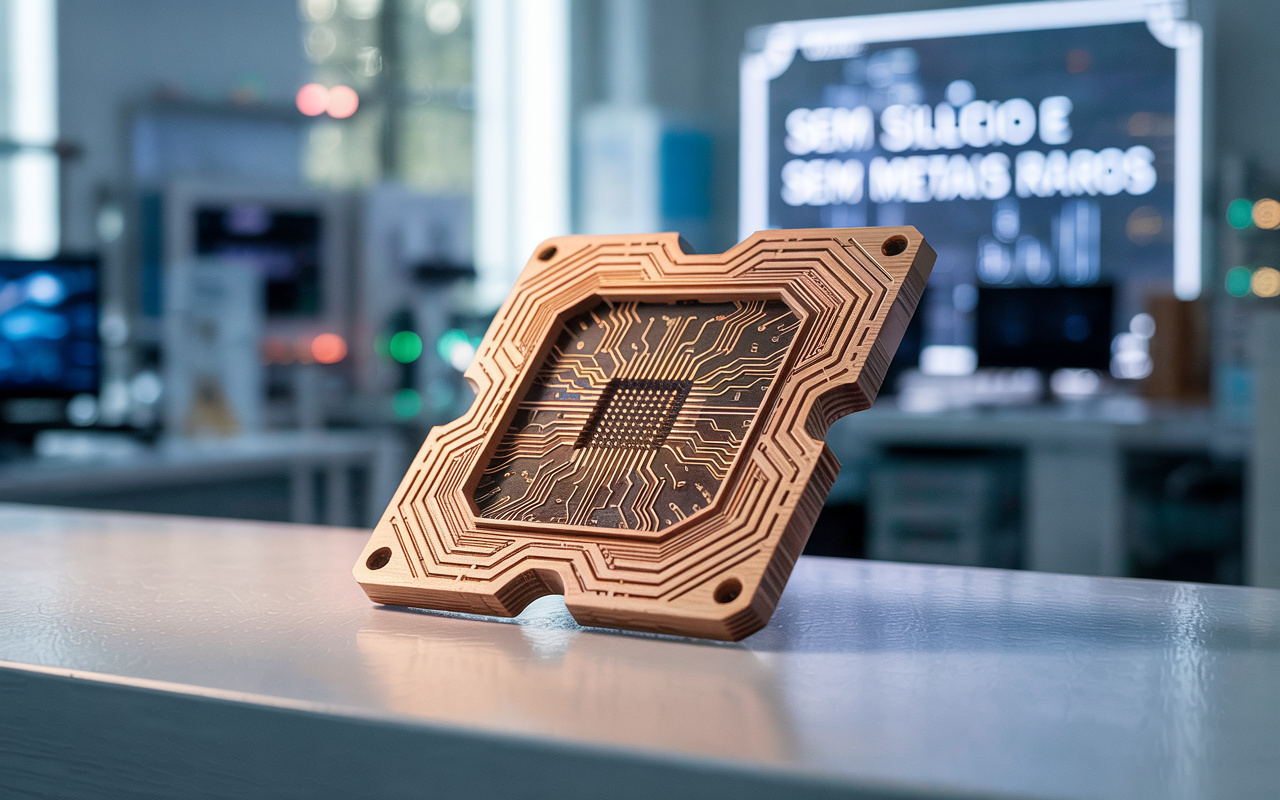
Researchers in Europe Develop Biodegradable Chips Made of Nanocellulose That Work Without Silicon and Rare Metals. Meanwhile, Brazil Is Drowning in Tons of Unrecycled Electronic Waste.
In the world of technology, silicon chips are the invisible brains that make almost everything work — from smartphones and laptops to coffee machines and watches. But the price of this digital revolution is high: billions of devices end up as electronic waste, and most are not recycled. The reason? They contain rare metals and non-biodegradable components that make disassembly expensive and complex.
Now, a discovery from universities in Germany and Sweden could change everything: biodegradable chips produced with nanocellulose — a wood derivative. Yes, “wood” chips that work, decompose naturally, and promise to drastically reduce the environmental impact of the electronics industry.
What Is Nanocellulose?
Nanocellulose is an extremely refined form of cellulose — the main component of plant cell walls.
-
A bright yellow mushroom imported from Asia escaped from a cultivation farm in the United States in 2010 and is now aggressively spreading across 25 states, destroying entire communities of native fungi in American forests.

-
Buried under China, a colossal machine weighing 20,000 tons began operating as the largest neutrino detector on the planet and, in just 59 days, surpassed results that science took half a century to achieve.

-
Iran enters the center of a climate alert after the war emitted 5.6 million tons of CO2 in two weeks, surpassing the annual pollution of entire countries.

-
Lunar exploration may change after a Chinese probe finds a “cavity” of radiation that reduces the impact on astronauts by up to 20% at certain times on the Moon.


When treated on the nano scale, it transforms into a lightweight, flexible, strong, and biodegradable material. It’s like turning wood into a smart polymer, capable of replacing plastics and even circuits.


Researchers from the Royal Institute of Technology in Sweden (KTH), in collaboration with the Hamburg University of Technology, have been developing functional chips based on nanocellulose, with printed circuits using carbon-based conductive inks.
These chips do not use silicon, copper, or rare metals like tantalum and neodymium, which are often aggressively extracted from the environment and come with a high geopolitical cost.
What Are These Biodegradable Chips For?
At the current stage of development, these chips are not ready to replace the microprocessors of an iPhone — but they are perfectly suited for an increasing range of simple and disposable devices, such as:
- RFID Tags for Logistical Tracking
- Temporary Smart Cards
- Single-Use Environmental Sensors
- Smart Packaging (Disposable IoT)
In other words: everything that requires a functional chip but does not need intensive processing — and that currently is discarded in large volumes without any recycling.
Electronic Waste Is Growing at an Alarming Rate — and Brazil Is Among the Worst
While researchers create the chips of the future, the present remains grim. According to the Global E-Waste Monitor, the world generated more than 62 million tons of electronic waste in 2022 — with less than 20% being properly recycled.
Brazil is the fifth-largest generator of e-waste in the world, producing over 2 million tons per year, but recycling less than 3% of that total. The rest ends up in landfills, rivers, or informal dumps, contaminating the soil with mercury, lead, cadmium, and toxic plastics.
Devices like remote controls, electronic toys, headphones, card readers, and even LED bulbs often contain small chips that are difficult to remove and recycle, contributing to the accumulation of invisible technological waste.
Why Do Nanocellulose Chips Make Sense?
The great advantage of nanocellulose is its biodegradability combined with basic electrical functionality. Unlike conventional chips that take hundreds of years to decompose, wood chips could be:
- Composted safely
- Incinerated without emitting toxic metals
- Used as Short-Lived Sensors in areas where recycling is impractical
Moreover, the production of these chips can be localized, using renewable raw materials such as cellulose from certified forests, something that Brazil — with its vast paper and cellulose industry — has in abundance.
And Performance? Is It Truly Functional?
Nanocellulose chips are in the prototype stage, but they can already perform tasks such as storing data, transmitting simple signals, and activating sensors. In 2023, a prototype developed at KTH was able to measure temperature variations and send the data via RFID, all on a paper substrate.
For basic functions like tracking, device activation, or quality control in logistics, this level of processing is already sufficient.
The Challenge of Scalability — and the Opportunity for Brazil
Like any new technology, the biggest obstacle now is scaling production and reducing the unit cost of biodegradable chips. But this is likely to change rapidly as large packaging, logistics, and apparel companies seek sustainable solutions for their labels and sensors.
If Brazil combines its forest potential, industrial cellulose base, and research centers, it could become a leader in the production of green chips for commercial application, especially in markets such as:
- Goods Tracking
- Agricultural and Food Logistics
- Rural Environmental Monitoring
- IoT for Smart Packaging
The Future: Chips That Work and Disappear
The idea of a chip that serves its function and then dissolves into the soil or compost bins sounds futuristic, but it is technically feasible. And it could be the answer to one of the most overlooked problems of the digital revolution: the invisible waste of disposable intelligence.
With the right investments and public policies that encourage eco-friendly product design, silicon-free and rare metal-free chips could come out of the labs and enter the market within less than a decade.
While the world’s eyes are on quantum processors and superchips of artificial intelligence, a more discreet revolution could change the foundation of modern technology: chips made from wood, biodegradable, affordable, and sustainable.
In an increasingly connected — and increasingly polluted — world, the answer may come from nature, reimagined on a nano scale. And perhaps Brazil, with its forestry industry and chronic electronic waste crisis, is the ideal place to transform this European experiment into commercial reality.







-

Uma pessoa reagiu a isso.