





 Portuguese
  English
  Spanish
  7 min of reading
  0 comments


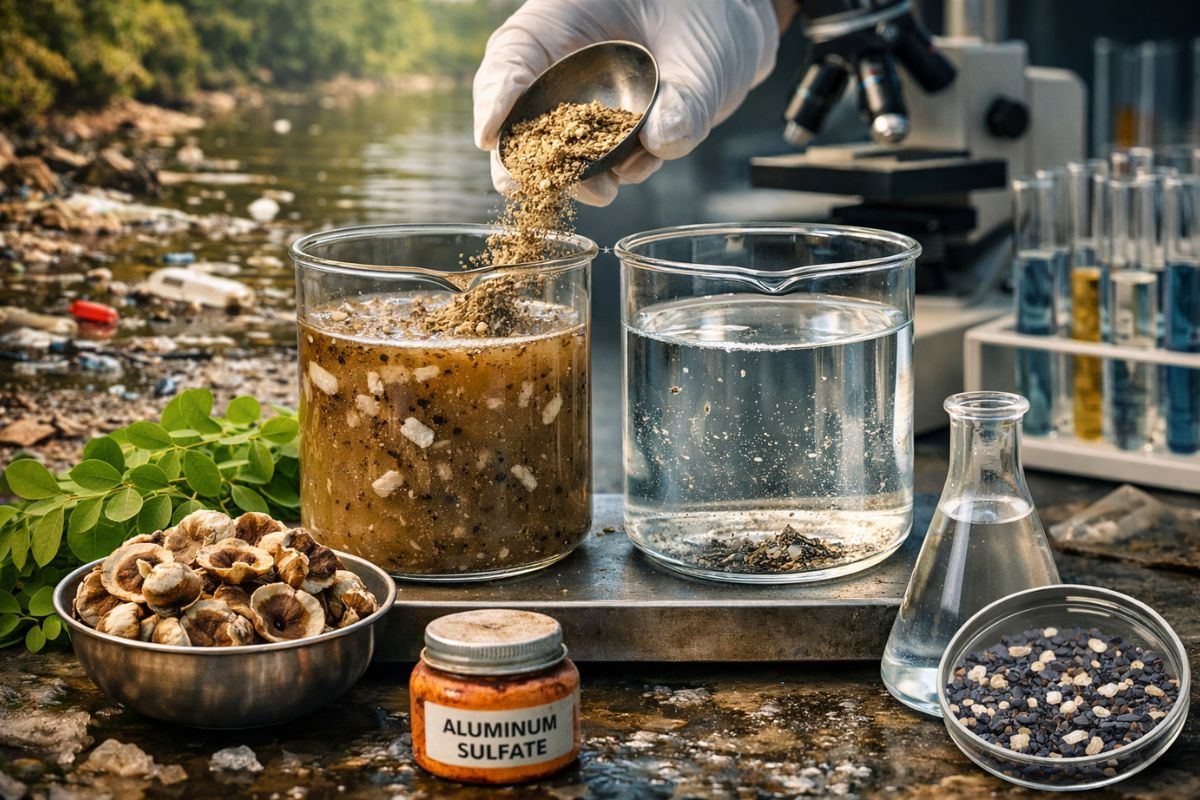
Research from ICT-Unesp in São José dos Campos Compared in Laboratory the Saline Extract of Moringa Seeds to Aluminum Sulfate in Coagulation and Inline Filtration. The Result Indicates Similar Efficiency in Removing Microplastics from Water and, at Higher pH, Even Better Performance, with a Technical Caveat.
The treatment of water may gain an unlikely ally: moringa seeds, also known as drumstick tree (Moringa oleifera). A study conducted at the Science and Technology Institute of Unesp in São José dos Campos indicates that the saline extract of these seeds achieves performance comparable to that of aluminum sulfate for removing microplastics from water in a direct inline filtration system.
The work, published in ACS Omega, was led by Gabrielle Batista, within the context of a master’s degree in Civil and Environmental Engineering at the Bauru School of Engineering (Unesp), under the coordination of Adriano Gonçalves dos Reis, who also conducts a project supported by FAPESP focused on filtration to reduce microplastics in water supply. The central message is simple and strong: it is possible to coagulate and filter microplastics with a coagulant of plant origin, but operational details matter.
What Was Observed in the Study and Why This Is Noteworthy

Moringa is native to India but adapts well to tropical countries and is already used for various purposes, including food, thanks to the consumption of leaves and seeds with nutritional value.
-
Man builds functional 5-meter submarine in his garage using gas cylinders, PVC pipes, and a refrigerator motor, and navigates with the vessel on a lake in Colombia.

-
Millions of people have been eating yam for centuries without knowing that this humble tuber contains a compound called diosgenin, which scientists have now discovered can improve memory and help control blood sugar levels.

-
Scientists from an international project drill 1,800 meters of ice in Antarctica using hot water and discover details about one of the most intriguing places on planet Earth.

-
Seen from space, a colossal volcano nearly 5,000 meters high in Russia has released 1,600 km of smoke over the Pacific, forming “devil’s horns” of lava and revealing the brutal force of the Ring of Fire.


In recent years, the seeds have come into focus for another reason: their ability to act as a coagulant, a crucial step in processes aimed at removing microplastics from water before filtration.
The most striking point, according to the results described, is that the saline extract of the seed showed performance similar to that of aluminum sulfate, a compound widely used in treatment plants for coagulation.
Furthermore, in more alkaline waters, the extract’s performance was even better than that of the chemical product. This does not mean “automatic substitution,” but rather that there is a promising alternative that deserves to be understood with technical rigor.
How Coagulation Helps Remove Microplastics from Water
To understand why a coagulant makes a difference, it is worth looking at the physical-chemical behavior of these particles. Microplastics tend to have a negative electric charge on their surface. This characteristic causes them to “repel” each other and also hinders their approach to filtering media such as sand, which is the basis of many filters. Without the coagulation step, part of this material remains dispersed and escapes more easily.
Coagulation specifically aims to break this stability: coagulants, such as aluminum sulfate and the saline extract of moringa, neutralize the charge, favoring the joining of particles into agglomerates (flocs). Once these flocs are formed, it becomes more feasible to remove microplastics from water by directing it to a sand filter, which retains the aggregated material.
In other words, coagulation does not “make” microplastic disappear; it changes the way it behaves so that filtration can capture it.
The Tested System: Inline Filtration and Application in Clearer Water
The focus of the study was treatment by inline filtration, in which water undergoes coagulation and goes directly to filtration, without necessarily passing through all the stages of a longer conventional cycle. This type of arrangement is indicated for low turbidity, clearer waters that do not require extensive processing before passing through the filter.
This choice is important because, in real scenarios, there are different water “profiles” and different infrastructure limitations. In some places, especially at smaller scales, solutions with lower operational complexity can be appealing.
Still, removing microplastics from water consistently requires control of variables such as pH, presence of organic matter, and quality of the filtering medium, because each of these conditions alters coagulation and retention in the filter.
Experiments: PVC as Source, UV Aging, and Direct Comparison with Aluminum
To test the effectiveness, researchers used tap water and experimentally contaminated it with polyvinyl chloride (PVC).
The choice of PVC was justified by two points raised: the presence of this material in aquatic environments and in water treated by traditional processes, along with the documented mutagenic and carcinogenic potential of PVC, which raises concerns about exposure.
Before the tests, PVC underwent artificial aging with ultraviolet irradiation, a procedure described as a way to mimic natural processes and reproduce properties of aged microplastics in the environment.
Then, the contaminated water underwent coagulation and filtration in the Jar Test, a device that simulates small-scale treatment stages. The results were compared to those obtained under the same conditions with aluminum sulfate.
This experimental design is important because it places both coagulants side by side, under the same “testing ground,” to evaluate their ability to remove microplastics from water without relying on subjective impressions.
How Removal Was Measured and What the Flocs Indicated
The counting of particles before and after treatment was performed using scanning electron microscopy (SEM), a technique used to observe and quantify very small structures. Additionally, the size of the flocs formed in each approach was measured with a high-speed camera and a laser beam.
In these measurements, no significant differences were observed in the size of the flocs between the treatments, while the removal of particles remained at a similar level between the saline extract of moringa and aluminum sulfate.
Within the scope presented, the reading is that the plant extract can perform the expected coagulation function and support filtration.
And the data that generates the most technical discussion is the behavior in alkaline conditions, when the extract proved to be even more competitive in removing microplastics from water.
The Main Limitation Found and Why It Affects Cost
The study also describes a disadvantage: the use of the moringa extract increased organic matter dissolved in the water. Practically speaking, this may require additional steps to remove this excess, which tends to raise the process cost when considering larger and more standardized systems.
At the same time, the authors point out a scenario in which the balance may be different: small scales, such as rural properties and small communities.
In these contexts, the availability of the raw material, the relative simplicity of preparing the coagulant, and the observed efficiency may favor the method, provided that the need to treat organic matter and monitor basic parameters is recognized.
The promise here is not “miracle,” but viability conditioned to scale and process control.
Why Seeking Alternatives to Aluminum Has Become a Regulatory and Health Issue
Another element that appears as a motivator is the increasing regulatory scrutiny and concern with aluminum-based and iron-based coagulants, described as non-biodegradable and associated with residual toxicity and disease risk.
This helps explain why sustainable alternatives have been gaining ground in research: to reduce persistent waste and seek solutions that leave a smaller chemical “footprint” without compromising performance.
It is at this point that moringa fits as a discussed alternative. If the goal is to remove microplastics from water without exacerbating other problems, the coagulant needs to be evaluated by the complete package: efficiency, byproducts, cost, stability, and suitability for the type of treated water.
The group itself had previously explored the seed in a complete treatment cycle, including flocculation, sedimentation, and filtration, reinforcing that the investigation has been built step by step.
Next Steps: Tests with River Water and Questions That Still Need Answers
After the trials in contaminated tap water, the group began testing the moringa extract in water collected directly from the Paraíba do Sul River, a water source that supplies São José dos Campos.
In the experiments conducted so far, the product has shown efficiency in treating natural water, but this type of step tends to be decisive because it introduces real variables, such as particle mixing, organic matter from different sources, and quality fluctuations over time.
From here on out, the most valuable answers are likely to be in the details: how performance holds up under different pH conditions, which strategies minimize the increase of dissolved organic matter, how to adjust dosage and mixing time to remove microplastics from water consistently, and what kind of monitoring is necessary to turn a laboratory result into a safe routine.
This is where the “how to make it work consistently,” and not just “work once,” truly proves the technology.
What this study brings to the table is a concrete path to discuss innovation in treatment: a plant-based coagulant tested under controlled conditions, with performance comparable to a traditional input and with an advantage in more alkaline water, but also with a clear limitation related to dissolved organic matter.
The combination of coagulation and inline filtration appears as a technically coherent route to remove microplastics from water, provided the choice of method considers the type of water and the scale of operation.
Now I want to hear experiences and practical opinions: in your city or community, do you trust the quality of treated water today?
Have you seen low-cost initiatives to improve treatment in rural areas or small towns, or do you think that “alternative” solutions still face significant barriers to become standard?







-

-

-

4 pessoas reagiram a isso.