





 Portuguese
  English
  Spanish
  5 min of reading
  2 comments


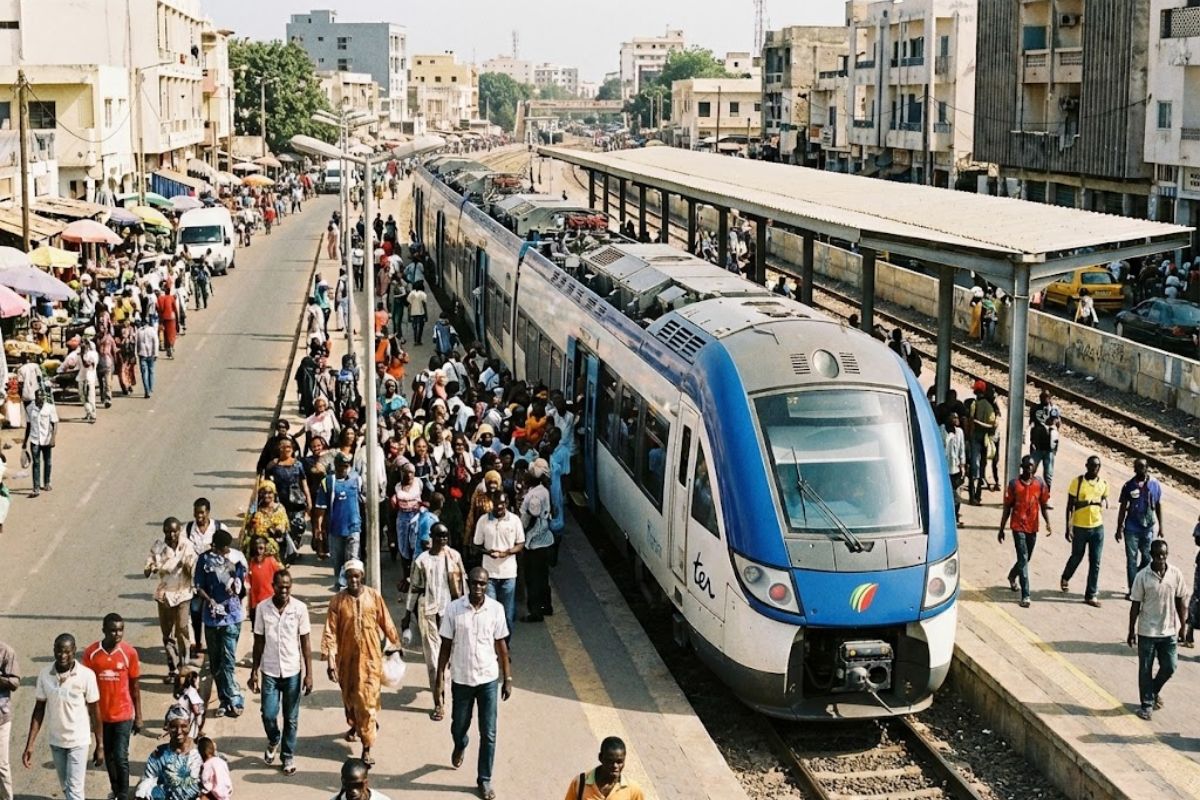


In The Corridor Between Dakar And Diamniadio, The Regional Express Train Went From Promise To Routine: Reduced Travel Times From Over Two Hours To 40 Minutes, Carried About 80 Thousand Passengers Per Day, Surpassed 55 Million Embarkations, And Exposed New Challenges Of Management, Security, And Urban Waste Around.
The train express regional from Senegal has become more than just an infrastructure project; it has become part of the capital’s routine. On the axis between Dakar and Diamniadio, the journey that once took over two hours in traffic jams now lasts about 40 minutes, changing the daily rhythm of those who rely on quick travel for work, study, and access to services.
The transformation is not limited to travel time. With approximately 80 thousand passengers per day and over 55 million total embarkations, the system has changed the pattern of urban mobility, reduced pressure on the roads, and consolidated a new logic of collective transportation. At the same time, the large-scale operation has brought problems that require continuous management, especially in the areas surrounding the tracks.
From Congested Route To High Demand Corridor

Before the TER began operations, the route between Dakar and Diamniadio was marked by chronic time loss. The 36 km corridor concentrated intense traffic from cars, minivans, and buses, with daily unpredictability impacting the productivity of those crossing the area.
-
Motorola launched the Signature with a gold seal from DxOMark, tying with the iPhone 17 Pro in camera performance, Snapdragon 8 Gen 5 that surpassed 3 million in benchmarks, and a zoom that impresses even at night.

-
Satellites reveal beneath the Sahara a giant river buried for thousands of kilometers: study shows that the largest hot desert on the planet was once traversed by a river system comparable to the largest on Earth.

-
Scientists have captured something never seen in space: newly born stars are creating gigantic rings of light a thousand times larger than the distance between the Earth and the Sun, and this changes everything we knew about stellar birth.

-
Geologists find traces of a continent that disappeared 155 million years ago after separating from Australia and reveal that it did not sink, but broke into fragments scattered across Southeast Asia.

For many frequent passengers, the commute was an invisible cost: hours spent in traffic, accumulated delays, and physical exhaustion by the end of the day.
With the train operating since 2021, mobility on this axis gained predictability. The most visible change is in time: moving from over two hours to 40 minutes repositions urban routines.
The change is concrete because it affects the daily lives of thousands of people at once, in an area that combines administrative, scientific, and economic functions critical for metropolitan growth.
Who Started Using The Train And Why The Migration Accelerated

The increase in demand helps explain the scale of the change. In its first year, the system operated with about 17 thousand passengers per day; then it progressed to nearly five times that volume, reaching approximately 80 thousand daily users.
This leap does not happen by chance: it indicates sustained adoption, repeated use, and trust in the service for frequent travel.

The migration to the train occurred due to a combination of objective factors: speed, less exposure to traffic, thermal comfort, and a better travel experience compared to overcrowded road transport options.
In daily use, the passenger doesn’t just decide based on fare price, but on the complete package: total time from door to door, arrival predictability, and reduced stress during the journey.
Environmental Impact: Reduced Cars, Less CO2, And Practical Limits
The project started with a relevant environmental goal: to help reduce CO2 emissions by around 30% in the country by 2030 as planned for the system.
In a context where Senegal emits about 12 million tons of greenhouse gases annually and where road transport accounts for almost the entire sector’s share, shifting travel from the pavement to the tracks is strategically significant.
Based on operational calculations associated with the transported volume, over 55 million passengers have already represented a savings of over 150 thousand tons of CO2, considering the substitution of trips that could have occurred by car or bus.
The result is significant, but it does not eliminate the climate challenge on its own. Reducing emissions depends on sustained demand, organized network expansion, and efficient integration with the rest of the urban system.
Fare, Comfort, And Quality Of Service In Daily Life
Fares, ranging from about 0.80 euros to approximately 4 euros, place the train in an access range that meets different commuting profiles, according to class and destination.
This fare range, combined with time savings, changes the practical equation for users: even when the travel cost is not the lowest possible, the return comes in recovered hours and less uncertainty during the commute.
There is also a quality component that weighs in the decision. Passenger reports indicate a perception of a more organized environment, less overcrowding compared to traditional road transport, and a feeling of a more stable journey.
When commuting stops being a daily battle, public transport starts to compete not only on price but also on experience and reliability.
The Less Visible Side Of Success: Tracks Under Pressure

The large-scale operation has heightened the demands on urban management and security. In areas surrounding the railway, illegal waste disposal within the railway right-of-way has become a critical issue. This problem affects maintenance, cleaning, operational risk, and compromises public perception of the system’s quality outside of the platforms.

To address this, the operator has established waste sorting actions in stations, maintenance areas, and trains, with separate collectors for recyclables and non-recyclables.
Awareness campaigns and cleanup events have also been conducted, focusing on operational safety and sanitation of the surrounding areas.
The central point is that high-performance infrastructure depends on urban behavior compatible with that standard.
What The Expansion To The Airport Represents In Practice
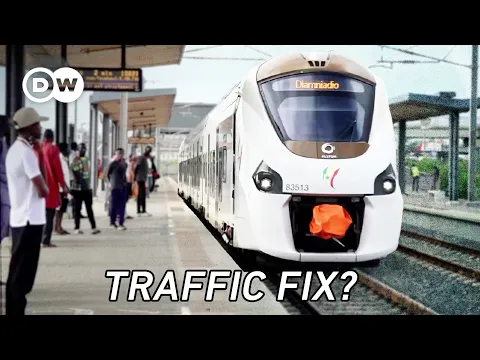

In the published plan, the extension of the line to the international airport appears as a decisive step to expand metropolitan reach.
This connection is likely to strengthen the role of the train as the backbone of medium-distance travel, reducing dependence on road transport for journeys that typically put pressure on strategic roads.
More than just expanding the network, the expansion redefines urban centralities. When a railway system connects work, services, and regional mobility hubs, it alters residential choices, circulation patterns, and local economic dynamics. It’s not just about moving passengers from one point to another, but about redesigning how the city functions over time.
The case of Dakar shows that a train can produce rapid and measurable effects: a drastic reduction in travel time, massive passenger adoption, reduced road traffic, and environmental gains based on the substitution of trips.
At the same time, it highlights that operational success creates new fronts of work, especially in security and waste management in the railway vicinity.
Now I want to hear from you directly: in your city, which change would make the most difference in your daily life: cutting travel time in half, having a more predictable fare, or reducing overcrowding in transportation? And, thinking about your real routine, would you switch your car for the train if you could save 1 hour a day?








Digo: cadê o VLT/BRT do corredor Norte Sul de SP pra destravar o trânsito e agilizar o transporte público para os trabalhadores de São Paulo???
Acorda Brasil… cadê o VLT no corredor Norte Sul de SP pra destravar o trânsito e agilizar o transporte público???