





 Portuguese
  English
  Spanish
  5 min of reading
  0 comments


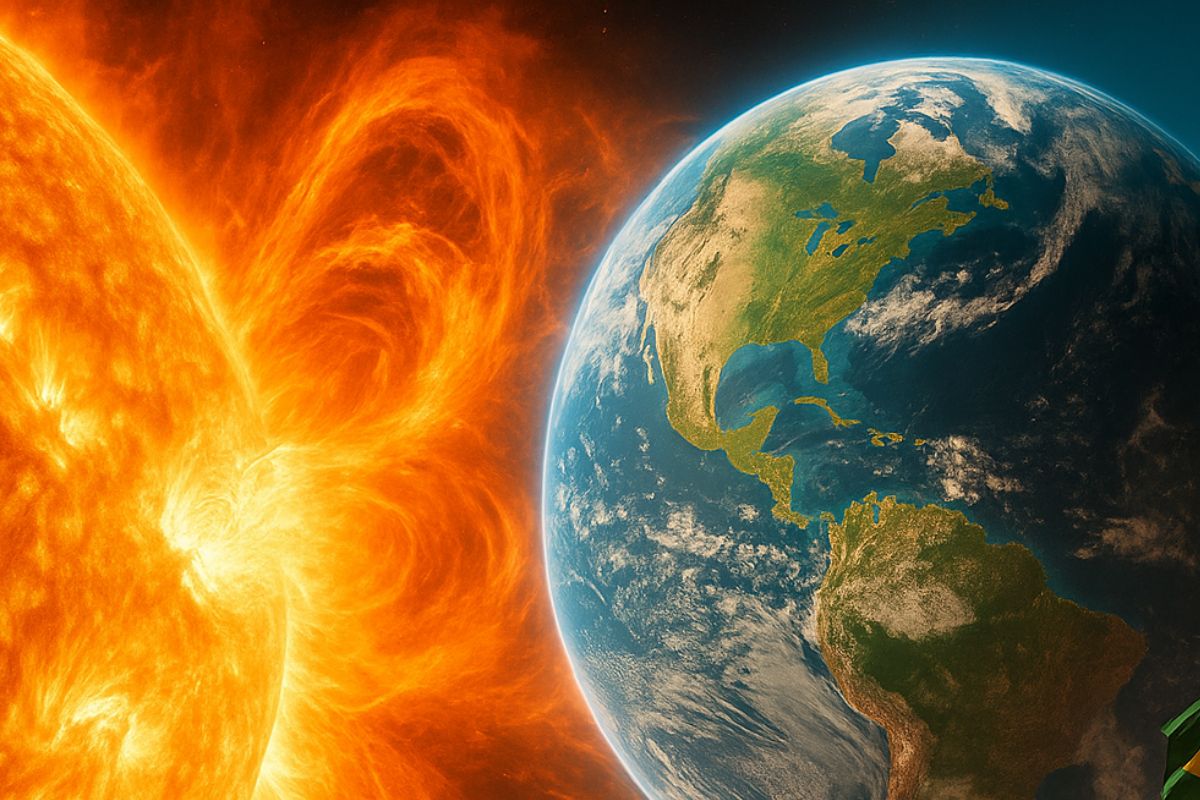
Sun Releases Unprecedented Sequence of X and M-Class Explosions, Causes Radio Blackouts on Air and Maritime Routes and Increases the Risk of Geomagnetic Storms on Earth.
An atypical sequence of activity from the Sun was recorded between Saturday and Monday morning, with at least two X-class eruptions, several M-class eruptions, and a series of smaller C-class events mainly from the active region AR4274. The strongest explosions, with magnitudes of X1.8 and X1.2, occurred within less than 24 hours and were directed towards Earth, a condition that increases the potential for impacts on communications, satellites, and sensitive networks.
The first effects have already been felt. The X1.8 class explosion registered around 4 AM Brasília time caused a strong level radio blackout for over an hour in the illuminated hemisphere. The second explosion, an X1.2 at 5:55 AM on Monday, also caused disturbance in the high-frequency band, especially over southern Africa, and was accompanied by a coronal mass ejection that is still being analyzed for its direct impact on the Earth’s magnetosphere. The overall picture indicates sustained solar activity above normal levels.
High-Energy Explosions in Less Than 48 Hours
The main area of interest for observers is the AR4274 region, which is positioned near the center of the solar disk facing Earth and shows a complex magnetic configuration of the beta-gamma-delta type, typical of areas more prone to intense explosions.
-
A “silent skill” is allowing Brazilians to earn up to R$ 22,000 per month without a degree and become indispensable for companies that rely on millions of data to survive.

-
Researchers at the Toyota Research Institute found that if a human uses robotic arms to flip a pancake 300 times in an afternoon, the robot learns to do it on its own the next morning, and this is currently the most promising method to solve the biggest bottleneck in modern robotics.

-
Goodbye iron: a common item in households is starting to lose space to technology that smooths clothes in minutes without an ironing board and with less energy consumption.

-
Antarctica reveals an unusual clue high in the Hudson Mountains, and what appeared to be just an isolated rock began to expose a secret hidden under the ice for ages.


It was from here that the X1.8 eruption occurred on Sunday and, a little over 24 hours later, the X1.2 eruption on Monday morning.
In addition to these main events, the same sector of the Sun produced several C-class eruptions over the weekend, which are weaker but serve as an indicator that the local magnetic field was in a state of strong instability.
In total, since Saturday, 15 eruptions of varying intensities have been recorded, characterizing a window of activity above average that is likely to keep monitoring centers on alert.
Radio Blackouts and Operational Impacts
The two X-class explosions produced strong category radio blackouts (R3), affecting high-frequency communications used by aviation and navigation. In the first episode, air routes over the Pacific and maritime operations in the Indian Ocean experienced degraded communication for over an hour.
In the second instance, the effect was shorter, around 30 minutes, but concentrated over southern Africa.
This type of disturbance occurs because the radiation from solar eruptions suddenly ionizes the upper layers of the Earth’s atmosphere. When this happens, radio signals that rely on reflection in these layers to reach long distances experience blockages, noise, or complete loss.
In scenarios of intense traffic, such as intercontinental routes, this momentary loss of HF requires alternative communication routes and contingency protocols already foreseen by operators. In a sequence of events like the one observed, the operational risk increases, even if temporarily.
Coronal Mass Ejections and Geomagnetic Risk
The two major eruptions were accompanied by coronal mass ejections (CMEs) observed as halos, meaning that the material was launched approximately in the direction of Earth.
A CME is formed by plasma and solar magnetic field that detach from the corona and travel through space. When they reach the planet and encounter the already unstable Earth’s magnetic field, they can trigger geomagnetic storms of varying intensity.
The geomagnetic field was already showing signs of instability after the first events. This means that, if the material ejected in the eruptions on Sunday and Monday arrives well oriented magnetically, there is potential for more intense auroras at high latitudes, small fluctuations in high-voltage power grids, and further degradation of satellite signals.
A complete assessment depends on the speed and exact direction of the CME, but the current context favors a posture of continuous monitoring.
Five Active Solar Regions Under Monitoring
AR4274 is not alone. The face of the Sun facing Earth currently has five numbered active regions.
AR4276, with a beta-gamma configuration, recorded an M6.3 class eruption, an intermediate strength capable of causing minor disturbances. AR4277 produced three C-class events, showing moderate activity. There was also an M4.0 class eruption associated with a not fully identified area.
This scenario, with multiple active regions at the same time, increases the probability that new eruptions will occur in the coming hours or days.
Even if they are isolated events of lower intensity, the accumulation of multiple disturbances can keep the ionosphere and magnetosphere in a state of stress. For sensitive systems on Earth, the constancy of activity is sometimes more problematic than a single extreme event.
Solar Cycle 25 and the Moment of Greatest Instability
The current behavior of the Sun is aligned with the progression of Solar Cycle 25, a phase of approximately 11 years in which the star transitions from a minimum of spots and eruptions to a maximum of activity.
As the cycle approaches its peak, the number of visible sunspots increases and the magnetic field lines on the surface become more twisted. This magnetic tangle is the fuel for eruptions.
The classes used to measure eruptions follow a scale from A to X, with each letter being ten times more intense than the previous one. Within the same class, the number indicates the weight of the event. Thus, an eruption X2 is twice as strong as an X1.
The X1.8 and X1.2 eruptions recorded now fall within the lower range of class X, but due to being directed towards Earth and occurring in sequence, they gain operational and scientific importance.
The sequence of 15 eruptions in a short time, including two in class X and several associated with M and C, shows that the Sun has entered a high activity window with direct potential impact on Earth. High-frequency communications have already been affected, coronal mass ejections have been launched in our direction, and the Earth’s magnetic field has responded with signs of instability.
This is the type of situation that requires heightened attention from sectors that depend on global communication and space monitoring.
In light of this intense solar activity, do you think that society and companies that depend on communication should closely follow reports about the Sun, or do we still treat this topic as something distant from our routine? Comment.







-

2 pessoas reagiram a isso.