





 Portuguese
  English
  Spanish
  4 min of reading
  0 comments


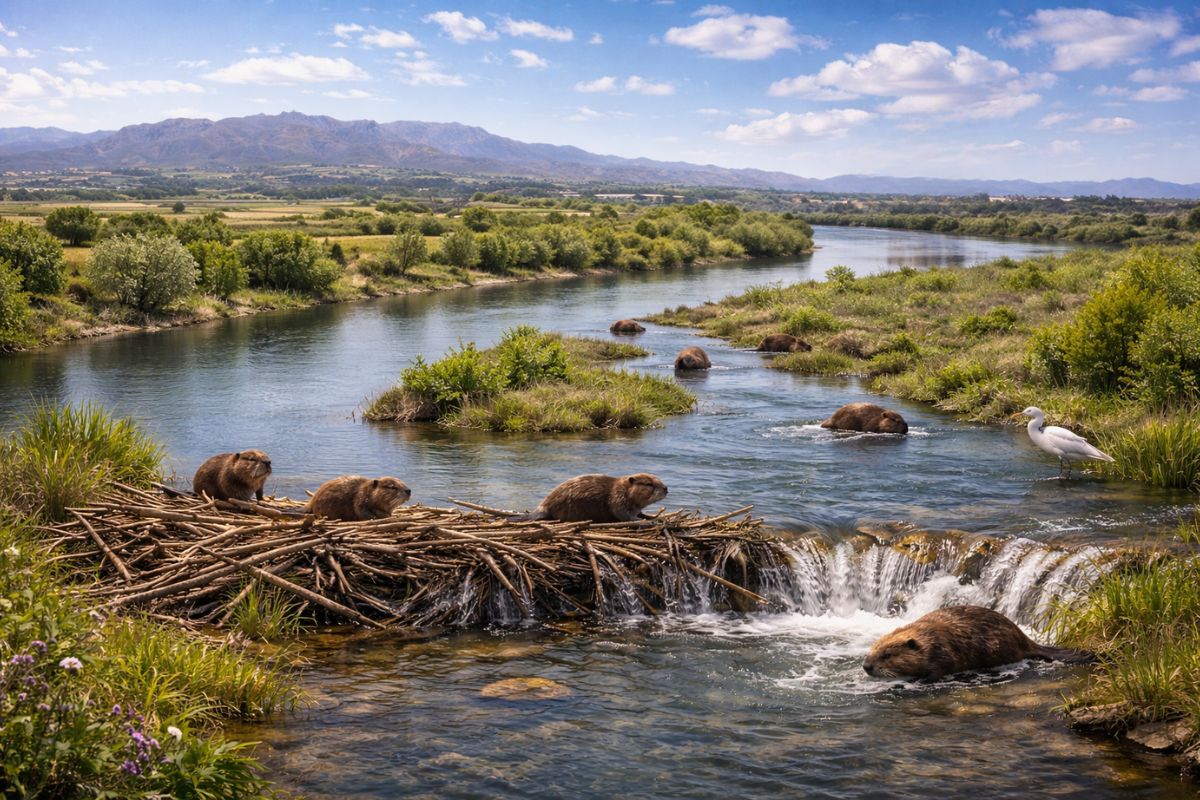
Introduced in 2003 from Bavaria, beavers advanced through the Ebro and other rivers of Spain, and the paradox is that they can recover wetlands and even capture carbon.
The beavers that now appear in rivers of Spain did not arise from natural recolonization. They were illegally introduced, spread rapidly, and have now reached Catalonia, in an advance that no one can fully explain or control.
The most intriguing aspect is that the story of beavers mixes invasion, uncertainty, and an unexpected side effect. The same animal that becomes a headache for environmental management can, at the same time, improve rivers and transform river corridors into permanent carbon sinks, according to recent studies cited in the report.
How beavers were discovered where they “did not exist”
In 2005, biologist Juan Carlos Ceña was studying the European mink along the banks of the Aragón River when he noticed unmistakable signs: fallen trees, remnants of foraging, footprints, burrows, and droppings typical of beaver colonies.
-
ZCC 11000 crane lands at the port of Vitória and heads to Ceará in a convoy with 64 trailers: Zoomlion, founded in 1992, builds a monster that lifts over 600 compact cars to 93 m.

-
The biggest drama of being born on Mars is not breathing: Rice biologist says that colonists’ children may cease to be Homo sapiens, shaped by low gravity, radiation, and isolation that divides humanity.

-
With no separate outdoor unit and designed to fit in the window, monoblock air conditioners used in Japan emerge as an alternative for those who cannot install a split system in a rented apartment.

-
China prepares a 78,000-ton pilotable floating island for deep-sea research: it accommodates 240 people for months, withstands category 17 typhoons and 9-meter waves, and uses metamaterials that dissipate nuclear explosions.


The shock came from a basic detail: there were no beavers in Spain, at least not officially. For years, researchers debated when the animal disappeared from the peninsula, and the cited consensus points to the only available evidence placing them in the 2nd century BC. After that, it is unclear what happened to the Iberian beavers.
The turning point of 2003 and the mystery of who released the animals
The investigation led to a straightforward conclusion: in the spring of 2003, someone illegally introduced 18 European beavers from Bavaria into the upper basin of the Ebro River. No one knows who did this, or why.
The problem is that, once established, beavers tend to stay. The text describes this behavior as a factor that transforms an isolated act into a process of continuous expansion.
The expansion does not seem natural and the numbers do not add up
The presence of beavers today is not limited to the Ebro. The report states that there are beavers in the Tagus and Guadalquivir rivers, and that the expansion is not natural.
In 2023, biologist Teresa Calderón calculated that the beavers of the Tormes River would take 40 years to arrive on their own, starting from the nearest documented population.
In Andalusia, the case is even harder to justify: there would be no way for the beavers to cover 365 kilometers of the southern plateau between the section of the Guadalquivir where they were found in 2023 and the closest point where they had been seen before.
The “beaver bombardment” became reality in the Ebro River

The report describes the most intense phase as a kind of “beaver bombardment.” By 2007, they had already “conquered” 60 kilometers of riverbanks. By 2023, they were already in Mequinenza and the lower course of the Ebro River.
From there to Catalonia was just a matter of time. And it happened: the Center for Ecological Research and Forest Applications confirmed the presence of beavers in the Segrià region, in the province of Lleida.
Why no one knows how to stop the beavers

The text suggests that the knot is not just speed. It is the combination of unclear human introductions, improbable routes, and the ability of beavers to settle in rivers when they find favorable conditions.
When an invasive species spreads and remains, control becomes a permanent challenge, and the report is direct in stating that, as things stand, no one will be able to get rid of them.
The paradox: beavers can recover rivers and capture carbon
This is where the story turns upside down. The arrival of beavers in Catalonia is not described as good or bad news. “It simply is.” The turning point is another: some recent articles cited claim that beavers can transform river corridors into permanent carbon sinks.
In practical terms, the text lists environmental benefits associated with the presence of beavers: helping to recharge aquifers, naturally purifying water, and contributing to the recovery of wetlands.
It is a climate paradox, because the animal spreads out of control, but can bring real ecological gains in the process.
What this story says about rivers, invasions, and irreversible choices
The main lesson is uncomfortable: when a species is illegally introduced and establishes itself, returning to “before” may be impossible.
At the same time, the case also shows that environmental impacts are not always linear, and that beavers can generate positive effects in some ecosystems, even being an invasive species in the described context.
In the end, there is a sense of an open window amid the problem: the beavers have arrived, advanced, no one knows exactly how to slow them down, but perhaps they help recover rivers at a time when water and carbon have become central themes.
Do you think beavers should be controlled at all costs, or does their ecological potential justify coexisting with their expansion?






Seja o primeiro a reagir!