





 Português
  Inglês
  Espanhol
  7 min de leitura
  0 comentários


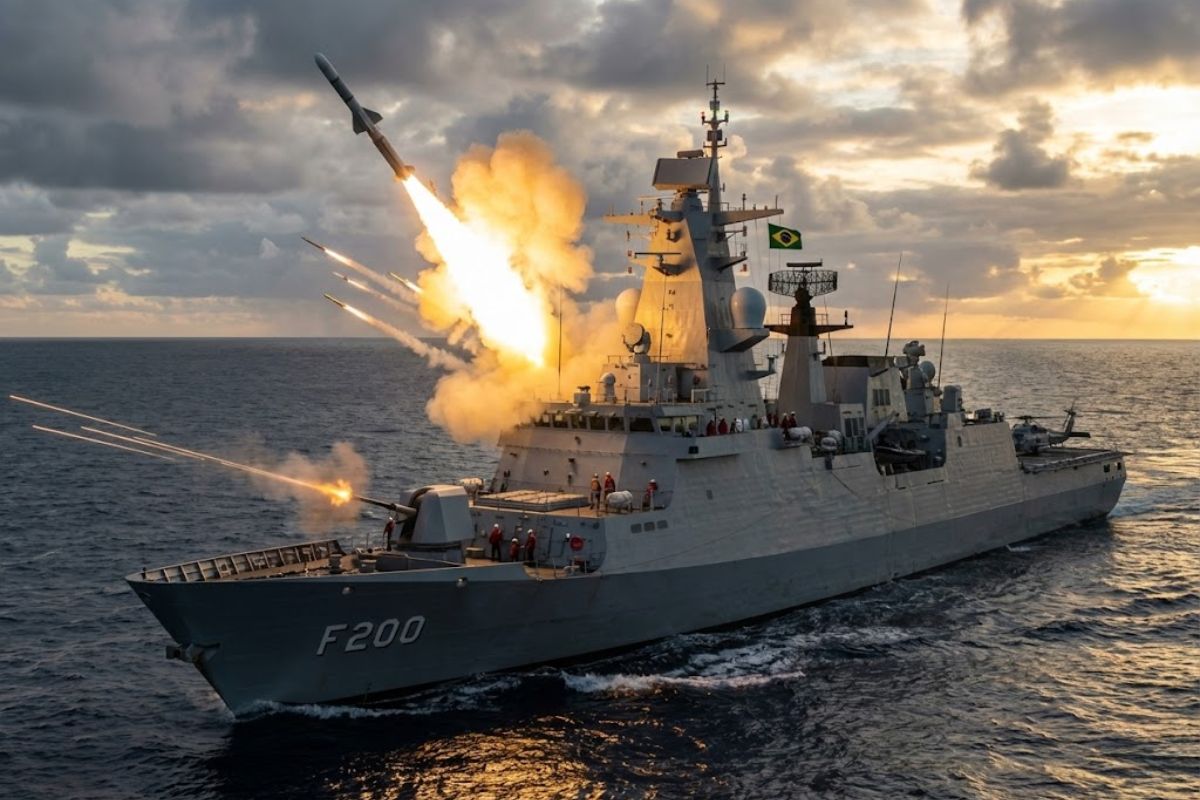
Built in Itajaí on the North Coast of Santa Catarina, the Frigate Tamandaré (F200) is the first of the Tamandaré class frigate program and has entered the decisive phase of sea trials, preparing to integrate into the Navy in early 2027 with layered defense, sensors, and high complexity countermeasures.
The Frigate Tamandaré (F200) is the first ship of a new generation of escorts for the Brazilian Navy and is already at the stage where everything needs to work together: sensors, software, weapons, and reaction procedures. The focus is not on “having armament,” but rather on chaining decisions in seconds when a threat appears.
In a surprise attack scenario, the logic of the ship is to operate in layers: detect, classify, engage, and if necessary, mislead. This involves volumetric radar for surveillance, fire control radar for precision, optronic sensors for discreet confirmation, air defense missiles, high cadence gun, and electronic countermeasures, all integrated to maintain situational superiority.
From Dock to Sea: Why Tests Determine the Readiness of the Frigate Tamandaré

The Frigate Tamandaré was built in Itajaí and, after years of construction, has entered the decisive phase of sea trials with a forecast for incorporation at the beginning of 2027.
-
Found in one of the most radioactive places on Earth, this Chernobyl fungus may be doing something with radiation that no one has been able to explain to this day.

-
A bright yellow mushroom imported from Asia escaped from a cultivation farm in the United States in 2010 and is now aggressively spreading across 25 states, destroying entire communities of native fungi in American forests.

-
Buried under China, a colossal machine weighing 20,000 tons began operating as the largest neutrino detector on the planet and, in just 59 days, surpassed results that science took half a century to achieve.

-
Iran enters the center of a climate alert after the war emitted 5.6 million tons of CO2 in two weeks, surpassing the annual pollution of entire countries.


At this stage, what is at stake is not just “setting sail,” but validating how the ship behaves when the systems are simultaneously demanded: navigation, communications, sensors, weapons, and combat routines.
Sea trials are the moment when the ship ceases to be a collection of components and becomes a unified system.
It is here that it is verified, for example, if an alert generated by a sensor reaches the right console, if the classification of the threat is consistent, if the firing solution appears in the expected time, and if the response, whether with missiles, gun, or misdirection, remains coherent with the rules of engagement and the electronic warfare environment.

It is also in this phase that the “decision cadence” is observed in realistic scenarios: multiple targets, surface contacts, and aerial threats appearing simultaneously, electronic noise in the environment, and the need to avoid unnecessary emissions. Reacting quickly is not about pressing a button: it is about having a detection and confirmation chain that does not break under pressure.
Nearly Invisible Detection: Volumetric Radar, Fire Control, and Optronic Confirmation

When talking about a surprise attack, the first battle is the information battle. The Frigate Tamandaré utilizes the Hensoldt TRS-4D Rotator volumetric radar to monitor the airspace and surface, with the ability to track up to a thousand targets simultaneously.
Practically speaking, this means maintaining a dynamic picture of the surroundings, continuously updated, and capable of differentiating behaviors that seem common from those that may indicate hostile intent.
Upon identifying a risk vector, the system enters the “refinement” stage: trajectory, speed, and impact risk begin to be calculated to reduce uncertainty.
The goal is to transform a “contact” into a comprehended threat, because only then does the response move from being reactive to being controlled.
Next, the Thales STIR 1.2 fire control radar comes into play, responsible for providing the precision needed for engagement.
And, to confirm the threat without relying solely on electromagnetic emissions, the frigate has Safran Paseo XLR optronic sensors, which can validate a target without “lighting up” signals in the spectrum. In an electronic warfare environment, confirming discreetly can be as valuable as early detection, because it reduces the chance of the ship revealing itself before the right moment.
Engagement in 360 Degrees: Sea Ceptor and the Vertical Launch of the CAMM
Once hostility is confirmed, the Frigate Tamandaré can activate the Sea Ceptor air defense system from MBDA. The CAMM missiles are launched vertically, which broadens the reaction to 360 degrees without requiring the ship to maneuver to point launchers. This shortens the path between “threat detected” and “threat engaged”, a decisive factor when response time is the scarcest resource.
The vertical launch also helps deal with simultaneous attacks because the employment logic does not get stuck to a single coverage sector.
Instead of relying on the hull alignment with the target, the ship can build a more flexible response, adapting priority according to risk: what is closer, what has a higher chance of impact, what represents greater potential damage.
In practice, the air defense of the Frigate Tamandaré is not an isolated gesture, but rather part of a layered design. The first layer attempts to prevent the threat from getting close enough to force desperate decisions. And, if this layer is breached, the following layers exist precisely to maintain control of the situation without collapsing the capacity to react.
When Time Presses: 76/62 Gun, Short Range, and Remote Weapons
If a target surpasses the first barrier, the Frigate Tamandaré can resort to the Leonardo 76/62 Super Rapid gun, installed at the bow, with a rate of fire of up to 120 rounds per minute and an effective range of approximately 16 kilometers.
This type of weapon serves as a high-speed response for scenarios where decision time is minimal and the target is already in a more critical threat envelope.
The role of the gun, in this context, is to offer an immediate and continuous engagement option, complementing air defense and covering situations where multiple contacts press the system at the same time. In surprise attacks, redundancy matters: if one solution fails, another needs to be ready without delays.
In short-range defense, the Rheinmetall Sea Snake appears, designed as a final protection against missiles, low-flying aircraft, drones, or fast boats.
And, reinforcing the set, the remotely operated FN Herstal Sea Defender machine guns, 12.7 mm, help deal with asymmetric threats and contacts that require precise and rapid response. The last layer is not “the best”; it is the one that still exists when the others have already been tested to the limit.
Electronic Warfare and Misdirection: Decoys, Emission Alerts, and the Logic of Layers
Modern defense is not just about “hitting the target”; it is also about making the enemy miss, delaying adversarial decisions, and confusing sensors.
The Frigate Tamandaré can employ the Terma C-Guard decoy system, responsible for launching decoys in 360 degrees to confuse sensors guided by radio frequency or infrared. In a survival logic, this can break the “lock-on” of a threat and create a window for other layers to do their job.
This electronic dimension gains even more weight when the environment is saturated with signals and attempts at interference. Therefore, the national system MAGE MB Omnisys Defensor MK3 complements protection by identifying adversary emissions and assisting in characterizing the threat. Knowing “who is emitting” and “how they are emitting” helps understand intent, anticipate movements, and avoid costly wrong responses.
The operational logic described for the Frigate Tamandaré is one of successive layers: detect, classify, engage, and if necessary, disorient the attack.
This sequence may seem simple on paper, but it is exactly what needs to function under stress: many targets, little time, and real risk of saturation. The ship does not depend on a single solution; it depends on an architecture that withstands chaos.
A Program, Four Ships, and an Industrial Chain: What the Tamandaré Class Adds to the Core of Escorts
The Frigate Tamandaré (F200) is the first of four ships in the new generation of Brazilian frigates. The program also includes the Frigate Jerônimo de Albuquerque (F201), the Frigate Cunha Moreira (F202), and the Frigate Mariz e Barros (F203).
By organizing the series renewal, the Navy is not just seeking a “modern ship,” but a core of escorts capable of operating with a common standard of systems, doctrine, and maintenance—something that directly impacts long-term readiness.
In the package of capabilities, in addition to air defense, there is an antiship component through the ITL 70A system, capable of launching Exocet MM40 or MANSUP missiles. There are also antisubmarine warfare resources, with MK46 or MK54 torpedoes and Atlas Elektronik ASO 713 hull sonar.
This designs a frigate conceived for aerial, surface, and submarine threats, without relying on a single “specialty.”
The combat power extends to the air: the frigate can operate the SH-16 Seahawk helicopter, equipped with sensors and armaments, as well as the ScanEagle UAV for intelligence, surveillance, and reconnaissance missions.
Integrated into the New PAC and the New Brazil Industry industrial policy, the Tamandaré Class Frigates Program foresees construction in the country, technology transfer, and the use of tools like “digital twins.” When the project includes method and industry, the gain is not just operational: it is continuity and evolution.
The Frigate Tamandaré encapsulates a central idea: in modern wars, winning the “first minute” can make the difference between controlling the scenario and merely reacting.
Radar capable of tracking up to a thousand targets, dedicated fire control, optronic confirmation, air defense with Sea Ceptor, high cadence gun, short-range systems, and electronic countermeasures form a coherent design of defense in multiple layers.
With a forecast for incorporation in early 2027, what is being tested now is not an isolated detail but the integration that transforms technology into real readiness.
In your view, which layer makes the most difference in a surprise attack: detecting before everyone, engaging from a distance, or misleading at the last second? And do you trust more in missiles, gun, electronic warfare, or the combination of all three?








-

-

5 pessoas reagiram a isso.