





 Portuguese
  English
  Spanish
  5 min of reading
  0 comments


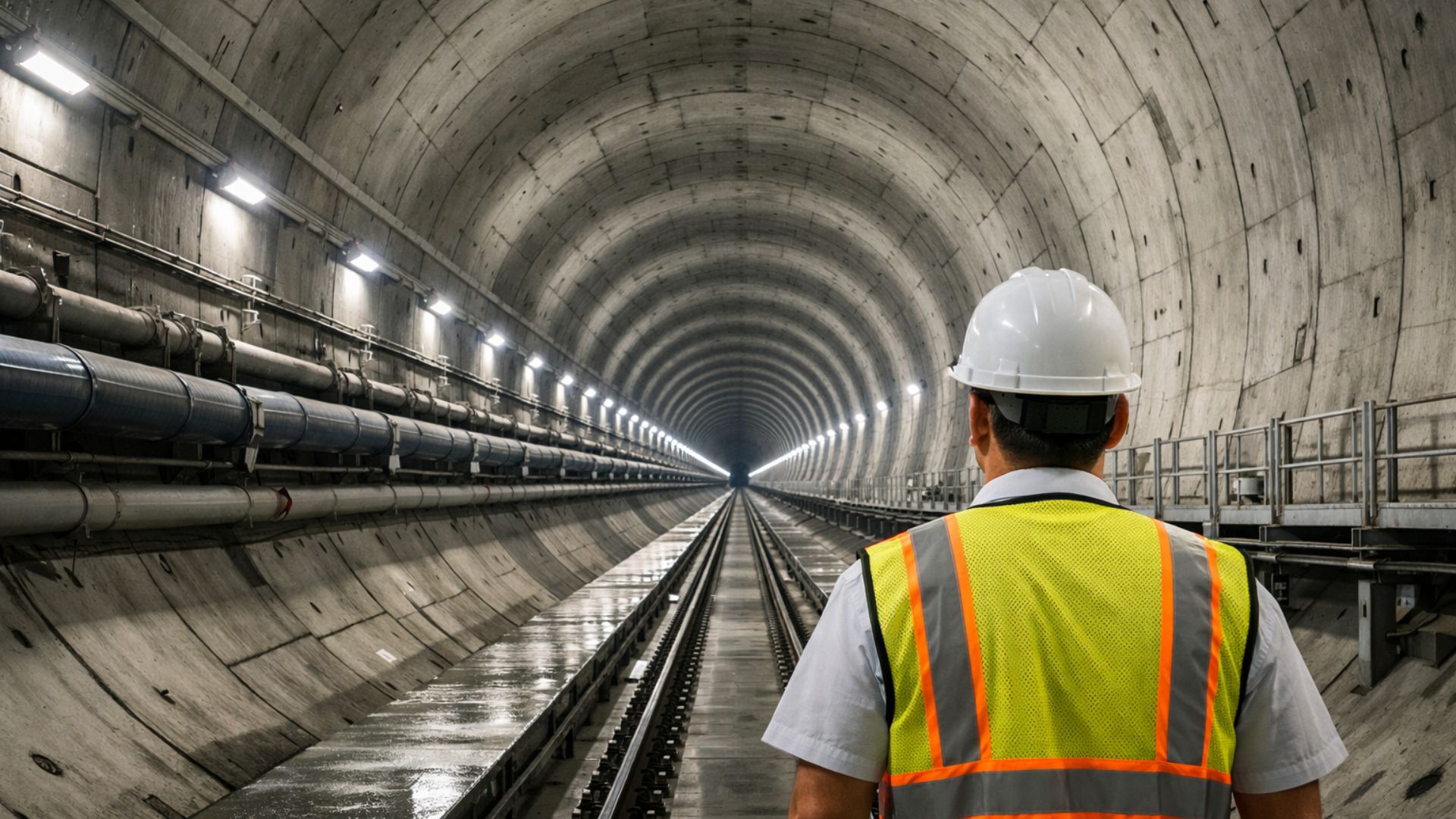
A $10 Billion Underground Mega Project Reshapes Sanitation in Singapore with 206 Km of Deep Tunnels and a Promise of Operations for a Century, Supporting Urban Growth and Water Security Without Occupying Surface Space.
Singapore invested around US$ 10 billion in an underground system that was not designed for people to circulate but to keep the city functioning without pressure on urban space: a deep network of tunnels that transports wastewater on a large scale to treatment plants.
Under one of the most densely populated areas in the world, the engineering works as an “invisible” backbone, replacing a dispersed logic of smaller stations with a continuous path for collection and transport, designed to last for decades without occupying surface space.
Underground System That Supports the City
The proposal may sound counterintuitive for those who associate sanitation with shallow networks and fragmented works; however, Singapore’s design invests in deeper, larger tunnels capable of receiving constant volumes and conducting them in an integrated manner.
-
Friends have been building a small “town” for 30 years to grow old together, with compact houses, a common area, nature surrounding it, and a collective life project designed for friendship, coexistence, and simplicity.

-
This small town in Germany created its own currency 24 years ago, today it circulates millions per year, is accepted in over 300 stores, and the German government allowed all of this to happen under one condition.

-
Curitiba is shrinking and is expected to lose 97,000 residents by 2050, while inland cities in Paraná such as Sarandi, Araucária, and Toledo are experiencing accelerated growth that is changing the entire state’s map.

-
Tourists were poisoned on Everest in a million-dollar fraud scheme involving helicopters that diverted over $19 million and shocked international authorities.


While the city continues above with roads, subways, and buildings, the infrastructure below functions like a “superhighway” for sewage, connected to branches and interceptors that channel the flow to centralized plants, reducing the need for multiple structures at street level.
Deep Tunnel Sewerage System and Long-Term Planning

The project is called Deep Tunnel Sewerage System (DTSS) and is presented by the national water agency as a long-term solution for wastewater collection and treatment, with operations designed to last around a century.
Instead of relying on dozens of smaller, scattered facilities, the system consolidates transportation into a network of deep tunnels that channels wastewater to recovery plants, emphasizing the use of topography and gravity.
206 Km of Tunnels and the “Superhighway” Concept
The official description points out that the DTSS forms a network of 206 km of deep tunnels, built to transport wastewater to centralized plants, and the comparison to a “superhighway” explains the continuous nature and large volume transported.
This is not an aesthetic metaphor but rather a high-capacity underground corridor that crosses the island below, allowing for stable sewage management even amid urban and industrial growth.
Freeing Urban Space and Risk Reduction
By focusing the system’s stages in larger plants, Singapore seeks to reduce land occupation by scattered facilities while gaining operational efficiency, as maintenance and control become more standardized at central points.
By relocating critical infrastructure to large tunnels, the city decreases its dependence on a network with many failure points above ground, something relevant in a small territory where each freed area can be redirected to housing, services, or parks.
Billion-Dollar Investment Divided into Phases

The total committed value to construct the DTSS, summing Phases 1 and 2, was presented by the Ministry of Sustainability and the Environment as US$ 10 billion, a figure consistent with long, deep works carried out in modules over the years.
As the phases are built and activated in a staggered manner, the cost often appears associated with specific phases and components, which helps explain why different technical documents cite different values, depending on the scope and period considered.
Changi Plant and Initial Operation of the System
In Phase 1, technical materials describe a main deep tunnel connecting areas like Kranji and Changi, in addition to dozens of kilometers of connections and a centralized plant in the east of the island, pointed out as the hub of the initial system.
This arrangement concentrates the arrival of wastewater in high-capacity infrastructure and allows part of the treated water to be used for reuse processes, a strategy integrated into the country’s water planning.
Expansion to Tuas and Network Enlargement
Phase 2 expands collection and transport to new areas, with a plant associated with Tuas in the west, and tunneling works described as completed, an important step to connect the network to this planned expansion.
Official reports also indicate the operation commencement of the Tuas plant in the mid-decade timeline while highlighting cost and complexity challenges typical of excavations in dense urban environments.
100-Year Lifespan and Water Security

The projected longevity is an important technical fact, as requirements for 100-year lifespan have been established, including with corrosion-resistant materials in parts of the tunnel lining.
With this horizon, the DTSS functions as a foundational infrastructure capable of supporting modernizations and changes in the way to treat and recover water, without requiring the same amount of surface works with each urban expansion.
The central point is that when sanitation works well, it is almost invisible, and the subterranean highway only draws attention for its size and cost, as its aim is to prevent overload, malfunction, and unnecessary land occupation.
Still, the system has a direct impact on daily life because it supports public health, reduces dependencies on scattered structures, and reinforces the capacity to treat wastewater on a large scale within a national water security strategy.
If a metropolis is willing to spend billions to maintain an underground system that no one directly uses, what other discreet infrastructures are now deciding what will work or fail in large cities?









-

-

-

-

7 pessoas reagiram a isso.