





 Português
  Inglês
  Espanhol
  4 min de leitura
  0 comentários


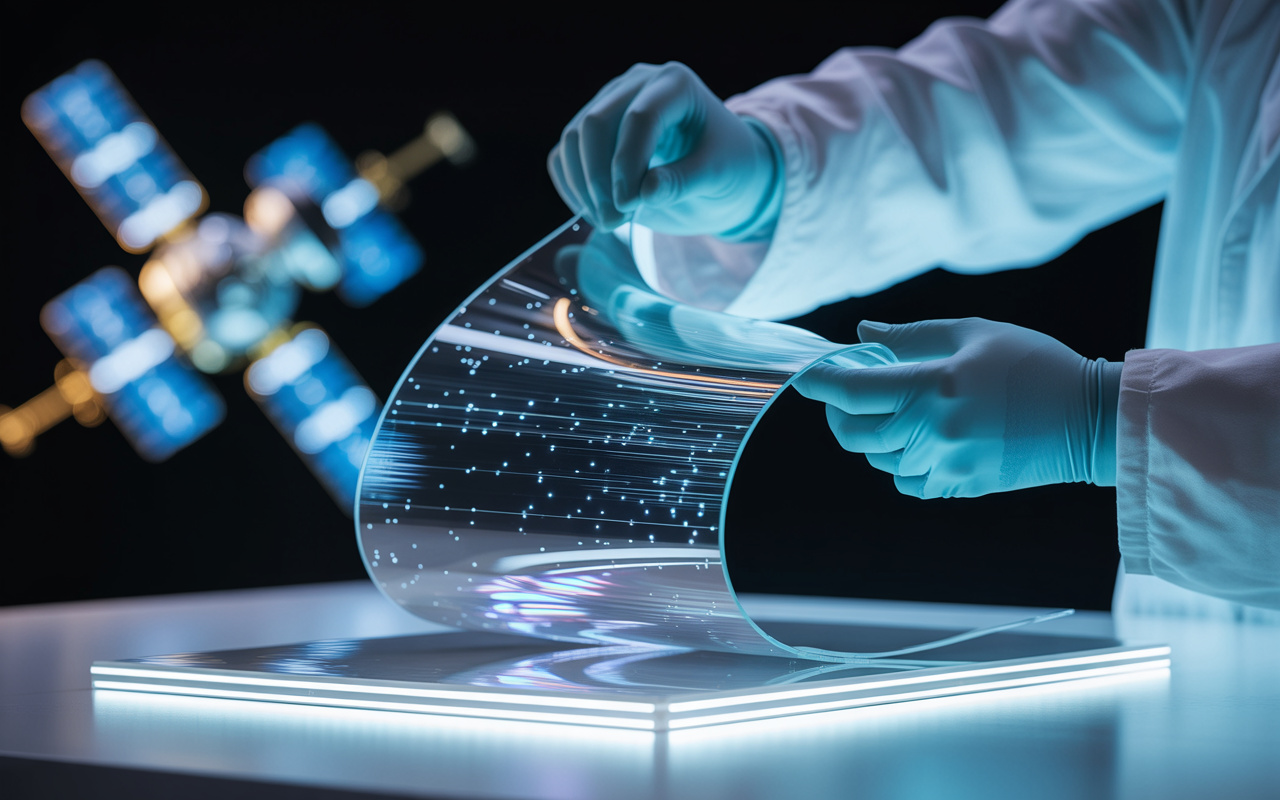
Ultra-Thin And Flexible Glass Developed By Fraunhofer And Partners Can Be Folded Like Plastic, Is Lighter Than Paper, And Is Already Hitting The Market As A Bet For Screens And Satellites.
For centuries, glass has been synonymous with rigidity, transparency, and fragility. Now, German researchers have proven that this material can go far beyond. At the Fraunhofer Institute For Organic Electronics, Electron Beam And Plasma Technology (FEP) in Dresden, a team led by figures like Dr. Jörg Neidhardt, Wiebke Langgemach, and Manuela Ehrhardt has been developing since 2016 a glass so thin — with a thickness of 25 to 100 micrometers, thinner than a human hair — that it can be folded, rolled, and shaped as if it were plastic.
This feat, a result of years of research funded by the German government, paves the way for a revolution in foldable screens, satellites, sensors, and even the automotive industry.
From Lab To Industry: The Timeline Of Flexible Glass
- 2016–2018: KONFEKT consortium, formed by SCHOTT, tesa, and VON ARDENNE, receives €5.6 million from the Federal Ministry of Education and Research (BMBF) of Germany to create the concept of “glass-on-roll” — rollable glass processed like plastic.
- 2017: Fraunhofer FEP announces readiness to process ultra-thin glass in roll-to-roll continuous lines, something previously unthinkable for such a fragile material.
- 2018–2023: Projects like Glass4Flex and CUSTOM expand production capabilities, including functional coatings (barriers against oxygen and vapor, optical filters, conductive layers).
- 2024–2025: Pilot lines are already delivering industrial samples; SCHOTT markets aluminosilicate glass sheets AS 87 eco/neo with 50–350 μm, scratch-resistant and ready for real applications.
Why Glass And Not Plastic?
The current prototypes of foldable smartphones use transparent polymers. The problem is that they scratch easily, yellow over time, and do not provide effective barrier against gases.
-
Found in one of the most radioactive places on Earth, this Chernobyl fungus may be doing something with radiation that no one has been able to explain to this day.
-
A bright yellow mushroom imported from Asia escaped from a cultivation farm in the United States in 2010 and is now aggressively spreading across 25 states, destroying entire communities of native fungi in American forests.

-
Buried under China, a colossal machine weighing 20,000 tons began operating as the largest neutrino detector on the planet and, in just 59 days, surpassed results that science took half a century to achieve.

-
Iran enters the center of a climate alert after the war emitted 5.6 million tons of CO2 in two weeks, surpassing the annual pollution of entire countries.


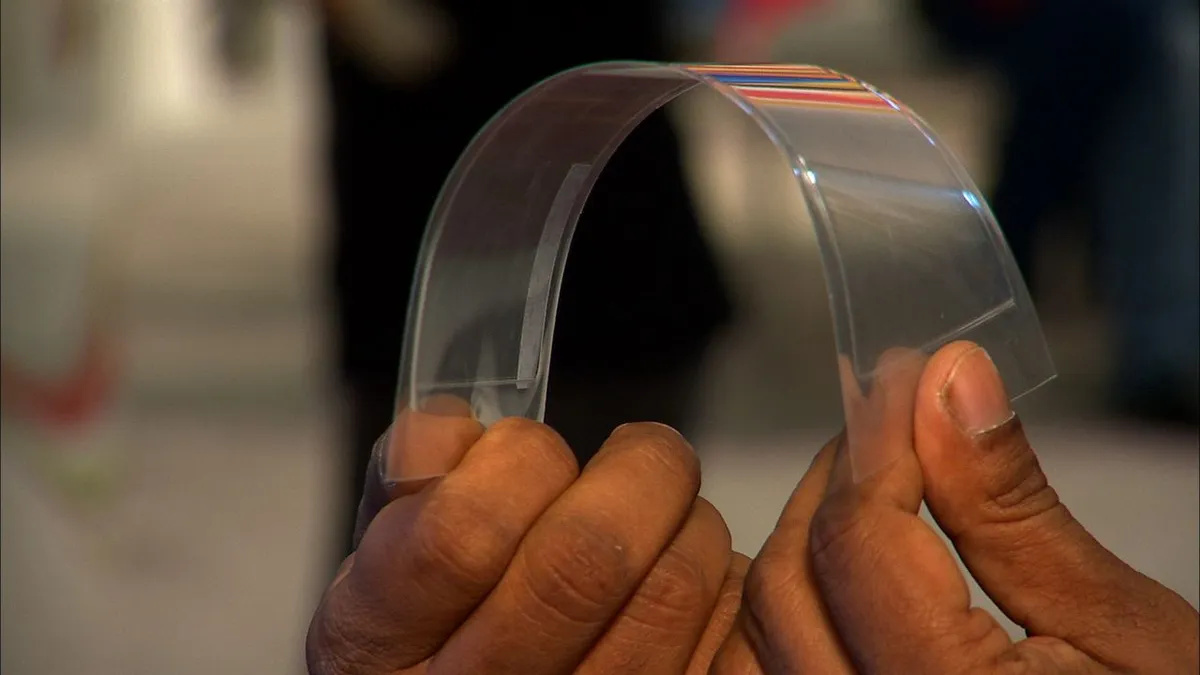
Ultra-thin glass overcomes all these points:
- Resistant To Scratches like conventional glass.
- Does Not Lose Transparency over the years.
- Protects Against Oxidation And Moisture, ideal for OLED and micro-LED displays.
- Withstands Extreme Temperature Variations, making it perfect for use in satellites.
Applications That Are Already On The Radar
- Foldable Smartphones And Tablets — more resistant and durable flexible screens.
- Satellites And Space Modules — every gram counts; the ultra-light glass can reduce launch costs.
- Automotive Sensors — LIDAR systems and cameras for autonomous cars require resistant optical surfaces.
- Futuristic Architecture — curved, lightweight, and extremely transparent windows.
According to researcher Andreas Baumann, who works on developing deposition processes in UTG, the material “combines the lightness of plastic with the strength of glass, opening a new era of applications.”

The Challenge Of Bringing It To Market
Despite the enthusiasm, the obstacles are clear. Producing sheets so thin without breaking them requires specialized handling lines, with vacuum transport, high-precision robotics, and complex lamination techniques.
“The biggest enemy of thin glass is sudden fracture,” explains Wiebke Langgemach, a specialist in mechanical properties at Fraunhofer.
“We study how it behaves under bending, thermal cycles, and impact. Every step of the chain needs to be redesigned to handle its delicacy.”
For this reason, outside the niche of foldable displays, mass production is still limited. But the learning curve resembles that of semiconductors: expensive and fragile technologies that, at scale, have become ubiquitous.
A Global Race
Fraunhofer and SCHOTT are not alone. American Corning, creator of Gorilla Glass, has been investing for years in its own lines, such as Willow Glass, but still without scale. In Japan and Korea, display manufacturers are also testing ultra-thin glasses for next-generation smartphones.
The European difference lies in the focus on industrial and space applications: the vision is that flexible glass will not only be for phones but for photonics, sensor encapsulation, and orbital solar panels.
The Foldable Future Of Technology
With pilot lines already delivering commercial sheets of 50–350 μm and the expectation to reduce costs in the coming years, the hope is that flexible glass will surpass the status of curiosity and become a key material of the next decade.
It is proof that even the oldest materials can be reinvented. Glass, created thousands of years ago, is now transforming into a transparent foldable film, ready to equip satellites, cars, buildings, and electronics.
From the lab in Dresden to the showcases of the world, this glass could redefine how we interact with technology.








-

-

-

-

-

-

56 pessoas reagiram a isso.