





 Portuguese
  English
  Spanish
  4 min of reading
  0 comments


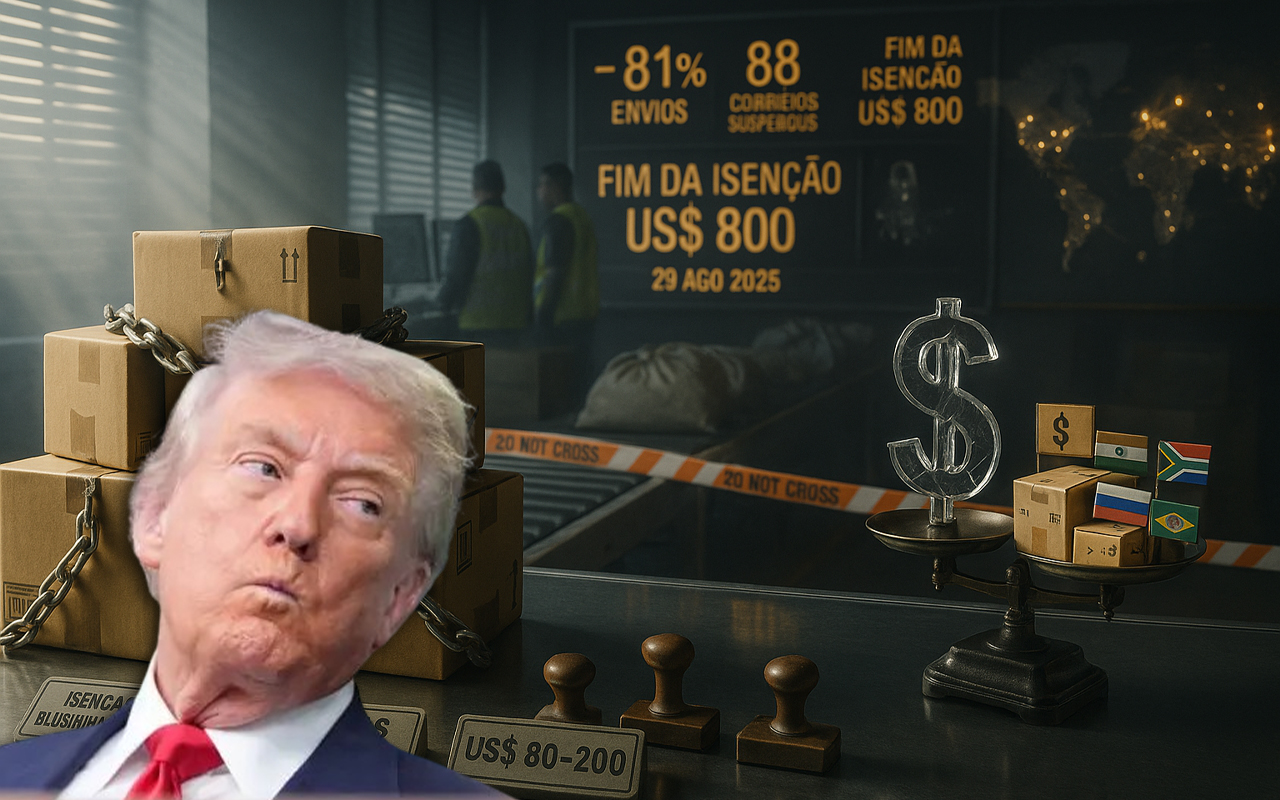
Since August 29, 2025, the US ended the exemption for packages up to US$ 800, and as an immediate result, there was a drop of 80% to 81% in international mail traffic and 88 operators suspended shipments to the country
The “de minimis” exemption allowed cheap purchases to enter the US without going through customs or paying taxes, which made cross-border e-commerce cheaper and faster. On July 30, 2025, the White House published the global suspension of the rule, with official implementation on August 29, 2025. The government justified the measure as a closure of a “loophole” associated with smuggling, counterfeiting, and the entry of synthetic drugs.
On the day of the change, CBP reported that it would start to enforce and collect the new tariffs, transferring to approved carriers and intermediaries the responsibility of calculating, collecting, and forwarding the due taxes. This made logistics more complex than the previous model, which freed millions of packages with low declared values.
The result was a sharp slowdown. The Universal Postal Union (UPU) reported a drop of 80% to 81% in international traffic to the US and the total or partial suspension of shipments by 88 postal services worldwide, lacking systems capable of calculating and collecting the new values at the point of origin.
-
A new Brazilian shopping center worth R$ 400 million will be built in an area equivalent to more than 4 football fields, featuring 90 stores, 5 cinemas, a supermarket, a college, and parking for 1,700 cars, potentially generating 3,000 jobs.

-
Larger than entire cities in Brazil: BYD is building a 4.6 km² complex in Bahia with a capacity for 600,000 vehicles per year, but the discovery of 163 workers in conditions analogous to slavery has shaken the entire project.

-
With an investment of R$ 612 million, a capacity to process 1.2 million liters of milk per day, Piracanjuba inaugurates a mega cheese factory that increases national production, reduces dependence on imports, and repositions Brazil on the global dairy map.

-
Brazilian city gains industrial hub for 85 companies that is equivalent to 55 football fields.


Why the ‘Blouse Tax’ in the US
The change in the US resembles the controversial “blouse tax” in Brazil, debated in 2023 and effectuated on August 1, 2024 by Law 14,902/2024. Since then, international purchases of up to US$ 50 began to pay 20% Import Tax (in addition to the ICMS charged by states), and from US$ 50 to US$ 3,000, they are subject to 60% tax (with a deduction of US$ 20).
In 2023, the Remessa Conforme program in Brazil had reduced the federal rate to zero for purchases up to US$ 50 on eligible websites — which explains the sense of “ending the exemption” when the new law took effect. In practice, both there and here, the similarity lies in the end of favored treatment for low-value packages and the direct impact on cross-border e-commerce.
What Changed in the US for the End of the De Minimis Exemption of US$ 800
Until August, international purchases of up to US$ 800 could enter without tariffs, with simplified screening and quick release. This arrangement, existing in various forms since 1938, favored small shipments typical of global marketplaces and independent stores. With the new rule, all parcels are to be assessed and taxed according to the origin and product classification.
The presidential act of July 30, 2025 suspended the exemption globally, following an earlier cut that had already affected shipments from China and Hong Kong months before. The official guideline is for CBP and “qualified parties” to collect and forward the due amounts, eliminating the tax exemption for cheap packages.
In practice, American consumers will no longer see “tax-free delivery” on most international checkouts, and foreign sellers must anticipate the total cost (tariff, tax, and fees) to avoid hold-ups and returns. It is a significant disruption in the flow that sustained over a billion low-value shipments in 2024.
How Much Will It Cost: Tariffs of 10% to 50% or Fixed Rate of US$ 80 to US$ 200
The new regime combines two modalities. For regular commercial shipments, tariffs of 10% to 50% apply depending on the country of origin and the product classification. For postal flow (post offices), there is a temporary specific value per package between US$ 80 and US$ 200, valid during a six-month transition period.
CBP published a factsheet detailing that, since August 29, 2025, goods valued up to US$ 800 are no longer eligible for “de minimis” and are subject to all applicable duties, taxes, and fees. For businesses and platforms, this requires a review of tariff classification, origin, and checkout processes with the calculation of “landed cost”.
The economic press emphasizes that higher costs and delays are likely in the short term, until operators and marketplaces adapt systems to charge at the point of purchase and settle with customs. Small sellers are likely to feel the bureaucratic weight more than large retailers with inventories in the US.
Drop of 81% and 88 Post Offices Suspended: Why the System Froze
UPU reported that international mail traffic destined for the US plummeted 80% to 81% on the day the charges were implemented, compared to the previous week. The number of 88 postal operators that suspended shipments partially or completely indicates an operational disruption: post offices and airlines were not ready to calculate, charge, and transfer fees on a case-by-case basis.
The UN agency stated that it is implementing a “landed-cost calculator” tool to help countries estimate taxes and fees at the origin, aiming to restore the predictability of international postings. Nonetheless, normalization depends on technological integrations and agreements with intermediaries authorized by CBP.
And you, will the American “blouse tax” really combat smuggling and protect the industry, or will it just raise costs and delay international purchases for those selling and buying from Brazil? Share your opinion in the comments.









Seja o primeiro a reagir!