





 Portuguese
  English
  Spanish
  4 min of reading
  0 comments


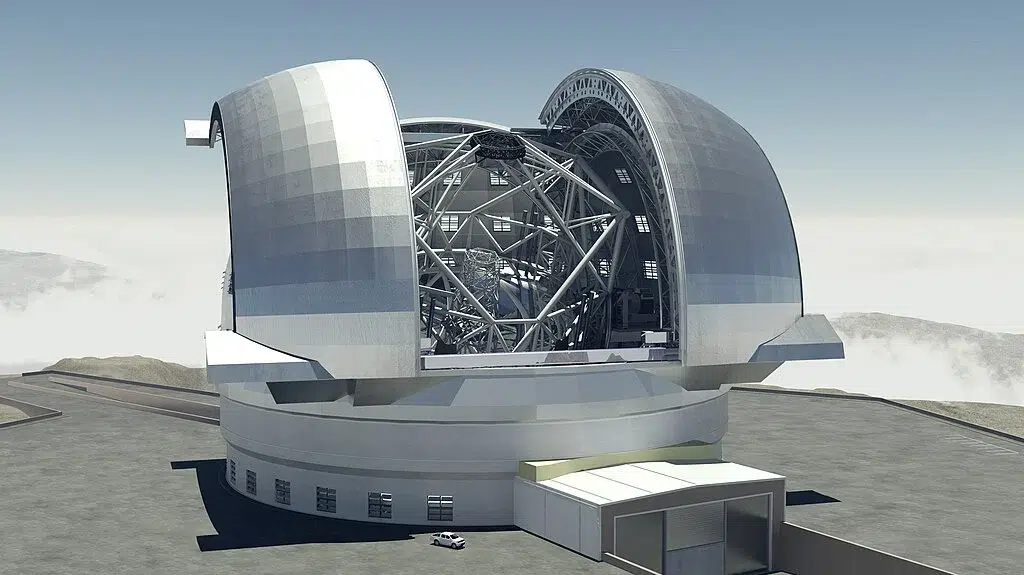
Under Construction In The Atacama Desert In Chile, The Extremely Large Telescope Is About To Change Astronomy. With The Largest Mirror Ever Installed In An Observatory, It Will Be Able To Identify Signs Of Life Found On Exoplanets With Just One Night Of Observation
New Giant Telescope In Chile Could Change Everything We Know About The Universe. Called The Extremely Large Telescope (ELT), It Is Scheduled To Begin Operations In 2028.
And right on its first night, it could already detect signs of life on planets around nearby stars, according to new simulations.
The ELT is being built in northern Chile and will have an impressive structure. Its primary mirror will have a specific diameter of 39 meters.
-
Motorola launched the Signature with a gold seal from DxOMark, tying with the iPhone 17 Pro in camera performance, Snapdragon 8 Gen 5 that surpassed 3 million in benchmarks, and a zoom that impresses even at night.

-
Satellites reveal beneath the Sahara a giant river buried for thousands of kilometers: study shows that the largest hot desert on the planet was once traversed by a river system comparable to the largest on Earth.

-
Scientists have captured something never seen in space: newly born stars are creating gigantic rings of light a thousand times larger than the distance between the Earth and the Sun, and this changes everything we knew about stellar birth.

-
Geologists find traces of a continent that disappeared 155 million years ago after separating from Australia and reveal that it did not sink, but broke into fragments scattered across Southeast Asia.
This means that the giant telescope in Chile will be able to capture much more light than any other ground telescope ever made. The images will be 16 times sharper than those from the famous Hubble Space Telescope.
This gain in observational capability is essential for scientists. With it, it will be possible to obtain details that were previously impossible to see. According to a recent study, the first results could arrive quickly, perhaps soon after the start of operations.
Telescope Can Analyze Exoplanet Atmospheres Without Focus
One of the most important tools of the giant telescope in Chile will be the analysis of the atmospheres of planets outside our solar system, known as exoplanets. This is done by observing when a planet passes in front of its star from our point of view.
The light from the star passes through the planet’s atmosphere before reaching us. By studying this light, scientists can identify molecules such as water, carbon dioxide, and oxygen.
The James Webb Space Telescope (JWST) already performs this type of analysis. It has obtained data from various exoplanet atmospheres. However, the results are not always clear. One example is the planets b, c, and d of the TRAPPIST-1 system.
The JWST was unable to accurately detect whether they have an atmosphere. The data suggests that they may not have air, but this is still not precise enough.
A greater sensitivity of the ELT could resolve this type of doubt. With it, it will be possible to observe very tenuous atmospheres that the JWST cannot detect. This could lead to important discoveries.
Beyond Planetary Transits: Reflected Light
And there’s more. The ELT does not only rely on planetary transits, meaning when the planet passes in front of the star. It will also be able to study planets that do not make this movement, using the reflected light from the star. This significantly increases the number of exoplanets that can be studied.
To test the potential of the telescope, researchers conducted simulations with various types of planets. They chose worlds that orbit nearby stars. These planets are the most common and likely to be studied in the future.
Telescope Can Find Alien Life In 10 Hours
Four types of Earth-like planets were observed: one with abundant water and vegetation, one with primitive life, one with evaporated oceans like Mars or Venus, and one without life, but with potential for it. Planets the size of Neptune, which have thicker atmospheres, were also simulated.
The idea was to see if the ELT could differentiate each type of planet. And more importantly: to avoid errors. In other words, not to confuse a lifeless planet with one that has life, and vice versa.
The results were positive. According to the study, the ELT will be able to make clear distinctions, at least for nearby stars.
In the case of the closest star to Earth, Proxima Centauri, only ten hours of observation would be needed to detect life on an Earth-like planet. For planets the size of Neptune, only one hour would be sufficient to gather enough data.
With this, the giant telescope in Chile could help answer one of humanity’s greatest questions: are we alone in the universe? And the answer could come in just a few years.
With information from Live Science.







Seja o primeiro a reagir!