





 Portuguese
  English
  Spanish
  5 min of reading
  0 comments


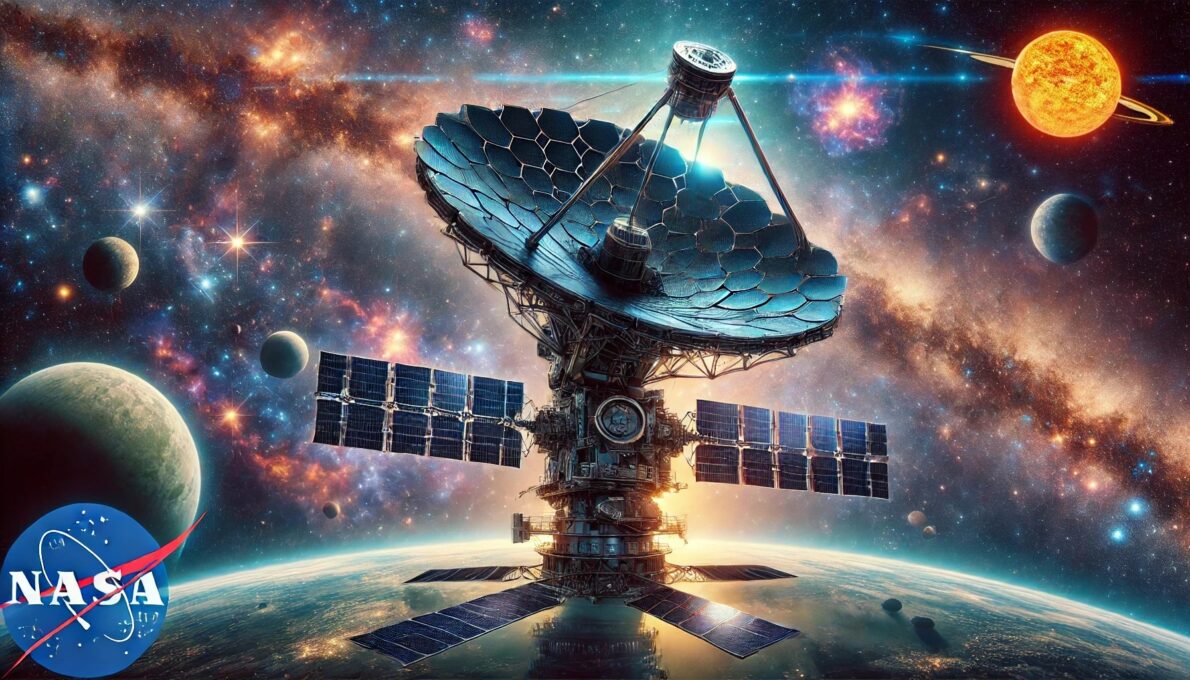
With Cutting-Edge Technology and a Launch Scheduled for 2027, NASA’s New Telescope Promises to Reveal Secrets of the Universe Like Never Before. Come Discover Everything About This Revolutionary Telescope Being Built at the Goddard Space Flight Center.
Imagine being able to explore the depths of the universe with a precision and reach we have never had before. That is exactly what NASA’s new telescope promises to do! The US space agency recently completed the installation of the Roman Coronagraph on the Nancy Grace Roman Space Telescope, marking a significant advance in the search for habitable worlds and, who knows, even for life beyond Earth. In this article, we will tell you everything about this revolutionary telescope being built at the Goddard Space Flight Center in Maryland, scheduled to launch in May 2027.
What Is the Nancy Grace Roman Space Telescope?
The Nancy Grace Roman Space Telescope, named in honor of one of NASA’s pioneers, will be one of the most powerful tools for exploring space. Unlike other telescopes, it will offer a field of view at least 100 times larger than the famous Hubble. This means it can explore vast areas of the universe with incredible precision, revealing details about dark energy, exoplanets, and infrared astrophysics.
This revolutionary telescope will feature the Roman Coronagraph, a cutting-edge technology that will allow it to directly observe the light from large gas exoplanets and dust and gas disks around other stars. In short, NASA’s new telescope will be a true window into the unknown, enabling scientists to observe phenomena that were previously impossible to see.
-
Man builds functional 5-meter submarine in his garage using gas cylinders, PVC pipes, and a refrigerator motor, and navigates with the vessel on a lake in Colombia.

-
Millions of people have been eating yam for centuries without knowing that this humble tuber contains a compound called diosgenin, which scientists have now discovered can improve memory and help control blood sugar levels.

-
Scientists from an international project drill 1,800 meters of ice in Antarctica using hot water and discover details about one of the most intriguing places on planet Earth.
-
Seen from space, a colossal volcano nearly 5,000 meters high in Russia has released 1,600 km of smoke over the Pacific, forming “devil’s horns” of lava and revealing the brutal force of the Ring of Fire.


The Importance of the Roman Coronagraph in the New Telescope
The Roman Coronagraph is one of the major innovations of this telescope. For those unfamiliar, a coronagraph is a device that “blocks” the brightness of stars, making it easier to see smaller stars and planets around them. This instrument was designed to capture images of exoplanets and disks around nearby stars, something that is challenging for conventional telescopes.
At 1.7 meters wide and with a unique design resembling a grand piano, the coronagraph uses masks and active mirrors to hide the brightness of the host stars of the exoplanets. This will allow it to capture detailed images of worlds beyond our Solar System, opening doors for the discovery of new planets and even clues to extraterrestrial life.
A Revolutionary Telescope for Space Exploration
This new NASA telescope is not just an advanced tool; it is a true springboard for the development of future technologies. NASA is already looking to the next step, and the Roman Coronagraph is essential in this process. It will act as a kind of test for technologies that will eventually be used in the Habitable Worlds Observatory, a telescope specifically designed to search for signs of life on Earth-like planets.
This advancement is so significant that NASA has stated, “to get from where we are to where we want to be, we need the Roman Coronagraph to demonstrate this technology.” In other words, the success of this new telescope could be the starting point for increasingly bold missions in the search for life beyond Earth.
The Construction and Challenges of NASA’s Telescope
Building a revolutionary telescope like the Nancy Grace Roman is no easy task. It is being assembled at the famous Goddard Space Flight Center, one of NASA’s research centers. The construction of this new telescope involves cutting-edge technologies and highly specialized teams, such as the engineers from California’s Jet Propulsion Laboratory (JPL), who designed the coronagraph.
One of the challenges is ensuring that the coronagraph operates at ambient temperature, as it will need special care to maintain the proper climate while in space. This involves insulation and other complex systems that will protect the equipment in the cold vacuum of the universe.
Another curious detail is that the same integration process used for the Hubble and James Webb was applied to the Nancy Grace Roman. In other words, NASA is leveraging what it learned from these historic telescopes to create an even more revolutionary and precise new telescope.
NASA’s New Telescope Will Search for Life and Cosmic Mysteries
But after all, what will this new NASA telescope search for in space? The answer is simple and fascinating: it will look for exoplanets, those planets outside our Solar System, and try to find evidence that they may host life. The Nancy Grace Roman Space Telescope will be capable of imaging Jupiter-sized planets and even observing those that are billions of years old.
In addition, it will help investigate one of the greatest mysteries of the universe: dark energy. This phenomenon, which makes up about 70% of the universe, is still a major enigma for science. With the expanded field of view of the new telescope, researchers will have a unique opportunity to study dark energy in a way that has never been done before.
What Can We Expect From This New NASA Telescope?
When the Nancy Grace Roman Space Telescope is launched in 2027, it will open a new chapter in the history of astronomy. With advanced technologies like the Roman Coronagraph, this revolutionary telescope will allow us to explore space like never before. From capturing images of giant exoplanets to studying dust disks around stars, it promises to transform our understanding of the universe.
The telescope is so advanced that, in addition to collecting scientific data, it will also be a true “space laboratory,” where NASA will test technologies that will be used in future missions. Everything indicates that the Nancy Grace Roman Space Telescope will be a game changer in space exploration, bringing us closer and closer to discovering new worlds and, perhaps, forms of life beyond Earth.








Seja o primeiro a reagir!