





 Portuguese
  English
  Spanish
  7 min of reading
  0 comments


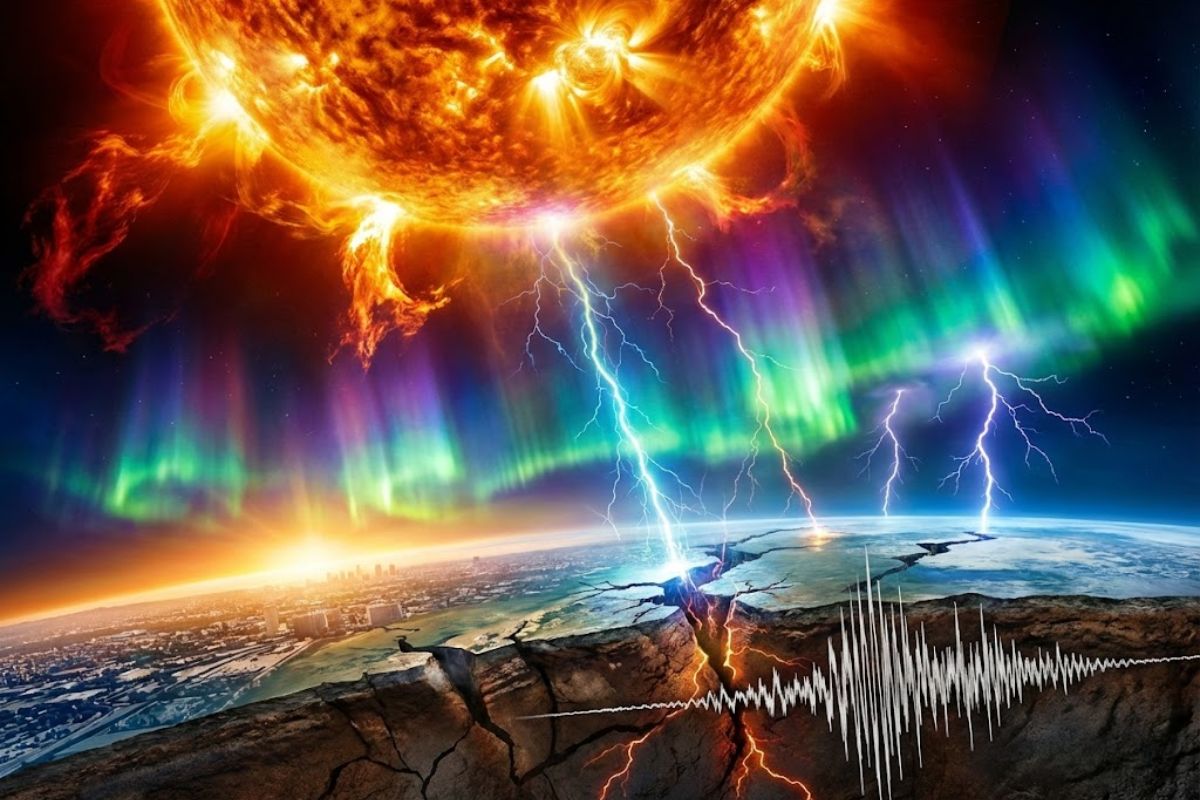
Kyoto University Scientists Modeled How Ionospheric Disturbances Amplified by Solar Eruptions Can Transfer Charge Through Capacitive Coupling and Increase Electrostatic Pressure in Fractured Rocks with Supercritical Water, Reaching Several Megapascals, a Value Comparable to Tidal Stresses When the Fault Is Already Critically Stressed in Major Earthquakes.
Scientists have been trying to understand why some earthquakes seem to “choose” the moment to happen when a fault is already dangerously close to collapsing. In this search, a group proposed a mechanism that broadens the view beyond the Earth’s interior and includes the upper atmosphere as part of the puzzle. The hypothesis does not point to a single culprit but describes a possible extra push under specific conditions.
The central point is the idea that solar storms, by altering the ionosphere, can reorganize electric charges and generate fields capable of penetrating fractured fault zones. If the fault is already critically stressed, this additional electrostatic pressure could act as a contributing factor to cross the “breaking point.” This is not about predicting earthquakes but rather testing a plausible physical pathway of interaction.
The Hypothesis Connecting Space Weather and Geological Faults
Scientists proposed a conceptual connection between solar eruptions and earthquakes through an intermediate link: the ionosphere, a charged region of the upper atmosphere that responds quickly to variations in space weather.
-
A “silent skill” is allowing Brazilians to earn up to R$ 22,000 per month without a degree and become indispensable for companies that rely on millions of data to survive.

-
Researchers at the Toyota Research Institute found that if a human uses robotic arms to flip a pancake 300 times in an afternoon, the robot learns to do it on its own the next morning, and this is currently the most promising method to solve the biggest bottleneck in modern robotics.

-
Goodbye iron: a common item in households is starting to lose space to technology that smooths clothes in minutes without an ironing board and with less energy consumption.

-
Antarctica reveals an unusual clue high in the Hudson Mountains, and what appeared to be just an isolated rock began to expose a secret hidden under the ice for ages.

When solar activity intensifies, the electron density can increase and form a more negatively charged layer in the lower ionosphere, creating conditions for changes in the electric field of the Earth-atmosphere system.
The crucial detail is that this change would not be “trapped” in the sky: it could couple with the underground.
In this view, the crust is not an isolated block that only responds to internal forces but part of a broader electrostatic system.
The proposal does not replace classical geophysical explanations, such as the accumulation of tectonic stress and friction at faults, nor does it suggest that solar activity “causes” earthquakes directly.
What comes into play is a possible additional trigger, capable of weighing more when the scenario is already at the limit. The difference between “initiating” and “contributing” is essential here.
The Natural “Capacitor” Between Crust, Surface, and Lower Ionosphere
Scientists from Kyoto University describe fractured zones in the crust as environments with particular electrical properties.
The idea is that these regions contain water under extremely high temperatures and pressures, possibly in a supercritical state, circulating in fractures and pores.
In electrical terms, this set of fractured rock and fluid can behave like a capacitor, a system that stores charge and can concentrate electric fields in certain geometries. It is a way to translate cracked rocks and extreme fluids into electrostatic language.
The model places this crustal “capacitor” coupled to two sides: the Earth’s surface and the lower ionosphere. Capacitive coupling is the bridge of the argument because it allows a charge alteration up top to influence the effective electric field down below, without requiring a visible “channel” like a wire.
This does not mean that the field traverses the entire crust uniformly; the effect would concentrate in microscopic voids and already fractured regions, where geometry and the presence of fluids can amplify the local field.
The scenario is one of micro-scale amplification, not of a giant force applied across the tectonic plate.
TEC, Microscopic Cavities, and Pressures of Several Megapascals
Scientists associate major solar eruptions with ionospheric disturbances that can elevate the total electron content by several tens of TEC units. Practically, TEC serves as an indicator of how much electronic charge is available along a column of the ionosphere, and significant increases suggest a more charged environment, prone to electric field reorganizations. In this model, the ionosphere “weighs” in the system not by mass but by charge.
From this increase in charge, calculations indicate that capacitive coupling can generate intense electric fields within microscopic cavities in fractured rocks.
The discussed consequence is electrostatic pressure: the force per area associated with the electric field acting on charges and internal surfaces in these cavities.
According to the team, under certain conditions, this pressure can reach several megapascals, a level similar to tidal or gravitational stresses that are already cited as influential in fault stability.
“Several megapascals” does not mean “creating an earthquake out of nowhere,” but it can mean “tipping the balance” when the fault is already critically stressed.
Ionospheric Anomalies Before Earthquakes and the Idea of Two-Way Interaction
Scientists have been recording, in different contexts, unusual ionospheric behaviors before powerful earthquakes: spikes in electron density, drops in ionospheric altitude, and a slower propagation of medium-sized ionospheric disturbances.
Traditionally, these changes are interpreted as “bottom-up” effects, that is, signals in the atmosphere generated by processes already happening in the crust during tension accumulation. The atmosphere, in this classical view, reacts; it does not participate in the trigger.
The proposed structure opens an additional possibility, without dismissing the traditional interpretation: a bidirectional interaction. On one hand, internal processes of the Earth could influence the ionosphere, as already discussed in various observational works.
On the other hand, ionospheric disturbances might also return a feedback force to the crust through electrostatics, acting as a contributing factor in faults near collapse.
This distinction is crucial to avoid simplistic readings: it is not “the Sun causes earthquakes,” but rather “the ionosphere may participate in the system when the crust is already at the limit.” The hypothesis shifts the framing from a linear chain to a circuit with feedback.
The Case of the Noto Peninsula in 2024 and the Caution with Coincidences

Scientists point to recent earthquakes in Japan, including the Noto Peninsula earthquake in 2024, as examples where the occurrence came shortly after periods of intense solar eruption activity. However, the emphasis is on methodological caution: temporal coincidence, by itself, does not prove a cause-and-effect relationship.
In science, nearness in the calendar may merely be that, nearness, and the risk of confusing correlation with causation is high when the underlying phenomenon, earthquakes, is complex and multifactorial. The strong argument is not the coincidence but the proposed physical mechanism to be tested.
The role of such examples is to suggest where to seek patterns rigorously, not to assert that one event explains the other.
The hypothesis would only make sense as a contributing factor when faults are already critically stressed, that is, when the tectonic system is on the verge of rupture for internal reasons.
In this scenario, an additional electrostatic disturbance could act as a final “push,” but only in a subset of cases, under specific conditions that are difficult to diagnose. The same solar storm might have no effect at all on a fault far from the limit, and this is part of the very logic of the model.
What Changes in Monitoring: GNSS, Ionospheric Tomography, and Seismic Risk
Scientists highlight that the proposal expands the view of seismic risk by combining plasma physics, atmospheric science, and geophysics.
If the ionosphere can, under certain circumstances, exert relevant electrostatic effects on the crust, then observing the “electrical state” of the environment above can help better understand how some earthquakes begin, even without promising predictions.
Monitoring, in this perspective, would not be an “oracle” but a way to integrate pieces of the system that are typically studied separately. Understanding the onset of an earthquake is different from predicting date and time.
Future works mention the use of high-resolution ionospheric tomography based on GNSS combined with detailed space weather data.
The goal would be to identify when ionospheric disturbances reach levels capable of producing significant electrostatic pressures in fractured regions of the crust, and in what geological contexts this might matter.
In practice, the scientific question shifts to “under what conditions does this coupling become relevant?” rather than “when will the next earthquake occur?” This shift in questioning may be the most transformative part of the hypothesis.
Scientists are outlining a scenario where the boundary between “Earth” and “sky” becomes more porous than it seems: a geological fault may primarily depend on internal stresses but still be sensitive to small additional forces when it is already at a critical point.
The value of this approach lies in offering a testable mechanism that connects changes in the ionosphere to electrostatic pressures in fractured rocks without promising certainties or reducing earthquakes to a single factor.
If you had access to a daily panel showing TEC variations and other ionospheric signals, would you trust it to understand the seismic risk in your area, or would you think that this kind of indicator tends to generate more alarm than clarity?







-

-

-

-

-

9 pessoas reagiram a isso.