





 Portuguese
  English
  Spanish
  11 min of reading
  0 comments


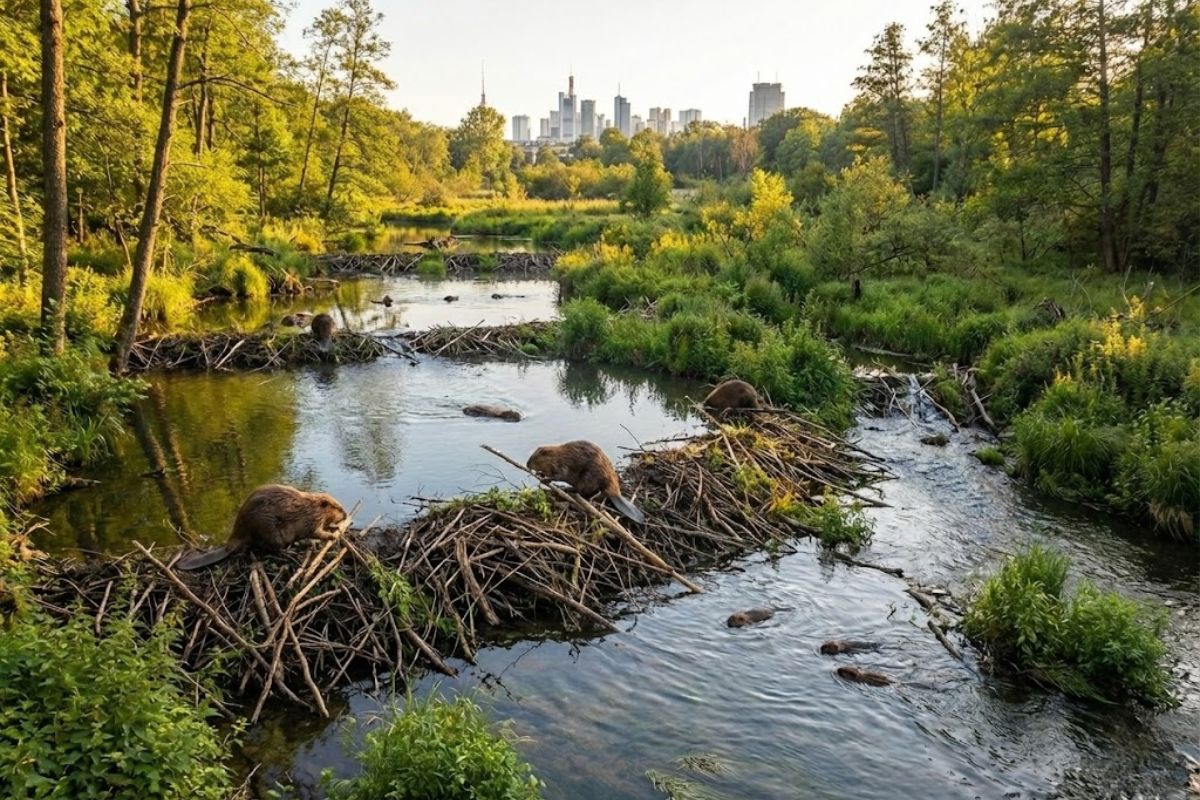
After Hunts, There Are One Thousand Two Hundred Eurasian Beavers Left in the 20th Century. Protection and Reintroductions Since the 1920s Boosted the European Population. At Sophienfließ, Near Berlin, 35 Dams in 10 Km Filter Phosphates and Chemicals, Raise the Water Table, Prevent Floods, but Create Conflict with Farms and Gardens.
It is still dark when it’s 4:30 AM. Care is taken to make little noise and not scare the beavers, which tend to move around while the city is still asleep. The mere possibility of spotting one of them would already be a victory on a continent that almost lost them.
The scene takes place about an hour from Berlin, in a small river called Sophienfließ. For a long time, this place was synonymous with chaos. The water once turned yellow, loaded with phosphates and chemicals from farms upstream. A few kilometers away, a sewage treatment plant also weighed heavily on the system. Today, what changes everything is not a promise; it is a set of dams that has become living infrastructure.
The River an Hour from Berlin That Changed Status
At Sophienfließ, the contrast is immediate. The surface may appear muddy in some stretches, but the dynamics are different. The water is so clean that, technically, it is drinkable. The cleanliness does not come from a single isolated action; it comes from how the river started to function after the beavers settled there.
-
A “silent skill” is allowing Brazilians to earn up to R$ 22,000 per month without a degree and become indispensable for companies that rely on millions of data to survive.

-
Researchers at the Toyota Research Institute found that if a human uses robotic arms to flip a pancake 300 times in an afternoon, the robot learns to do it on its own the next morning, and this is currently the most promising method to solve the biggest bottleneck in modern robotics.

-
Goodbye iron: a common item in households is starting to lose space to technology that smooths clothes in minutes without an ironing board and with less energy consumption.

-
Antarctica reveals an unusual clue high in the Hudson Mountains, and what appeared to be just an isolated rock began to expose a secret hidden under the ice for ages.


Beavers arrived there about ten years ago and have since transformed the stream into a sequence of ponds and wetlands. The result is a river that has stopped being a fast corridor of pollution and has started to retain, filter, and redistribute water across the landscape.
The Engineering of Beavers: 35 Dams in 10 Km
The number that gives scale to what happens there is objective. Along 10 km, there is a network of 35 structures built by beavers. This chain creates ponds, small lakes, and wetlands full of oxygen-rich water.
The practical effect appears in a chain reaction. By building dams, beavers slow down the flow, and this deceleration opens up space for sediments and part of the chemical load to stop flowing downstream.
The river behaves like a large, constant, and repetitive filter. Instead of just transporting phosphates and chemicals, it starts to hold them longer in the system itself.
The Family Base: A 600 Square Meter Lake
Within this arrangement, there is a central point. A lake serves as the main base for a family of four beavers. This lake is about 600 square meters and stores a huge amount of water. The reason lies in the structure supporting the whole.
There, a giant dam of 20 meters in length holds the lake and keeps the volume stable. This helps explain why the system is not just “a dam”.
It is storage, it is retention, it is the creation of an environment where water stays and works for the territory.
How Beavers Build Dams and Why They Do It
The raw materials are simple: twigs, branches, and mud. To gather these materials, beavers chop down trees with their teeth and transport logs and branches through the water. What seems artisanal is, in practice, an efficient method of altering the landscape.
The reason is also straightforward. On land, beavers are slow and clumsy. In water, they become fast and agile. The ponds become the “front yard,” and the entrance to the burrow is hidden underwater.
This configuration protects against terrestrial predators like wolves and foxes, as well as humans. The dam, therefore, serves as both protection and home, but the impact goes beyond the animal.
Filtering Phosphates and Chemicals, Changing the Water Chemistry
Previously, pollution came from farms and the sewage treatment plant located a few kilometers upstream.
The consequence was visible: yellow water, phosphates, chemicals, a river described as chaos. The turning point lies in what the dams do with the flow.
The dams and ponds act as a filter because they decrease the river’s pace. With less speed, sediments and part of what is dissolved in the water get retained for longer. The chemical balance of Sophienfließ itself changes.
It is not a sudden “miracle”, but a transformation through repetition, structure after structure, over the course of 10 km.
A Problem That Is Not Just Local: Sewage and Untreated Water in the World
Sophienfließ is a concentrated example of a much larger problem. The UN Environmental Program points out that more than 80% of wastewater resulting from human activities ends up untreated in rivers and streams worldwide.
In other words, the pressure on water is global, and what happens near Berlin resonates with what occurs in distant regions.
In this scenario, beavers emerge as a rare form of non-human response. They build structures, modify the surrounding environment, and, in doing so, end up reducing some of the damage that flows through the rivers.
The Decline of Beavers in Europe: From Tens of Millions to Almost Zero
For a long time, Europe did not see the benefits of beavers. Systems similar to that of Sophienfließ existed throughout the region, and the population numbered in the tens of millions. This situation crumbled in the 19th century.
Beavers were hunted for their exceptionally thick fur, for meat, and for the so-called castoreum, a secretion used to make perfumes and medicines.
By the time the 20th century arrived, only about one thousand two hundred Eurasian beavers remained. It was a near-planned extinction, driven by market and habit.
Protection and Reintroductions: The Turnaround Since the 1920s


Recovery begins when several countries grant beavers protective status and ban hunting and trapping. Starting in the 1920s, reintroductions began in Europe, North America, and the British Isles, using the small remaining populations to spread them and allow natural multiplication.
The result is a historical leap. In about 100 years, the number of beavers rises to more than one and a half million in Europe and more than ten million in North America.
And when beavers return, the territory regains dams, ponds, wetlands, and a complete reorganization of water.
Groundwater: The Resource That Sustains Half of the Drinking Water
The impact of beavers is not confined to the river’s surface. One of the central points is groundwater. Half of the world’s drinking water comes from groundwater, in addition to being essential for agriculture and industrial manufacturing.
Near Sophienfließ, there is a consumption landmark: the Tesla Gigafactory is just 40 minutes away and uses, according to the company, the same amount of water as a city of 10,000 inhabitants.
At the same time, the continent is going through a critical period: between 2018 and 2022, Central Europe experienced some of the worst droughts in recorded history, with depleted and polluted groundwater levels.
High Water Table: When Water Returns to the Landscape
In the beaver settlement of Sophienfließ, the difference appears on the ground. The groundwater level near the river is likely very high and is sustained by the activity of beavers. The structures conserve water in the landscape, allowing infiltration into the aquifer and helping maintain levels.
There is so much groundwater that, in some places, it even rises to the surface. When it reaches the surface, the oxidation of iron can produce a reddish color in the areas around. It is the landscape visibly showing that it has returned to holding water.
Fires: Wet Bulges That Become Natural Barriers
The extra water changes the fire risk. In the United States, this is strongly evident in a specific episode: in 2018, a forest fire devastated southern Idaho, burning 65,000 acres of forest and land and destroying everything in its path, except for the pockets of beaver territory.
These pockets functioned as natural barriers. The landscape remained wetter due to the activity of beavers, recovery was faster, and the extent of damage was significantly less. In a time of more common and extreme fires, moisture becomes real protection.
Floods and Flash Floods: Dams Slow Down Peaks and Hold Sediments
Climate change increases the chance of extreme events, and with them, the brutal alternation between excess and lack of water. At this point, beavers also intervene.
When a flood peak occurs, without dams, water would rush at speed and power, carrying sediments, wood, and rocks down to the lake.
With beaver dams, peaks lose speed, part of the sediment gets trapped, and damage tends to be less. Beavers help when there is little water and when there is an excess of water. They push the system toward a middle ground that the landscape could no longer find on its own.
The Border with the Czech Republic: The River That Moves with Beavers
To understand what happens when the population grows, the observation goes a few hours south, crossing the border into the Czech Republic. There, the border is a river that moves based on the activity of beavers.
It is a direct portrayal of how dams and retention can reshape a territory that, by definition, seemed fixed.
This stretch also exposes the political and practical dimension of the return. When an animal alters the course of a river, it impacts boundaries, properties, banks, and the human organization of space.
An EU-Funded Project to Measure Benefits and Problems
In this scenario, enter Torsten Heyer and Ales Vorel, connected to a project funded by the European Union. The question is straightforward: does the help of beavers in adapting to climate change justify the work they cause?
The location was chosen for having a well-established beaver population and for being in a region vulnerable to global warming.
Drought, fires, floods, and bark beetle infestations have already affected many nearby forests. Nevertheless, beavers are already making a difference there, creating stable ecosystems with their dams.
Twelve Families and a Stable Ecosystem Built by Repetition
In the observed region, there are twelve beaver families. Each family produces a similar effect, and the sum creates a stable ecosystem, filled with dams, water, and life.
The gain appears in diversity. Some species need shallow waters, others deep waters. Some depend on stable water, others on flowing water, small lakes, or ponds.
Beavers deliver exactly that variety by building and maintaining structures. They create habitat options where there was once a uniform channel.
Straightened and Paved Rivers: The Continent That Lost “Chaos”
For centuries, Europe altered the natural courses of rivers, straightening them and paving beds for agriculture, transportation, industry, and settlement along the banks. The result is artificial and barren rivers.
In these rivers, the ingredient that many plants and animals need is missing: chaos. Chaos here means complexity, variation in depth, change in flow, small flooded areas, puddles, ponds, and living banks. Beavers automatically reintroduce this chaos.
They correct barrenness by creating elevations, retentions, and a landscape that breathes water again.
When Beavers Become a Problem: Farms, Gardens, and Crops
The return, however, does not come without friction. As beavers return to former territories, they move into areas where they are not wanted: farms, tree plantations, and places where humans live.
Initially, enthusiasm prevailed, and the return was celebrated. Over time, negative effects appeared: flooded gardens, newly planted trees felled, changes in the water impacting daily life. The same mechanism that filters a river can flood a backyard.
Protected Species: The Tension That Grows with the Population
There is a point that makes the conflict more sensitive: beavers are protected. Hunting, trapping, or removing beavers and their dams requires authorization from authorities. With more beavers, tensions increase.
The issue becomes balance. There are places where beavers cause more damage than benefits. There are places where the benefits are so high that they outweigh the inconvenience. And there is the challenge of deciding this without reducing ecology to a simple equation.
How Much Beavers Are Worth: Large Numbers and a Clear Limit
Ecology is difficult to quantify in currency, but some effects come onto the economic radar. Higher groundwater levels keep plants hydrated and allow for water savings. Reducing the spread of fires and mitigating floods prevents costly damages.
A study found that the services provided by beavers in Oregon could be worth up to 414 million dollars per year.
In another case, a family of beavers built a dam a few hours to the east, creating a flooded area overnight, exactly the type of project authorities had been planning for years. The estimated savings reached 1.2 million euros.
At the same time, there are gains that do not make it to spreadsheets. Being in a landscape with water, life, and diversity produces a human effect of calm and well-being that is priceless.
Tools for Coexisting: Maintaining, Moving, Controlling
The practical path involves guidelines and tools for authorities to decide when a dam is worth the effort for local residents. In many cases, communicating benefits helps reduce rejection and increase tolerance. In others, beavers can be relocated to different areas.
There is also a compromise solution: underwater pipes capable of keeping the ponds small enough to be controlled without the beavers noticing.
This allows for control of water levels without destroying the system and without turning every dam into a direct conflict.
The Accumulated Impact: When a Dam Seems Small and the Collective Becomes a Force
A beaver pond, alone, may seem almost insignificant. An isolated dam may appear to be just a minor intervention. But when twelve families build and maintain structures, the total effect on the water layer becomes enormous.
This is the central point of the return. Beavers do not deliver results through a single act. They deliver through accumulation, through repetition, through maintenance. Each dam is a piece, and the entire landscape changes when the pieces multiply.
Beavers and Other Ecosystem Engineers
Beavers are not the only ecosystem engineers. There are other strong examples. Corridors made by Indian elephants allow other animals to pass safely, spread species over wider areas, and increase resilience in extreme climate events.
In the ocean, mussels and coral polyps build reefs that protect coasts from erosion and extreme events while providing habitat for various types of marine life.
Would you accept beavers building dams near your home, even with the risk of flooding gardens and toppling trees, if it meant cleaner water, fewer floods, and more protection against fires?







-

-

-

-

-

-

13 pessoas reagiram a isso.