





 Portuguese
  English
  Spanish
  5 min of reading
  0 comments


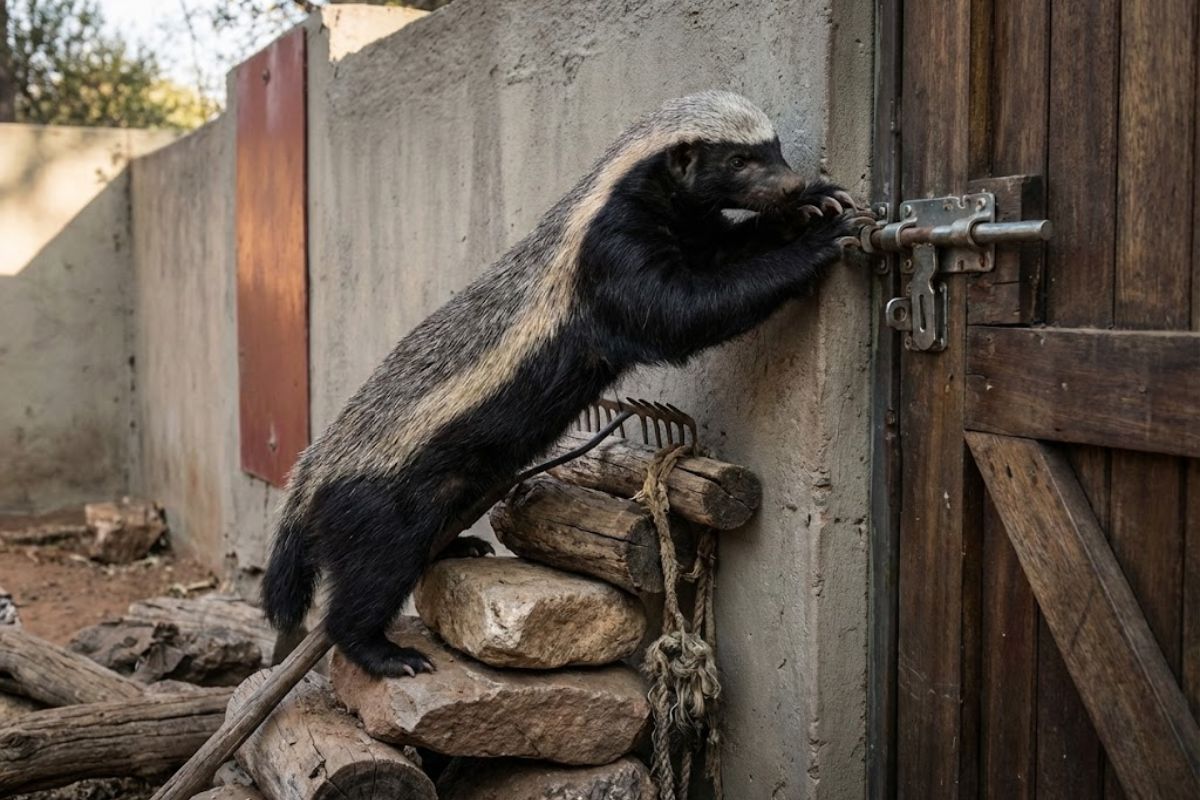
Inside a Enclosure Created to Contain the Honey Badger, Brian Saw the Animal Plan Escape in Series with Its Partner Hammy: First, It Unlocked Two Latches, Then Used Trees, Stones, a Forgotten Rake, and Even a Ball of Mud to Escape and Enter the House in the Early Morning Without Stopping Again.
Widower to tranquility and surrounded by frustrated containment attempts, Brian spent years facing the same problem on his own property: the honey badger Stoffel not only escaped, it “solved” the captivity as if it were a puzzle, repeating escapes even when they seemed impossible.
It all started when Brian decided he needed to control the animal and built a new enclosure, in addition to bringing Hammy to help him de-stress. The intention was simple, to maintain control and reduce the risk of new episodes, but the result was the opposite: the honey badger showed such intelligence that was hard to predict that each reinforcement became just another challenge.
A New Enclosure, A Simple Idea, and a Problem That Only Grew

Brian tried the most straightforward approach: a newly built space, fencing, and routine.
-
Millions of people have been eating yam for centuries without knowing that this humble tuber contains a compound called diosgenin, which scientists have now discovered can improve memory and help control blood sugar levels.

-
Scientists from an international project drill 1,800 meters of ice in Antarctica using hot water and discover details about one of the most intriguing places on planet Earth.

-
Seen from space, a colossal volcano nearly 5,000 meters high in Russia has released 1,600 km of smoke over the Pacific, forming “devil’s horns” of lava and revealing the brutal force of the Ring of Fire.

-
Expedition 501: Scientists drill into the ocean floor and discover a giant reserve of fresh water hidden beneath the sea, extracting nearly 50,000 liters and revealing an invisible system that could reshape the map of water scarcity.


The logic was that a well-made physical barrier would end the escape attempts.
However, instead of settling down, Stoffel reacted as if he had received an invitation to test limits.
Coexisting with Hammy, introduced to relieve stress, also changed the dynamic.
What seemed like a calmer duo turned into a strategic pair.
The behavior of the honey badger was not random: the escapes had sequence, persistence, and adaptation to each obstacle.
The First Major Turnaround: The Gate with Two Latches Became “Teamwork”

The mesh fence was the first bet, and it failed. Shortly after came the gate with two latches, which was supposed to be a final point.
Stoffel, however, devised a plan that depended on cooperation and timing.
He would climb up, open the first latch, and hold the gate, waiting for Hammy.
Then she would climb to the top and remove the second latch.
Only then would the gate fully open, and they would both descend and escape together.
The escape was not by chance: there was order, division of stages, and a repeated execution until it worked.
“Private Alcatraz”: When Reinforcement Became Expensive and Still Wasn’t Enough

After multiple attempts and significant expenses, Brian reached his limit and decided to build maximum containment, described by him as a kind of Alcatraz for the honey badger.
The bet was that a wall and a more robust system would eliminate any chance of escape.
The feeling of victory lasted little. That same night, came the call that shattered any certainty: Stoffel was out.

The first reaction was disbelief because the project had been made precisely to make escape impossible.
Reality showed that, for Stoffel, “impossible” was just another phase of the game.
Trees Became a Bridge and the Exit Appeared Where No One Was Watching
The explanation for the escape did not come from an obvious hole or an open gate.
There were trees on-site, and Stoffel climbed them, leaned over the wall, and escaped.
The exit was not on the ground; it was at height.
Brian’s response was immediate: to cut all the branches and leave the trees “in the middle,” offering no passage to the top of the wall.
However, by closing one route, he unintentionally ignited another challenge. Stoffel did not stop; he just changed his strategy.

Stacked Stones Like a Ladder: Strength, Patience, and Precision Against the Wall

With the branches cut and the aerial route blocked, Stoffel sought what was in the environment itself.
He dug up stones, rolled them with his hind legs to the wall, and carefully stacked them, layer by layer, until he reached sufficient height to overcome the wall.
When the team removed the stones, he would start over.
To him, it was like a mental game: each containment measure turned into a problem to be solved.
The repetition was not stubbornness; it was method.
The Escape Went from the Enclosure to Inside the House and Exploded the Risk of Routine


The most frightening moment occurred at 1 AM. Brian’s wife woke him up with an alert: someone in the house, a broken window, the immediate suspicion of thieves.
The tension lasted seconds until the unexpected discovery.
It was Stoffel at the bedroom door, trying to get in.
The escape was no longer just about “leaving the enclosure”; it was about crossing the property and reaching the most intimate space of the house.
The containment had turned into a domestic security problem, and the honey badger was testing limits that no one planned to face.
The Ball of Mud and the Improvised “Step” That Fooled Everyone
When asked if that was training, Brian denied outright.
He didn’t train the animal to perform any of that, nor did he imagine such solutions.
What he saw was a disconcerting improvisation: Stoffel made a ball of mud, mashed it to enlarge it, rolled it to position it, climbed on top, and used it as a base to gain height and escape.
Creativity emerged as a tool, even without “tools” in the conventional sense.
The Forgotten Rake and Proof That Any Object Can Become a Tool
In another striking scene, a caretaker left a rake in the enclosure. Stoffel scratched himself, lay on his side, and seemed to be thinking. Brian’s description is simple and revealing: “computers working.”
Then the animal took the rake, placed it on its back, and leaned it against the wall, creating a sort of support to gain height and escape. The most dangerous detail is not the object itself, but the ability to see function where no one sees.
When Captivity Becomes a Game and the Team Starts Losing Before It Begins
The central point of this story is not just the repeated escape.
It is the feeling that every human attempt to contain Stoffel turned into a new round of a game, in which the honey badger always seemed to be one step ahead.
Brian sums it up as constant deception: every plan he devised became, for Stoffel, a chance to find out how to overcome it.
The more experienced the team was, the greater the shock upon realizing that the “final solution” was never final.
Do you think an animal like this should be kept in captivity, even with so many risks, or has the challenge of containment become too great a danger for any caregiver?







-

-

-

6 pessoas reagiram a isso.