





 Portuguese
  English
  Spanish
  6 min of reading
  0 comments


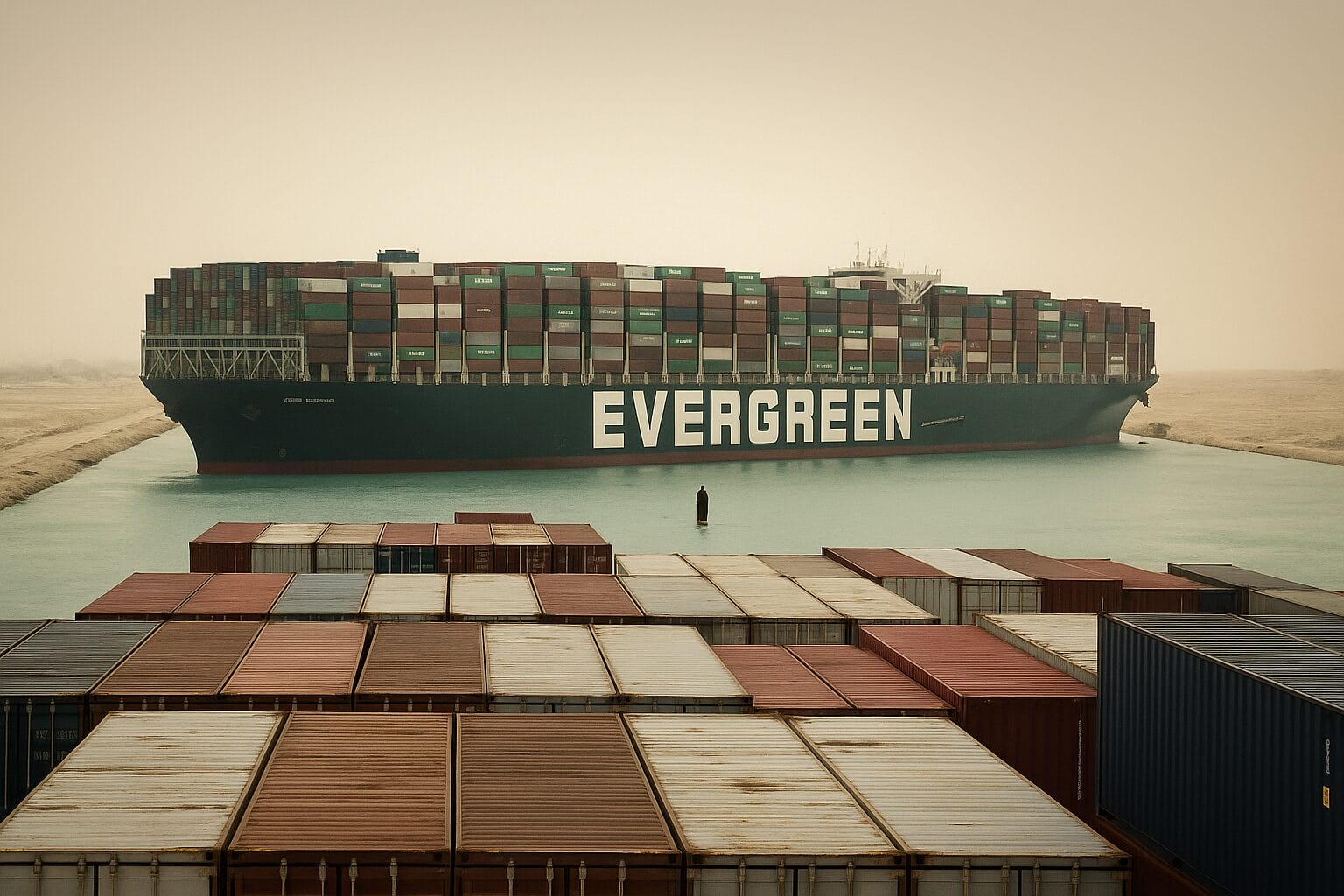
In March 2021, the world stopped in front of an unusual scene: a giant ship stuck on its side on one of the main trade routes on the planet. The stranding of the Ever Given in the Suez Canal caused a six-day blockade, interrupted billions of dollars in goods, and became a symbol of the fragile balance of global trade.
The Suez Canal, in Egypt, is considered one of the most strategic arteries of international maritime transport, stretching 193.3 km and linking the Mediterranean Sea to the Red Sea. This direct connection between Europe and Asia allows ships to save thousands of kilometers of navigation, avoiding the complete circumnavigation of the African continent. Before its inauguration in 1869, routes like London to Mumbai covered about 19,950 km. With the canal, this distance was reduced to approximately 11,670 km — representing a savings of up to 30 days of navigation and a significant reduction in fuel consumption. Daily, between 50 and 70 vessels cross the canal, which handles about 14% of global trade. Unlike the Panama Canal, the Suez Canal has no locks, as the Red Sea and the Mediterranean are at the same level. This feature makes it particularly attractive for the traffic of giant ships, like the iconic Ever Given ship, which in 2021 became stranded in the canal, disrupting global trade for six days and highlighting the vital importance of this maritime route for the world economy.
The Giant Ship Ever Given: The Colossus of 400 Meters That Stopped the World
On March 23, 2021, the Ever Given, a 400-meter-long and 59-meter-wide vessel, ran aground in a narrow stretch of the Suez Canal due to strong winds and navigational failure.
Operated by the company Evergreen Marine, the freighter belongs to the Ocean Alliance, formed by other giants such as CMA CGM, Cosco, and OOCL. With a capacity of 20,000 six-meter containers, it became the symbol of modern logistical chaos.
-
Friends have been building a small “town” for 30 years to grow old together, with compact houses, a common area, nature surrounding it, and a collective life project designed for friendship, coexistence, and simplicity.

-
This small town in Germany created its own currency 24 years ago, today it circulates millions per year, is accepted in over 300 stores, and the German government allowed all of this to happen under one condition.

-
Curitiba is shrinking and is expected to lose 97,000 residents by 2050, while inland cities in Paraná such as Sarandi, Araucária, and Toledo are experiencing accelerated growth that is changing the entire state’s map.

-
Tourists were poisoned on Everest in a million-dollar fraud scheme involving helicopters that diverted over $19 million and shocked international authorities.


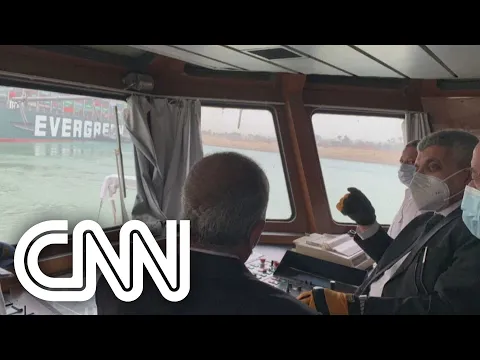

The stranding was so severe that the ship was crossed sideways, lodged against both banks of the canal, completely blocking the passage.
The Consequences of the Stranding: 6 Days of Global Paralysis
The scene of the stranded ship went viral on social media and exposed a little-known reality outside the logistics sector: the world relies on extremely vulnerable routes.
During the six days of blockade, more than 400 ships were stranded or redirected. The queue grew on both sides of the canal, with freighters, tankers, oil tankers, and even aircraft carriers awaiting passage.
The consequences were immediate:
- Delays in global supply chains
- Product shortages in various sectors, such as electronics, automobiles, and clothing
- Spike in oil prices, as a significant portion of fuel traffic also uses the canal
- Estimated losses of over US$ 10 billion per day, according to Lloyd’s List
Shipping companies even redirected vessels via an alternative route, bypassing the Cape of Good Hope, in southern Africa, which represents an increase of over 9,000 km in the journey.
Why Is the Suez Canal a Critical Bottleneck?
In addition to being a unique route with no viable alternatives in the short term, the canal is operated by an Egyptian state structure — the Suez Canal Authority (SCA) — which, while highly efficient, depends on limited infrastructure for increasingly larger ships.
In the last 50 years, freighter ships have grown exponentially. While in 1956, the average width of a freighter was 148 m on the deck, in 2010 this number exceeded 313 meters. The Ever Given, at 400 meters, represents this extreme growth.
Despite the expansion works carried out between 2015 and 2020, which included the excavation of a 35 km parallel canal, many sections are still too narrow for complex maneuvers.
How Was the Ship Freed?
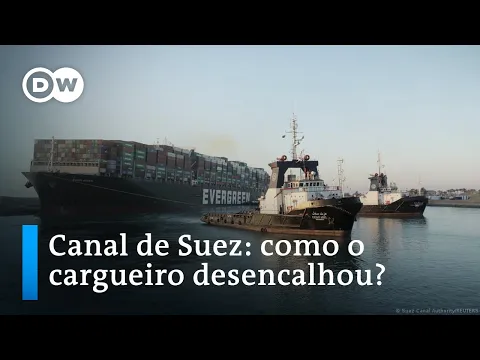
After six days of intense efforts, the Ever Given was freed on March 29, 2021, with the help of:
- 14 large tugboats
- Intensive dredging at the bow and stern
- Manual and hydraulic excavation of the canal’s edge
- Use of high tide to release the hull
The operation involved SCA engineers, Dutch specialists from the company SMIT Salvage, and international logistical support. When it finally moved, the Ever Given was greeted with horns by all the surrounding ships.
The Global Impact on Trade and Logistics
The interruption of the Suez Canal affected a logistics chain already pressed by the COVID-19 pandemic. The world, which had just begun to understand the bottlenecks in semiconductor production, was now seeing maritime transport collapse due to a single incident.
The effects extended for months:
- Congestion in European and Asian ports
- Delayed delivery of industrial components
- Increased cost of maritime freight
- Disorganization of international logistical fleets
Some specialists compare the impact to that of a “broken bridge on a global highway.” When the Suez Canal stopped, the whole world felt it.
Suez Canal: A Story of Geopolitics and Power
The construction of the canal was marked by disputes and suffering. Conceived in Ancient Egypt and dreamed of by Napoleon, it only came to fruition in the 19th century thanks to the French Ferdinand de Lesseps, who obtained a 99-year concession from the then viceroy of Egypt.
Construction began in 1859 and was completed in 1869. It is estimated that over 120,000 laborers died during construction, many under conditions akin to slavery.
Throughout the 20th century, the canal was a stage for political disputes:
- 1956: Nationalization by President Gamal Abdel Nasser
- 1967–1975: Closed during the Six-Day War
- 1975 onward: Reopened and maintained under Egyptian control, gradually modernized
Today, the canal is operated with cutting-edge technology, including radars, satellites, and computerized traffic control.
Unlike the Panama Canal, the Suez Canal has no locks, as the Red Sea and Mediterranean seas are at the same level. This reduces the crossing time, which lasts between 13 to 15 hours.
However, the absence of locks also makes the canal vulnerable to natural variations, such as tides, strong winds, and lateral currents — exactly what helped push the Ever Given off course.
Lessons from the Stranding: The Future of Maritime Trade
The stranding of the Ever Given served as a global alert. Some of the most relevant lessons include:
- Redesign of navigation protocols in narrow canals
- Investments in alternative routes and port infrastructure
- Adoption of smaller ships in critical sections
- Integration of AI systems for forecasting weather and operational risks
Furthermore, the event led Egypt to announce new investments in duplicating and deepening strategic sections of the canal, to avoid future blockages.
The Ever Given Today: Where Is the Ship ‘Symbol of Chaos’?
After the incident, the Ever Given was detained by Egyptian authorities for about three months. The SCA demanded compensations that reached US$ 900 million, but after negotiations, a confidential agreement was reached.
Currently, the Ever Given continues to operate, but its reputation has been marked. It has become an icon of the fragility of global trade — and a living lesson about the cost of logistical dependency.
The stranding of the Ever Given in the Suez Canal is an emblematic case. A single ship, in a stretch of only 200 meters wide, was able to paralyze global commerce, affecting millions of people and trillions of dollars in goods.
The episode exposed the limits of modern maritime transport, still dependent on canals built in the 19th century, and reinforced the need for logistical diversification, investment in innovation and international cooperation.
In the end, the Ever Given was not just a giant ship stuck in a canal — it was a warning that globalization can be as strong as its narrowest point.










Seja o primeiro a reagir!