





 Portuguese
  English
  Spanish
  5 min of reading
  0 comments


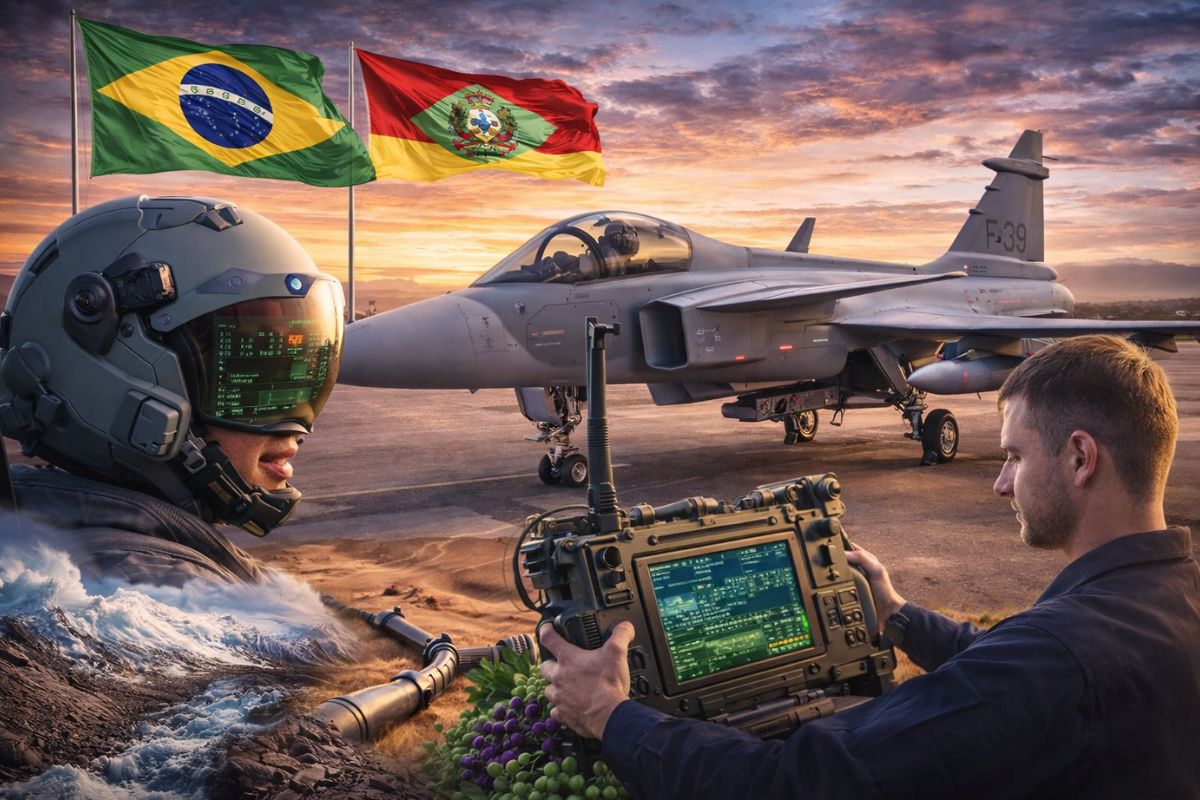
AEL Sistemas is responsible for the avionics of the F-39E Gripen fighter, the most advanced defense aircraft ever produced in Brazil. The company from Rio Grande do Sul developed the panoramic display, the helmet-mounted display, and the encrypted communication system that make up the technological brain of the fighter.
The presentation of the first F-39E Gripen fighter produced in Brazil brought to light a fact that still surprises many people: the digital core of the country’s most advanced military aircraft was developed by a company from Rio Grande do Sul. AEL Sistemas, headquartered in Rio Grande do Sul, is responsible for designing and producing the main avionics systems that equip the fighter, including the high-resolution panoramic display, the helmet-mounted display, and the encrypted tactical communication system.
AEL’s prominence in the Gripen program represents a milestone in the Brazilian defense industry. Instead of simply importing ready-made technology, Brazil developed critical components internally that define the operational capability of the fighter, systems that determine how the pilot perceives the battlefield, processes information, and communicates securely with other aircraft and command centers.
The panoramic display that changes how the pilot operates the fighter
Among the components developed by AEL Sistemas, the most notable is the Wide Area Display (WAD), a high-resolution panoramic display that consolidates all essential information for the operation of the fighter into a single interface.
-
Scientists have excavated a giant cave beneath the snow of Antarctica to create a natural refrigerator at minus 50 degrees that operates without electricity and can preserve the Earth’s climate memory for centuries.

-
Scientists detect a rare and frightening phenomenon in the Pacific Ocean that could trigger a devastating Super El Niño as early as 2026, and American experts say it is one of the strongest ever recorded in history.

-
Researchers from Embrapa have discovered how to transform the saline water found in 140,000 wells in the Brazilian Semi-Arid region into a tool for producing food in an area where agriculture has always relied solely on rainfall.

-
China inaugurates a ghost factory that operates in the dark 24 hours a day without any human workers and produces 10 million smartphones a year using 97% of equipment developed by the company itself.


Radar data, electro-optical sensors, navigation, electronic warfare, and mission systems appear organized on a configurable and touch-sensitive screen, allowing the pilot to have a complete tactical view without needing to switch between multiple panels.
In practice, this technology reduces what experts call cognitive load the amount of information the pilot’s brain needs to process simultaneously during flight. In a combat scenario, where decisions need to be made in fractions of a second, the difference between a well-designed interface and a disorganized one can determine the outcome of a mission.
The fact that this display was developed and produced entirely in Brazil, by AEL, is significant because it places the country in a select group of nations with mastery over this type of avionics technology for fighter aircraft.
Helmet-mounted display and HUD enhance the pilot’s perception of the fighter
In addition to the panoramic display, AEL Sistemas developed two other systems that complement the avionics architecture of the F-39E Gripen fighter.
The first is the Head-Up Display (HUD), which projects essential flight data such as altitude, speed, and direction directly into the pilot’s field of view, without the need for them to lower their eyes to consult the panel instruments.
The second is the Helmet Mounted Display (HMD), a display integrated into the pilot’s helmet that represents a technological leap in the operation of fighter aircraft.
The HMD projects combat information directly onto the helmet visor, meaning the pilot can track tactical data simply by looking around the cockpit, without needing to keep their eyes fixed in a specific direction.
This enhances spatial awareness and responsiveness in complex situations, such as air combat where multiple threats move simultaneously.
The encrypted communication system that protects the operations of the fighter
Another strategic component developed by AEL is the Link-BR2, an encrypted tactical communication system that allows secure data exchange between aircraft and command centers in real-time.
In modern military operations, the ability to share information quickly and securely is as important as the fighter’s armament, as it enables coordination among multiple aircraft, coordinated mission control, and integrated responses to threats.
The Link-BR2 was designed to operate in an increasingly digitized environment, where information security is critical. Non-encrypted or vulnerable communication systems can compromise entire operations, exposing positions, routes, and strategies to adversaries.
The fact that Brazil developed this system internally, rather than relying on foreign technology, strengthens the country’s technological sovereignty in the defense sector and ensures that the F-39E Gripen operates with a communication channel whose code is nationally controlled.
Why the Gripen has a Brazilian digital brain
AEL Sistemas’ participation in the F-39E Gripen fighter program is not accidental. It is part of a technology transfer agreement between Brazil and Sweden, established when the Brazilian government chose the Gripen as the new fighter for the Brazilian Air Force.
The agreement stipulated that Brazilian companies would actively participate in the development and production of aircraft components, and not just in final assembly.
AEL, which already had experience in electronic defense systems, was selected to take on the avionics the set of electronic systems that forms the operational brain of the fighter.
This includes not only the displays and communication system but the entire integrated architecture of hardware and software that ensures interoperability among the different sensors and mission systems of the aircraft.
The result is that the Gripen produced in Brazil is not a simple assembly of imported parts, but a fighter with critical technological components genuinely developed on national territory.
What the prominence of Rio Grande do Sul means for the defense industry
AEL Sistemas’ role in the Gripen program highlights a concrete advancement of the Brazilian defense industry.
Developing avionics for a next-generation fighter requires mastery of systems engineering, signal processing, human-machine interfaces, and military-grade encryption skills that, once acquired, can be applied to other defense projects and even in civilian sectors such as commercial aviation and monitoring systems.
For Rio Grande do Sul, AEL’s prominence reinforces the state’s presence in a segment of extremely high added value.
The fact that the digital brain of Brazil’s most advanced fighter was developed by a company from Rio Grande do Sul shows that the country’s industrial base goes beyond traditional hubs and that investments in cutting-edge technology can yield strategic results from any region.
With information from the portal Aeroin.
What do you think about knowing that the avionics of the Gripen are developed in Rio Grande do Sul? Do you believe Brazil should invest more in the national defense industry? Leave your opinion in the comments.







Seja o primeiro a reagir!