





 English
  Francês
  Alemão
  Italiano
  Japonês
  Norueguês
  Portuguese
  Spanish
  5 min of reading
  0 comments


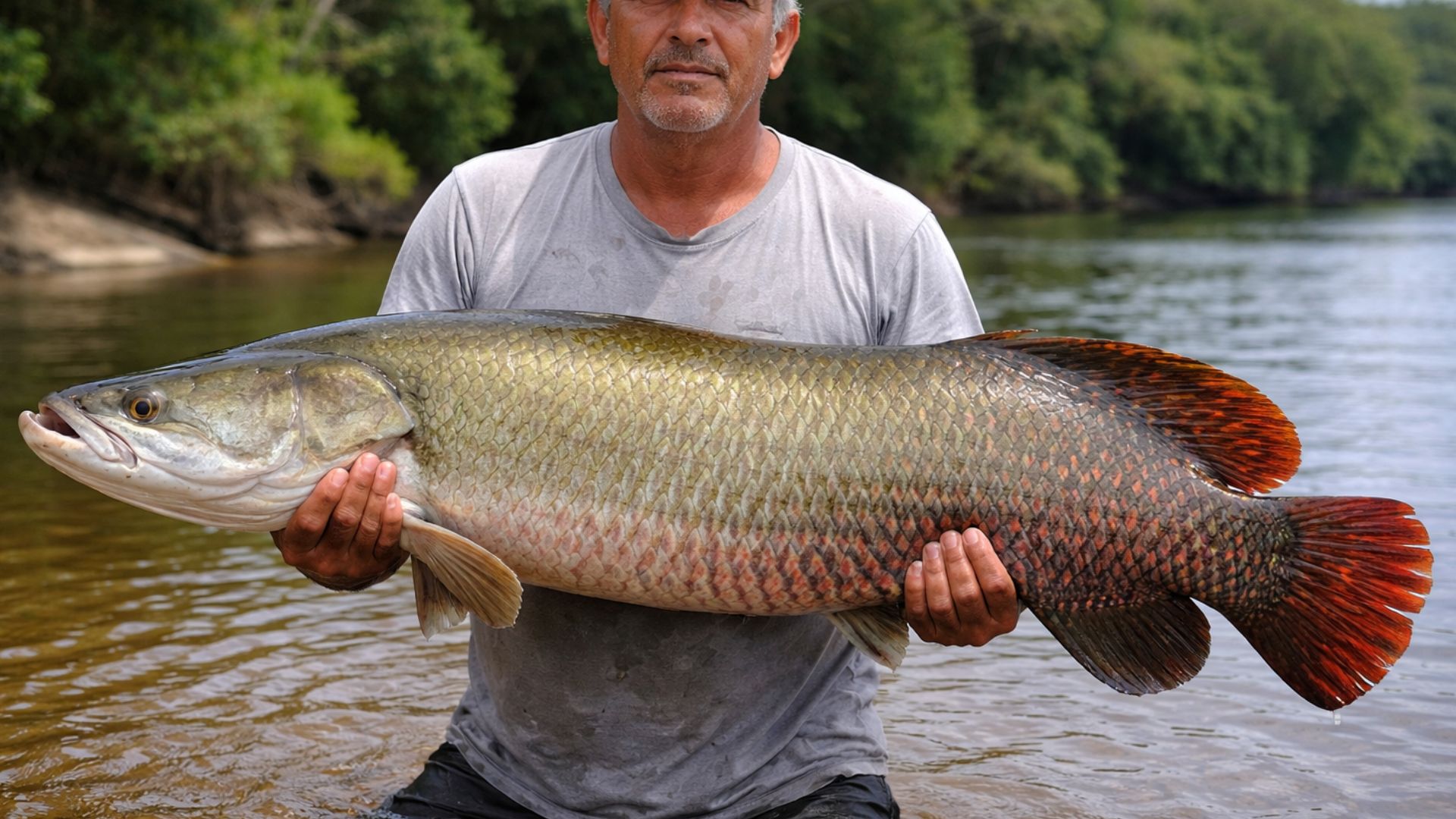
Regulatory change redefines status of pirarucu in part of Brazilian territory, allows slaughter without restrictions in specific areas and provokes immediate reaction from the productive sector in light of environmental, economic impacts and questions about legal safety.
The pirarucu, one of the most emblematic species of the Amazon, has become the target of official control outside its natural occurrence area after Ibama published, last Tuesday (17), Normative Instruction No. 7.
The rule classifies the fish as an invasive exotic species in ten hydrographic regions of the country and also in the upper portion of the Madeira River, above the Santo Antônio dam in Rondônia, allowing fishing and slaughter without limits on quotas, size, or time of year.
Rule allows fishing without limits and changes pirarucu management
In practice, the norm allows capture by both professional and artisanal fishermen throughout the year in these areas, as long as the specimens removed from the water are not returned to the environment.
-
Forgotten region becomes a powerhouse in the heart of Brazil, transforming unproductive lands into fortune and making MATOPIBA the new billion-dollar agricultural empire that almost no one saw being born.

-
With a 775 hp engine, the world’s largest axial combine harvester arrives in Brazil, promising to harvest more in less time with advanced automation and the capacity for platforms up to 61 feet.

-
With 18 million feet, giant farms, and 2.2 million sacks per year, a mining group is building a coffee empire in Brazil with heavy mechanization, giant silos, and exports to various continents.

-
China and Russia suspend fertilizer exports, prices soar, and Brazil is already at real risk of shortages in the fields.


The text also stipulates that the product obtained from this population control can only be marketed within the state where the capture occurred, under penalty of seizure in case of sale outside the originating federation unit.


The change reorganizes the discussion around the fish by separating two distinct realities.
Within the natural occurrence area, the pirarucu remains a native species of the Amazon and maintains recognized economic and environmental importance.
Outside of this space, however, Ibama claims that the fish can exert pressure on the local ichthyofauna due to its characteristics typical of a top predator, with a generalist diet and the ability to occupy different niches in the aquatic environment.
Advancement in the Madeira River is linked to environmental changes
In the case of the Madeira River, the decision received special attention because the advancement of the pirarucu into stretches where it previously did not establish itself has come to be associated with environmental changes occurring in the region.
The technical reading reproduced in the material received indicates that, before the changes in the river’s course, rapids and stretches of faster waters functioned as natural barriers, hindering the species’ expansion to areas above the former Santo Antônio Falls.
This context helps explain why an Amazonian fish can be treated as an invader within the Amazon itself, depending on the point in the watershed where it appears.
The framing adopted by Ibama considers the natural distribution of the species and not just its presence in the biome in a broad sense.
That is why the instruction included the upper part of the Madeira basin, upstream of the Santo Antônio dam, among the areas where the pirarucu must be controlled.
Environmental impacts motivate Ibama decision
The official justification is based on ecological risk. According to Ibama, the permanence and expansion of a top predator in ecosystems where it does not naturally occur increases the potential impact on native fish.
In the note released on March 23, 2026, the agency stated that the removal of individuals tends to reduce predatory pressure and, therefore, was authorized as a population control instrument.
There is also another relevant point in the norm.
The instruction provides that control in federal, state, or municipal conservation units will depend on the agreement of the managers of these areas and must follow the respective population control plans.

The text also opens space for local environmental education campaigns and establishes that the rule will be reviewed, if necessary, after three years of validity to measure its effectiveness.
Aquaculture sector reacts and points out legal uncertainty
The reaction from the productive chain was immediate. Entities linked to aquaculture began to point out the risk of legal uncertainty and impact on already made or planned investments around pirarucu farming.
The sector argues that the species has been treated, in recent years, as a promising asset of Brazilian aquaculture, with productive presence in different states and potential for commercial expansion.
Among the public statements, the Brazilian Aquaculture Association, PEIXE BR, stated that the decision raises a red flag for the business environment.
To Compre Rural, the president of the entity, Francisco Medeiros, said that the measure raises concerns due to the lack of dialogue on a sensitive topic and added that the pirarucu is a strategic species for national aquaculture, with the capacity to generate income and regional development.
Medeiros also argued that there is a contradiction between the recent history of incentives for production and the new classification adopted by the environmental agency.
According to him, federal and state governments have recognized the potential of the species for aquaculture in recent years, and the regulatory change now tends to create a worrying precedent by affecting predictability, productive planning, and legal safety for producers.
Regulatory debate increases tension between environment and production
The sector’s criticism gained traction because the debate on invasive exotic species had already been mobilizing different areas of the government.
In November 2025, Ibama itself published clarification stating that the eventual inclusion of species in national lists of invasive exotics has a technical and preventive character and does not, by itself, mean a ban or automatic restriction of use.
At the same time, the agency informed that the update of this list was under analysis at Conabio and mentioned the participation of several ministries, universities, the productive sector, traditional communities, and civil society organizations.
This backdrop helps to understand why the decision regarding the pirarucu generated noise beyond the environmental field.
For aquaculture, the concern is not limited to management in the Madeira River or other basins outside the species’ natural area.
The fear is that the classification will increase regulatory uncertainties around an activity already established in parts of the country, especially when the technical debate on criteria and effects of framing still appears, in other forums, as a topic under discussion.
At the same time, Ibama’s note seeks to delimit the scope of the measure.
The agency states that the instruction deals with the management and population control of the pirarucu where it has been detected outside its natural area, focusing on reducing risks to aquatic biodiversity.
It also recommends avoiding reintroduction or transport of the fish to other water bodies and following the guidance of local environmental agencies, indicating that the strategy combines inspection, capture, and disposal of the specimens removed.
At the center of the controversy is precisely this dual condition of the pirarucu in Brazil.
Symbol of the Amazon and species of high economic value, the fish is now treated, in certain basins, as an environmental problem to be contained.
The new norm makes it clear that the discussion does not revolve around the disappearance of the species or a generalized prohibition of use, but around the attempt to control its presence in areas considered outside its natural distribution, under criteria defined by Ibama in Normative Instruction No. 7, of March 17, 2026.









Seja o primeiro a reagir!