





 English
  Francês
  Alemão
  Italiano
  Japonês
  Norueguês
  Portuguese
  Spanish
  5 min of reading
  0 comments


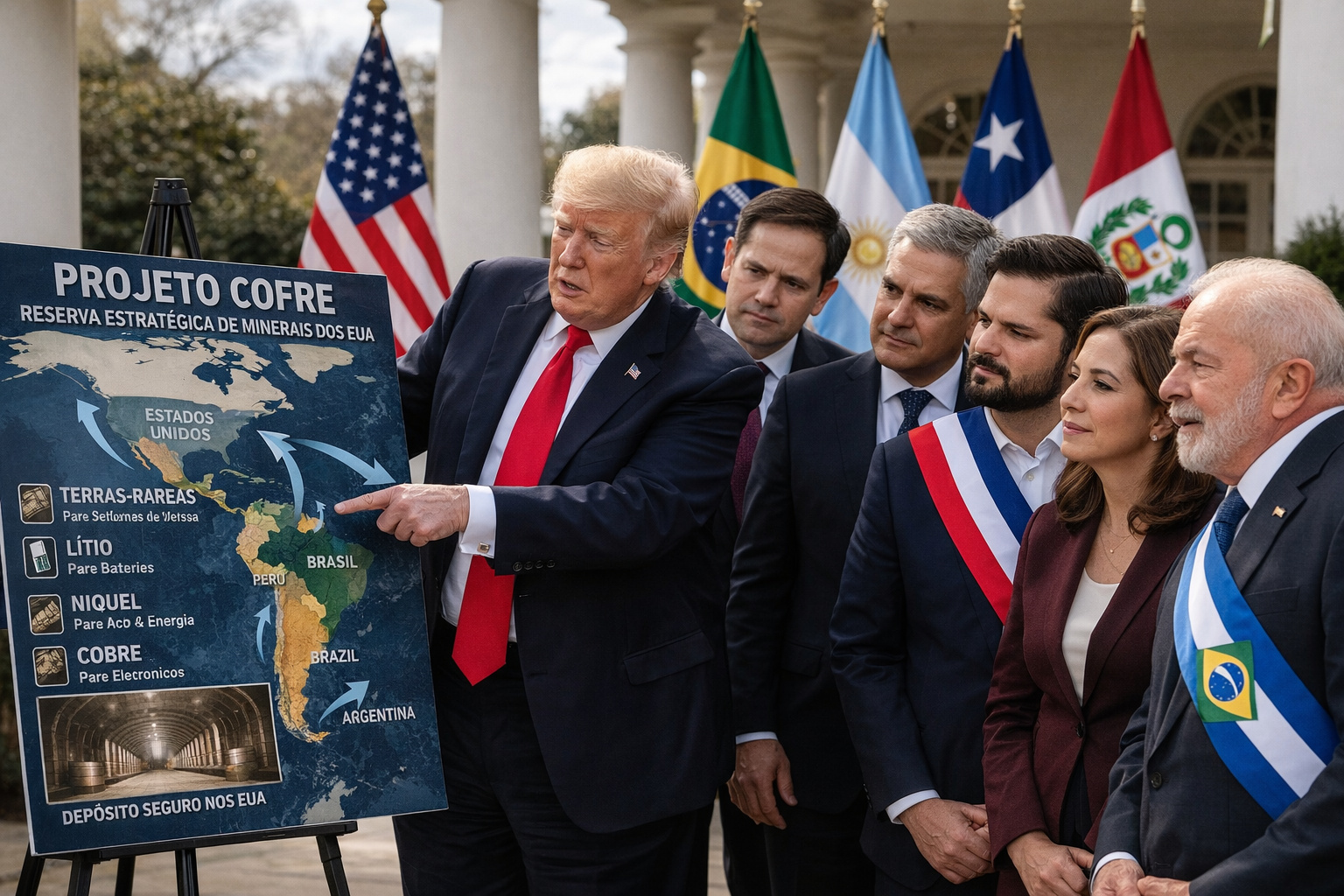
American strategic plan seeks to reduce Chinese dependence and positions Brazil at the center of the new global race for essential minerals
A new mineral strategy with significant geopolitical impact has been presented by the United States, expanding the global competition for strategic resources. In this context, the so-called Project Vault emerges as a direct response to American dependence on China in the critical minerals sector. According to an announcement made in early February 2025 by President Donald Trump at the White House, the plan includes an investment of US$ 12 billion.
With this move, the American government seeks to ensure a continuous supply for strategic industries, technology, and national defense. At the same time, the initiative occurs amid rising trade tensions between the United States and China, as reported by BBC News Mundo. Thus, the project also takes on a significant geopolitical character in the international scenario.
Therefore, in addition to the economic impact, the plan reinforces the competition for global influence in the strategic resources sector. In this sense, the creation of Project Vault represents a structural change in the industrial policy of the United States. Consequently, the strategy combines economic security, technological innovation, and productive independence.
-
If the USA were to go to war with Brazil, Washington’s greatest fear would not be the attack itself, but facing a vast territory, prolonged resistance, and a costly, chaotic, and unpredictable occupation.

-
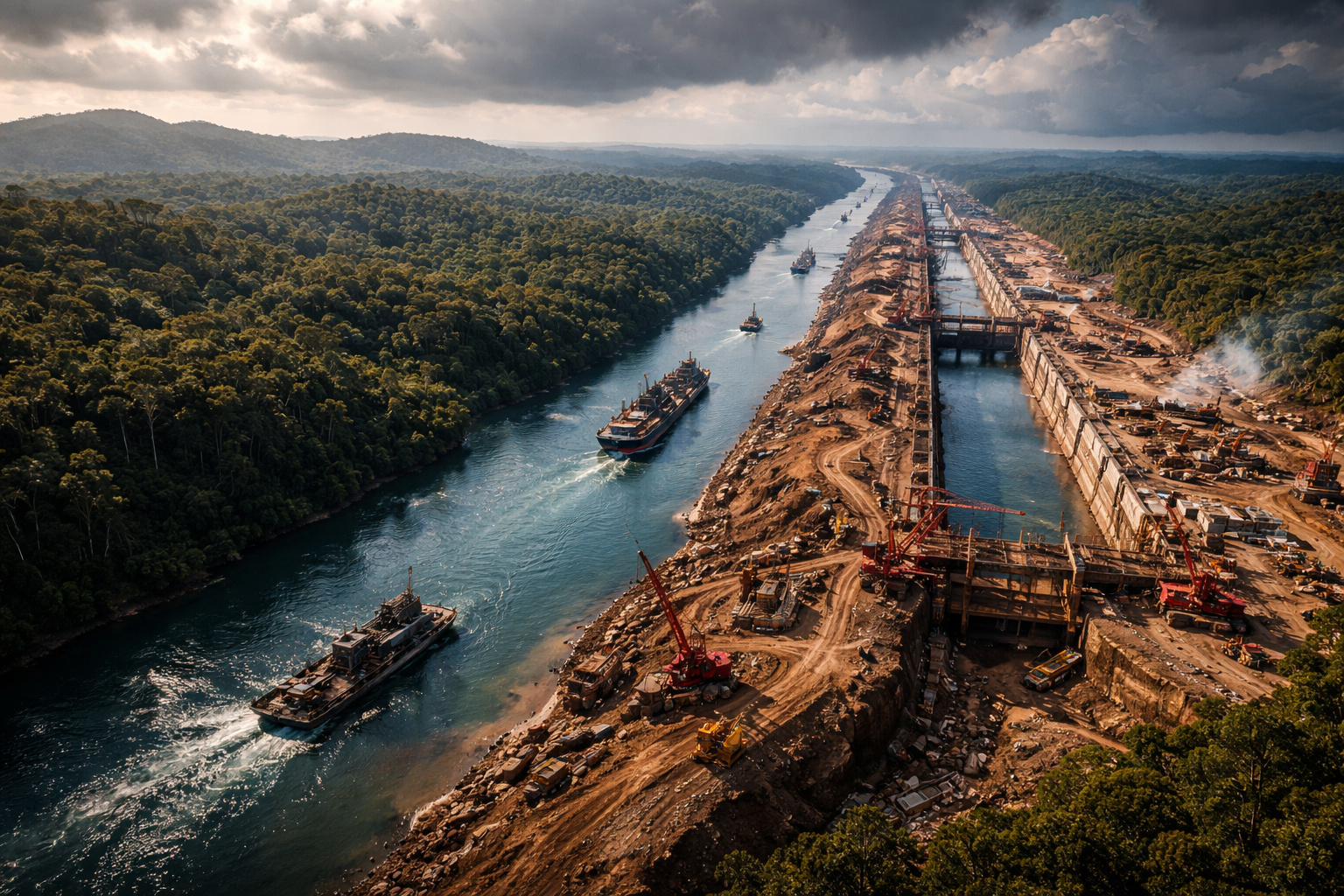
In 2013, Nicaragua sold the concession for a canal to rival Panama to a Chinese billionaire who lost 85% of his fortune, disappeared, and was declared bankrupt. Now the project resurfaces with a new route, a new Chinese partner, and a cost of $64.5 billion.
-
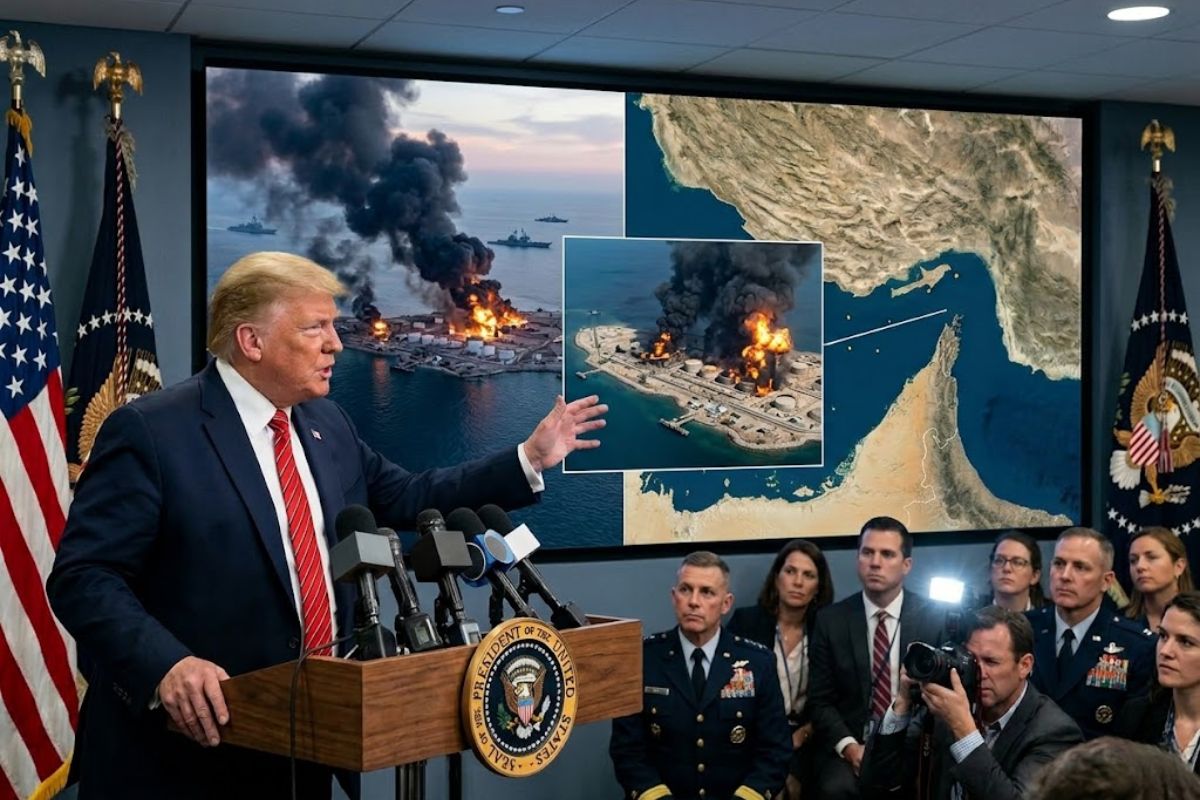
Trump Announces Bombing of U.S. Military Targets on Iranian Island Responsible for About 90% of Iran’s Oil Exports, Warns of Further Attacks if Navigation in Strategic Strait of Hormuz Is Threatened
-
At Less Than 40 Kilometers Wide, Strait of Hormuz Holds 20% of Global Oil and Becomes Epicenter of Global Crisis After Military Operation Against Iran Halts Oil Tankers and Triggers Energy Price Surge


New strategy inspired by the oil reserve
Since the 1970s, the United States has maintained a robust Strategic Petroleum Reserve, created after the energy embargo imposed by Arab countries. Currently, about 714 million barrels are stored in underground salt caverns, ensuring energy security in times of crisis. Thus, this structure has become one of the pillars of American energy policy.
Now, the American government seeks to replicate this model, but focused on critical minerals. In this context, Project Vault emerges as an evolution of this historical strategy. Thus, the proposal expands the concept of energy security to mineral security.
Therefore, the plan represents an adaptation to the new demands of the global economy. Additionally, it reflects the growing importance of minerals in modern industry. Consequently, the country seeks to anticipate risks associated with external dependence.
Critical minerals gain global prominence
The United States classifies about 60 minerals as critical, essential for the functioning of the modern economy. Among them, rare earths, copper, nickel, lithium, cobalt, and graphite stand out, widely used in sectors such as defense, technology, and energy. Thus, these resources become fundamental for various production chains.
Moreover, these materials are indispensable for the production of warplanes, semiconductors, electric vehicles, artificial intelligence systems, and medical devices. In this context, the dependence on these minerals is growing rapidly. Thus, their strategic importance increases in the global scenario.
In this scenario, it is estimated that a single F-35 fighter jet uses more than 400 kg of rare earths, while China dominates approximately 70% of global extraction and 90% of chemical processing. Therefore, Chinese dominance expands its economic and technological influence. Consequently, this pressures other countries to react.
Chinese reaction accelerates American plan
In 2025, the government of Xi Jinping restricted exports of rare earths, highlighting China’s strategic power in global trade. Thus, the decision directly impacted international production chains. Therefore, the measure reinforced global dependence on China.
In light of this, the United States intensified its efforts to reduce vulnerabilities in the supply of these inputs. In this context, Project Vault gains strategic priority. Therefore, the initiative seeks to anticipate possible future crises.
According to statements from President Trump, the country does not intend to face scarcity situations again. Additionally, the policy aims to ensure industrial stability. Consequently, the plan consolidates as a tool for economic security.
Challenges in the mineral production chain
Despite the urgency, experts point out significant obstacles to the execution of the plan. According to Jeff Dickerson from the consulting firm Rystad Energy, the United States has been slow to build adequate stocks. Thus, recovering competitiveness becomes more complex.
Moreover, the biggest challenge lies in processing these resources. In other words, it is not enough to simply extract the minerals. Thus, it is necessary to transform them into usable materials.
Therefore, creating a complete industrial chain becomes essential. Additionally, this step is considered strategic. Consequently, the success of the plan depends on this structure.
Latin America becomes a battleground
In this scenario, Latin America gains increasing strategic importance, especially due to its mineral diversity. According to Henry Ziemer from the Center for Strategic and International Studies (CSIS), the region has taken a central position in American foreign policy. Thus, mineral resources have become a geopolitical priority.
Furthermore, Latin American countries concentrate significant reserves of critical minerals. In this context, investors and governments are increasing their attention on the region. Thus, international interest is growing rapidly.
Meanwhile, China maintains a strong presence in the region, especially in the Southern Cone. According to Tilsa Oré Mónago from Rice University, the United States has arrived late to this competition. Consequently, the competitive scenario becomes more challenging.

Brazil assumes a global strategic role
In this context, Brazil emerges as a key player in the American strategy, mainly because it holds between 20% and 23% of the world’s rare earth reserves, ranking second globally. Thus, the country gains international relevance. Consequently, its strategic position strengthens.
In 2025, Brazil exported about US$ 12 million of these minerals. However, approximately 99.4% were destined for China, highlighting the current commercial dependence. Therefore, the trade flow remains concentrated.
Thus, a possible partnership with the United States could alter this scenario. Still, the Brazilian government maintains a cautious stance. Consequently, negotiations proceed with prudence.
International agreements advance rapidly
Following the announcement of Project Vault, the United States intensified diplomatic efforts. According to the U.S. Department of State, 11 agreements on critical minerals have been signed, including countries such as Argentina, Ecuador, Paraguay, and Peru. Thus, the international strategy strengthens.
Additionally, Mexico has joined a strategic action plan. According to trade representative Jamieson Greer, these agreements involve extraction and processing projects. Thus, the production chain gains regional integration.
At the same time, Chile has initiated bilateral consultations with the U.S. The country is a leader in copper production and lithium reserves. Consequently, its strategic importance increases.
Missing link may define the project’s future
Despite the enormous mineral potential of Latin America, there remains a significant structural challenge. According to Jeff Dickerson, the main problem lies in the absence of local processing. Thus, external dependence remains.
In other words, many minerals still need to be refined outside the region, especially in China. Thus, the production chain remains incomplete. Therefore, this factor limits regional autonomy.
Thus, building this complete industrial chain becomes decisive for the success of Project Vault. Additionally, the geographical proximity to the United States favors this integration.
Consequently, the global competition for critical minerals is likely to intensify — and whoever dominates this chain could lead the new global technological economy?









Seja o primeiro a reagir!