





 English
  Francês
  Alemão
  Italiano
  Japonês
  Norueguês
  Portuguese
  Spanish
  6 min of reading
  0 comments


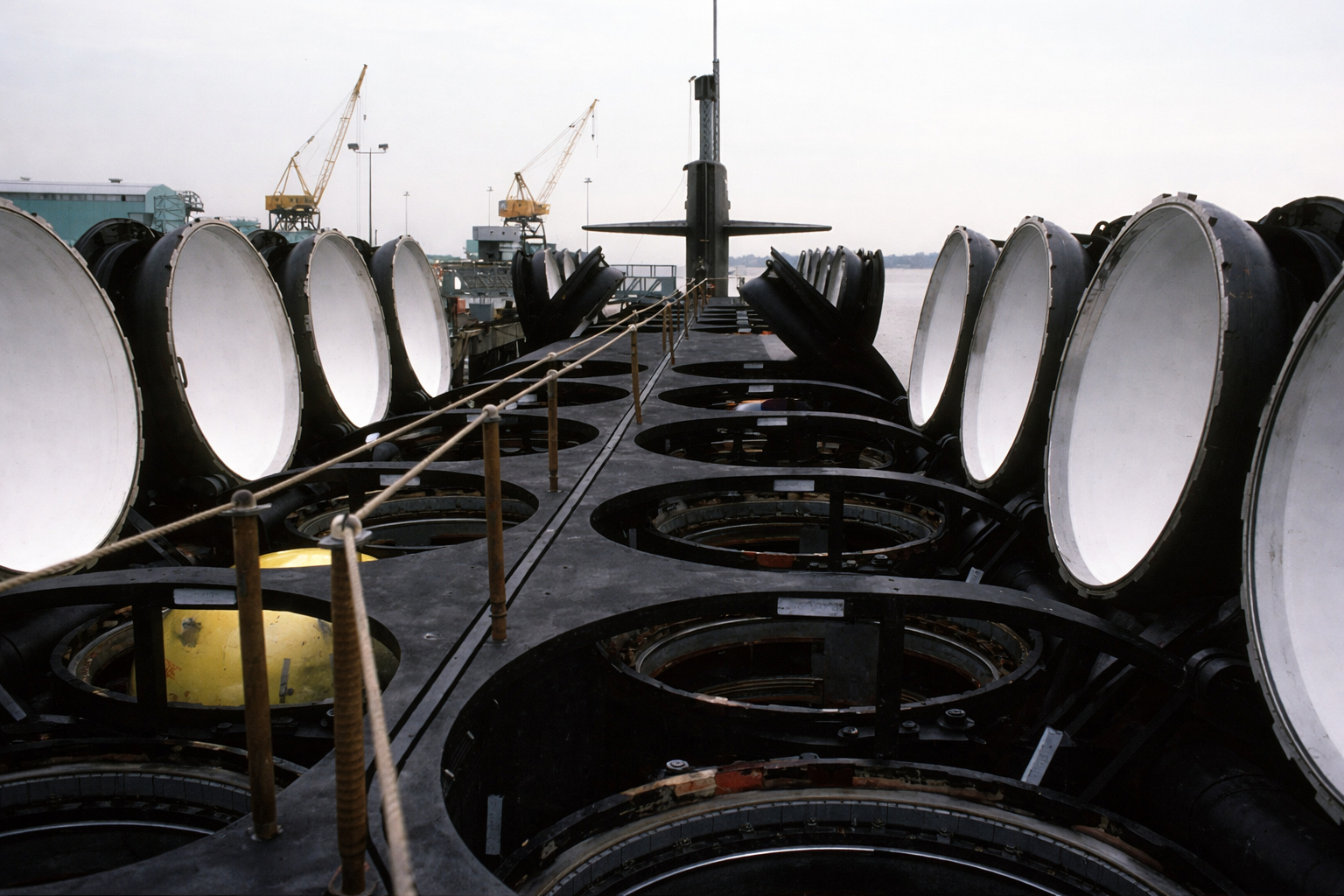
Nuclear SSGN submarines of the Ohio class redefined modern warfare with 154 Tomahawk missiles, secret operations, and global strategic impact.
On March 19, 2011, at 11:59 PM local time, a series of Tomahawks silently launched from a nuclear submarine deep in the Mediterranean and flew towards Libya. Within minutes, Muammar Gaddafi’s air defense radars ceased to function. That night marked a new kind of warfare and the combat debut of a military platform that most of the world didn’t even know existed. The submarine was called USS Florida. It was neither a conventional attack submarine nor a nuclear ballistic missile carrier. It was something completely different: a former strategic nuclear submarine converted into a secret special operations base, capable of launching more Tomahawks than a full carrier strike group. That night, it fired 93 of them. Ninety reached their targets.
According to analysts from the Submarine Industrial Base Council, the operation marked the first time in history that a SSGN-class guided missile submarine launched Tomahawks in combat.
The origin of the SSGN submarines of the Ohio class and the post-Cold War transformation
The story begins at the end of the Cold War. In 1994, the United States Nuclear Posture Review concluded that the country needed only 14 of the 18 Ohio-class SSBN nuclear submarines to maintain its strategic deterrence. The four oldest — Ohio, Michigan, Florida, and Georgia, commissioned between 1981 and 1984 — would be retired to meet the requirements of the START II treaty.
-
Brazil presents the first national F-39 Gripen fighter and redefines air defense with technological advancement, job creation, and strengthening of the defense industry on the global stage.
-
The construction of the Polar Ship Almirante Saldanha is progressing ahead of schedule and strengthens Brazil’s presence in Antarctica; the vessel will be 93 meters long, have a two-month autonomy, and technology to face ice.
-
The United States Army has an armored vehicle that reaches speeds of up to 100 km/h, capable of operating normally on different types of terrain and also on asphalt without causing damage; equipped with a 350 hp engine, it can transport up to 9 soldiers — meet the Stryker.
-
Gepard 1A2: the armored vehicle that fires 1,100 rounds per minute and became a shield against drones in Brazil.

The United States Navy faced a strategic decision: deactivate the submarines or reinvent them. It chose the latter option.
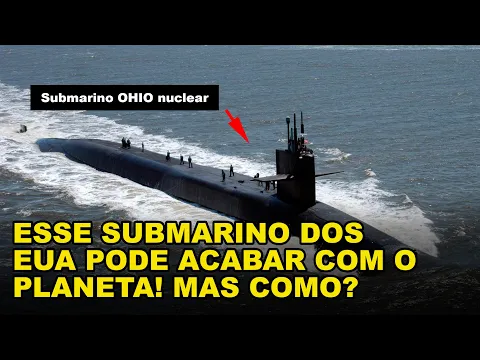

Between 2002 and 2008, each unit spent about 36 months in dry dock for an unprecedented conversion. The cost ranged from $700 million to $1 billion per submarine. The result was the emergence of a new class: the SSGNs, nuclear submarines capable of launching guided missiles.
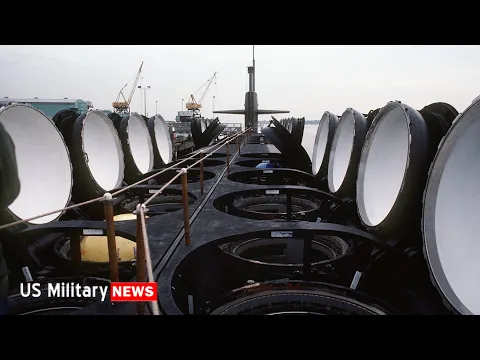
The old Trident nuclear missile tubes were modified. Twenty-two of the 24 tubes were adapted to accommodate multiple launch systems for Tomahawk missiles, with seven missiles per tube, totaling 154 per vessel. The remaining two tubes were converted into exit chambers for special operations.
Additionally, internal compartments were adapted to accommodate up to 66 special forces operators, including Navy SEALs and MARSOC units, transforming the submarine into a clandestine forward operating base.
Attack capacity of the SSGN submarines: firepower superior to aircraft carriers
The strategic relevance of SSGNs can be understood by direct comparison with aircraft carrier strike groups.
A Nimitz-class aircraft carrier, accompanied by destroyers and cruisers, carries approximately 60 Tomahawk missiles distributed among its escort ships. A single Ohio-class SSGN carries 154.
Two submarines of this class equal the firepower of an entire battle group, with the crucial difference of operating invisibly, hundreds of meters deep.
Each SSGN uses two rotating crews, known as Blue Crew and Gold Crew, allowing for continuous operation over long periods without the need to return to base. The USS Florida, for example, completed a mission in May 2025 after 727 consecutive days in operation, covering three strategic areas simultaneously: Middle East, Mediterranean, and Western Pacific.
During this period, it conducted Tomahawk missile strikes against targets in Yemen, demonstrating the operational flexibility of the platform.
Nuclear submarines as a global strategic deterrence tool
SSGNs are not just attack weapons, but instruments of strategic signaling. In June 2010, the USS Ohio, USS Florida, and USS Michigan simultaneously surfaced in three distinct regions: Indian Ocean, Pacific, and Sea of Japan. The action was interpreted as a coordinated demonstration of global reach and responsiveness.
In July 2025, the USS Ohio docked in Brisbane, Australia, marking the first visit of this kind to the country. The event coincided with multinational military exercises and was interpreted as a direct signal to the strategic balance in the Indo-Pacific.
Months later, the same submarine was spotted in the Philippines, in an area close to disputed maritime routes in the South China Sea.
The retirement of the SSGNs and the risk of loss of US military capability
The four Ohio-class SSGNs have an estimated lifespan of 42 years. Their nuclear reactors are approaching operational limits, and maintenance costs are progressively increasing.
The retirement of these units by 2028 represents the elimination of 616 vertical launch tubes from the United States Navy, the largest reduction in long-range conventional strike capability in decades. Currently, these four submarines represent about half of the vertical launch capacity of the American submarine force.
The planned replacement is the Virginia Block V class submarine, equipped with the Virginia Payload Module, capable of carrying 28 additional missiles. To replace a single SSGN, nearly four submarines of this new class would be needed.
However, the industrial capacity of American shipyards does not keep pace with demand. Annual production hovers around 1.1 submarines per year, while more than two would be needed to simultaneously meet internal needs and international commitments, such as the AUKUS agreement.
The differential of the SSGN submarines: invisibility, range, and surprise attack
The main differential of SSGNs is not just the amount of armament, but their ability to operate undetected.
Nuclear submarines can remain submerged for months, limited only by food supplies. Unlike aircraft carriers or naval fleets, they do not produce detectable signatures by radar or satellite.
This allows for positioning close to enemy shores without prior warning. When missiles are launched, the first sign perceived is the impact.
This was exactly the scenario that occurred in Libya in 2011. The USS Florida operated for weeks gathering intelligence before executing the attack. In less than 15 minutes, it neutralized critical air defense systems.
SSGN submarines as secret bases for special operations at sea
Beyond attack, SSGNs introduced an unprecedented concept in modern warfare: submerged bases for special operations.
The adapted compartments allow for the launch of elite teams using infiltration mini-submarines. These operators can reach enemy shores undetected, execute missions, and return to the submarine.
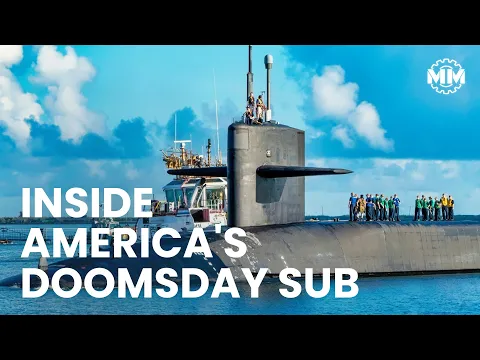
The satellite communication capability allows the SSGN to act as a clandestine command center, coordinating multiple simultaneous operations.
Additionally, the launch tubes can be used for drones, sensors, and experimental systems, further expanding the platform’s versatility.
The strategic challenge: how to replace a capability that cannot be replicated
The United States Navy faces a structural problem. The capability of SSGNs cannot be quickly replaced.
The development of Virginia-class submarines takes years, and shipyards are already committed to producing the strategic Columbia-class submarines.
Meanwhile, other powers are expanding their naval capabilities, including fleets of increasingly silent and technologically advanced submarines. The gradual deactivation of SSGNs will create an operational gap that cannot be filled in the short term.
The legacy of the SSGN submarines of the Ohio class in modern warfare
SSGNs have redefined the concept of naval power projection. They combined massive strike capability, special operations, and strategic command into a single invisible platform. They made it possible to attack, infiltrate, and coordinate operations without detectable presence.
When they surface, as occurred in Brisbane in 2025, it does not represent their normal use, but a strategic message.
The true function of these submarines remains in silence. A silence that, when broken, translates into dozens of missiles hitting their targets simultaneously. Before the debate on replacement concludes, part of this capability will already be out of service. And the silence that will remain will be different.









Seja o primeiro a reagir!