





 Portuguese
  English
  Spanish
  7 min of reading
  0 comments


Natural Clay and Lime Paint: Ecological Alternative Can Cover 30 m² for Less Than R$ 30 and Reduce Chemical Compounds on Walls
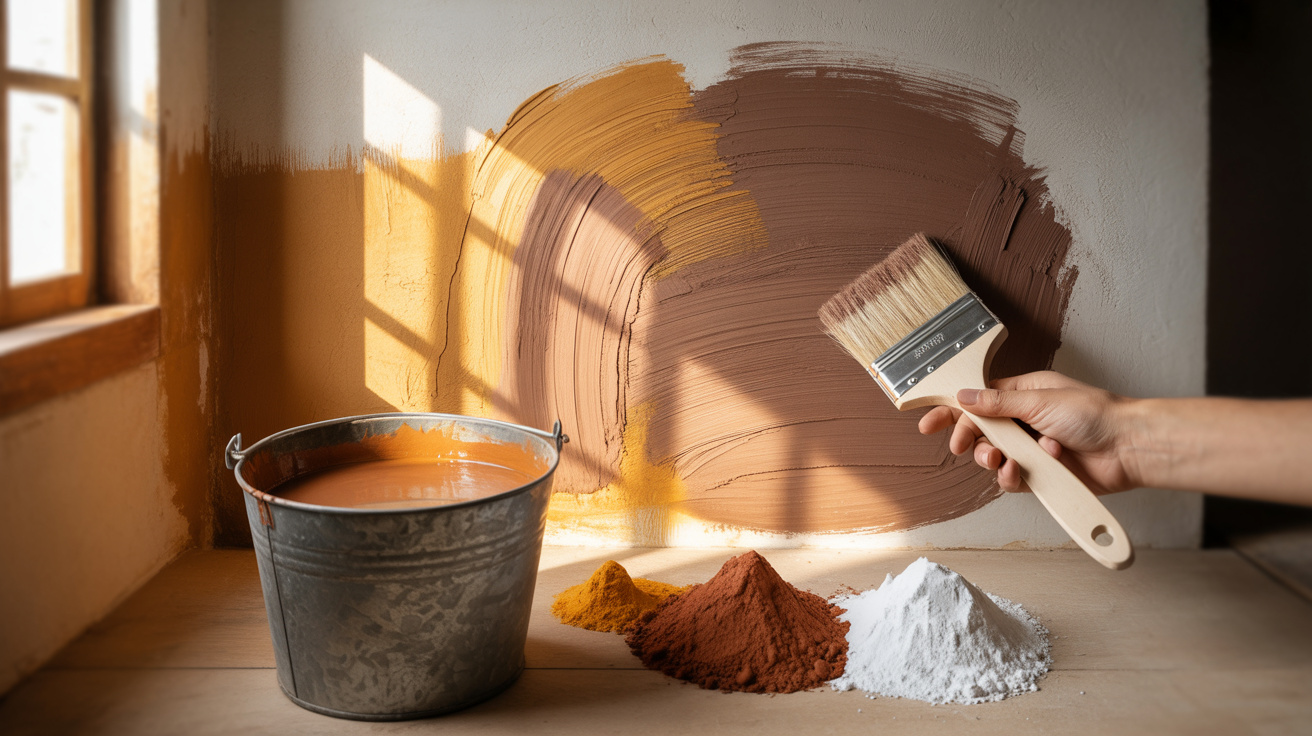
A conventional can of paint to cover about 30 m² costs between R$ 80 and R$ 150 in Brazil. In contrast, a version made with clay, hydrated lime, and natural mineral pigments can cover the same area for less than R$ 30, and depending on the region and availability of suitable soil, the cost can be virtually zero. The technique is used in bioconstruction and sustainable architecture projects, which aim to reduce the use of industrial materials and take advantage of abundant natural resources. The method uses sifted earth, water, lime, and mineral pigments to produce breathable paint with a low environmental impact and a characteristic rustic appearance.
Although it may seem a modern sustainable building solution, this principle is very ancient. Mixtures of clay, water, and mineral pigments have been used for thousands of years for decorative and protective coatings in different cultures, from prehistoric cave paintings to whitewashed facades in the Mediterranean.
Volatile Organic Compounds in Industrial Paints Explain the Strong Odor of Painting
When a can of acrylic or latex paint is opened, the environment often becomes impregnated with a characteristic odor. This smell primarily comes from VOCs — volatile organic compounds.
-
New CCR concrete paving technology promises roads up to 3x more durable, less maintenance, and cost reduction in Brazil.

-
Made from recycled plastic, plastic wood is gaining space in the construction industry because it does not rot, resists moisture, and reduces maintenance costs over the years.

-
Florianópolis will receive a million-dollar BRT that will begin construction in 2026 with nearly 400 million in funding from the federal government and the Inter-American Development Bank, and the map already shows the routes for the exclusive bus corridors.

-
Without a blueprint, without an engineer, and using scrap from the dump, a father spends 15 years building an 18-room castle for his daughter, featuring tram tracks, 13 fireplaces, and over 700 m², which may now be demolished.

These substances evaporate easily at room temperature and are released into the air during the paint drying process. Depending on the concentration and ventilation of the space, they can cause irritation to the respiratory tract, headaches, eye discomfort, and dizziness. With prolonged exposure or in poorly ventilated areas, some of these compounds can cause broader effects on the nervous system.


Researchers from the Federal University of Paraná (UFPR) who analyzed materials used in civil construction noted that industrial paints can represent one of the materials with the highest embedded energy consumption over the life of a building. This occurs primarily because their manufacturing relies on energy-intensive industrial processes and petroleum derivatives.
Another relevant factor is the need for periodic repaints over decades, which increases the total resource consumption. According to these studies, over approximately 50 years of use of a building, the accumulated energy impact of repaints can exceed that of structural materials such as cement, steel, and concrete.
Clay and Lime Paint: Ancient Technique Used Before Industrial Paint
The natural alternative for surface pigmentation has existed long before the modern chemical industry. Mixtures of mineral earth, water, and natural binders have been used by different civilizations to coat internal and external walls.
This principle appears in cave paintings dated tens of thousands of years ago, in Egyptian murals preserved in temples and tombs, and in traditional adobe buildings in Latin America and the Middle East. It also forms the basis of the whitewashed facades common in Mediterranean regions, where hydrated lime has been used for centuries as a protective coating.
The logic remains virtually the same today: a mineral pigment for color, a binder to hold the mixture on the wall, and water to adjust the paint’s consistency.
How Natural Clay Paint Works on the Wall
The natural paint used in bioconstruction is made up of three main elements. The pigment provides the color, the binder allows the paint to adhere to the surface, and water acts as a solvent to enable application.
In the case of clay paint, the clay or sifted earth itself serves as a mineral pigment and also as the mixture’s structure. The hydrated lime or quicklime acts as a binder, helping to anchor the paint to the surface of the plaster.

Lime also has an important property: its natural alkalinity helps inhibit the growth of fungi and mold. Therefore, limewashed surfaces are historically used in internal and external environments as a simple form of protection against microorganisms.
Some modern recipes also include extra-strong white glue, added in small amounts to improve adhesion and increase the paint layer’s resistance.
Breathable Walls: Advantage of Natural Paint Over Synthetic Paints
An important characteristic of clay and lime paint is its ability to allow the wall to exchange water vapor with the environment. In other words, the surface continues to breathe.
This means that the moisture present inside the wall can gradually evaporate, reducing condensation formation and the appearance of bubbles or peeling in the paint.
Synthetic paints, such as acrylics or latex, often form an impermeable film over the surface. When there is internal moisture in the plaster, it can get trapped behind this layer, favoring the emergence of bubbles, stains, or hidden mold.
Natural paint, being more porous, allows for the gradual passage of water vapor, which helps maintain moisture balance within the environment.
Natural Colors Produced by Minerals Present in the Soil
The final color of natural paint directly depends on the mineral composition of the clay used. Different types of soil contain varying proportions of minerals, resulting in distinct shades.
Soils rich in iron oxide, for example, produce ochre, reddish, and brown colors. Lighter clays can yield beige or gray tones. Pure lime produces a bright white hue, traditionally used in whitewashed facades.
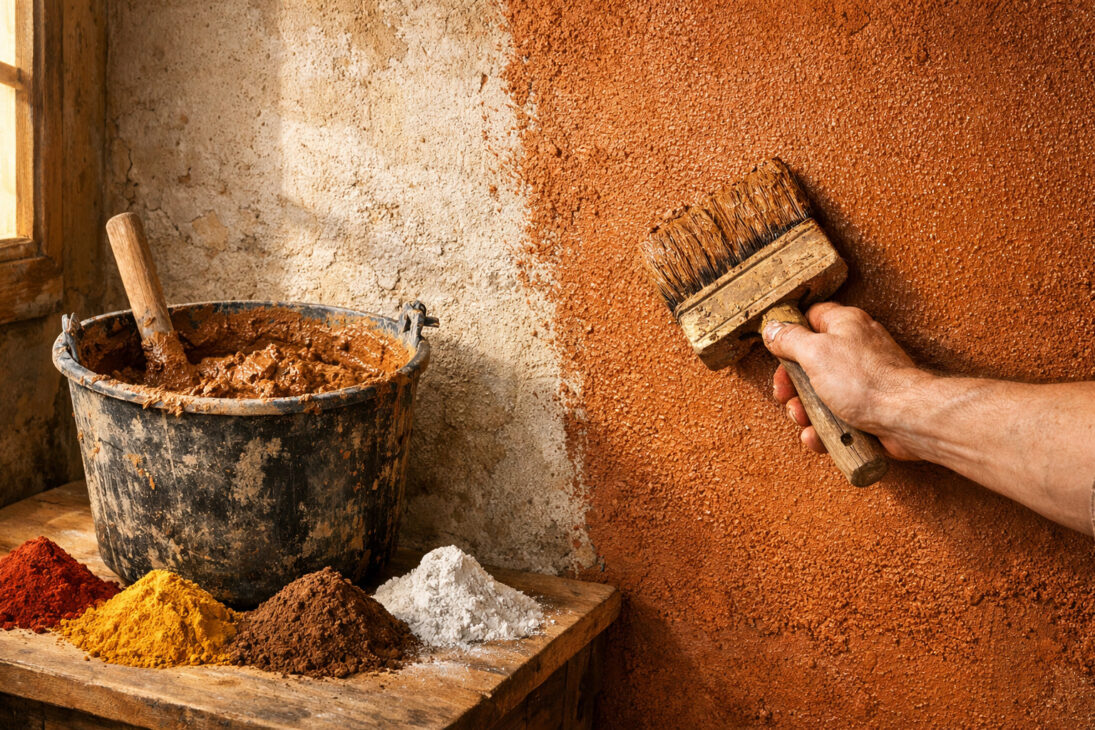
The palette can be expanded with the addition of natural pigments. Annatto can produce orange tones, saffron yields yellow, and charcoal can be used to obtain black or dark gray.
Researchers from UFPR also tested industrial mineral pigments, such as iron oxide powder and black soot, found in construction material stores. These pigments usually cost between R$ 10 and R$ 15 and yield several liters of natural paint.
The visual result differs from industrial paint. Instead of a completely uniform surface, the wall presents natural variations in tone and texture, something valued in ecological architecture projects and known as “living color.”
Basic Recipe for Natural Clay Paint Used in Bioconstruction
One of the most widely disseminated recipes in bioconstruction workshops in Brazil was documented by researchers from the Federal University of São Francisco Valley (UNIVASF). The formula uses sifted earth, hydrated lime, water, and a small amount of extra-strong white glue. Natural or mineral pigments can be added to change the color.
The most common ratio is two parts of earth to one part of lime, diluted in water until it reaches a consistency similar to liquid yogurt. The white glue is added at the end of the mixture solely to improve coverage and adhesion.
Before application, it is recommended to sift the mixture again to eliminate any lumps that could interfere with the paint’s texture.
How to Apply Natural Clay Paint on the Wall
The application process begins with proper surface preparation. The wall must be clean, dry, and free from grease residues. If mold is present, it is recommended to treat it previously with a diluted solution of bleach and allow it to dry completely before starting the painting.
The clay used should be dry and sifted twice to remove stones, roots, or larger particles. This care helps achieve a more homogeneous mixture.
After all ingredients are mixed, it is advisable to conduct a test on a small area of the wall or on a piece of cardboard. The paint should dry for about 24 hours to observe the final color, which usually lightens after drying.
The application is usually done with a foam roller, brush, or wide brush. The first coat is typically more diluted and acts as a bonding base. The second coat is thicker and defines the final finish of the surface.
How Much It Costs to Paint a Room with Natural Paint
The cost of natural paint can vary depending on the availability of materials. In many cases, the clay can be obtained for free on the property or in nearby areas.
Hydrated lime usually costs between five and eight reais per kilogram. Extra-strong white glue normally ranges from twelve to eighteen reais per 500 ml bottle. Natural pigments such as charcoal or annatto may be free, while industrial mineral pigments like iron oxide cost around ten to fifteen reais per package.
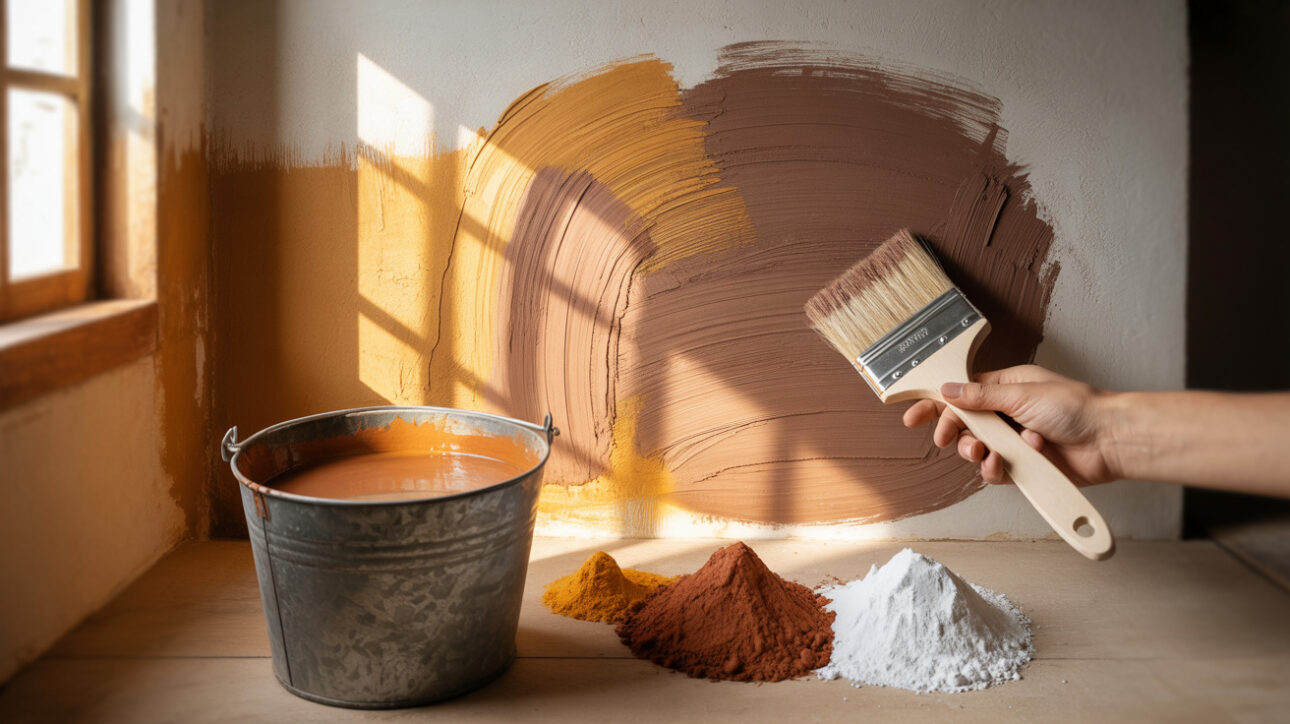
When adding up the materials, the total cost to paint a room of approximately 30 m² typically ranges from R$ 17 to R$ 36.
For comparison, a conventional acrylic paint for the same space can cost between R$ 80 and R$ 150, depending on the brand and quality of the product. Meanwhile, industrial natural mineral paints sold in specialty bioconstruction stores can exceed R$ 180 or even R$ 320 per 18-liter bucket.
Durability of Natural Clay and Lime Paint
When applied correctly in indoor environments protected from direct moisture, natural clay and lime paint can last between six and ten years.
This range is similar to that of many conventional paints used on interior walls. An additional advantage is the ease of maintenance. If repainting is necessary, it generally suffices to apply a new coat over the previous layer without the need for sanding or using a primer.
The main limitation is its water resistance. Without additional protection, the paint can stain in areas that receive frequent splashes, such as regions near sinks or showers.
Limitations and Suitable Surfaces for Natural Paint
Despite the advantages, natural clay and lime paint has some usage restrictions. It is not suitable for external walls fully exposed to direct rain without some form of additional protection.
It also does not adhere adequately to smooth surfaces such as glass, metal, or ceramic without prior preparation. Another important point is that natural paint usually does not bond well to layers of acrylic paint or joint compound. In such cases, the wall needs to be scraped down to the plaster before application.
The technique works best on porous surfaces such as traditional sand and cement plaster, adobe walls, rammed earth constructions, or common masonry. These are the same types of surfaces where hydrated lime has been used for centuries in traditional civil construction.










-

Uma pessoa reagiu a isso.