





 Portuguese
  English
  Spanish
  6 min of reading
  7 comments


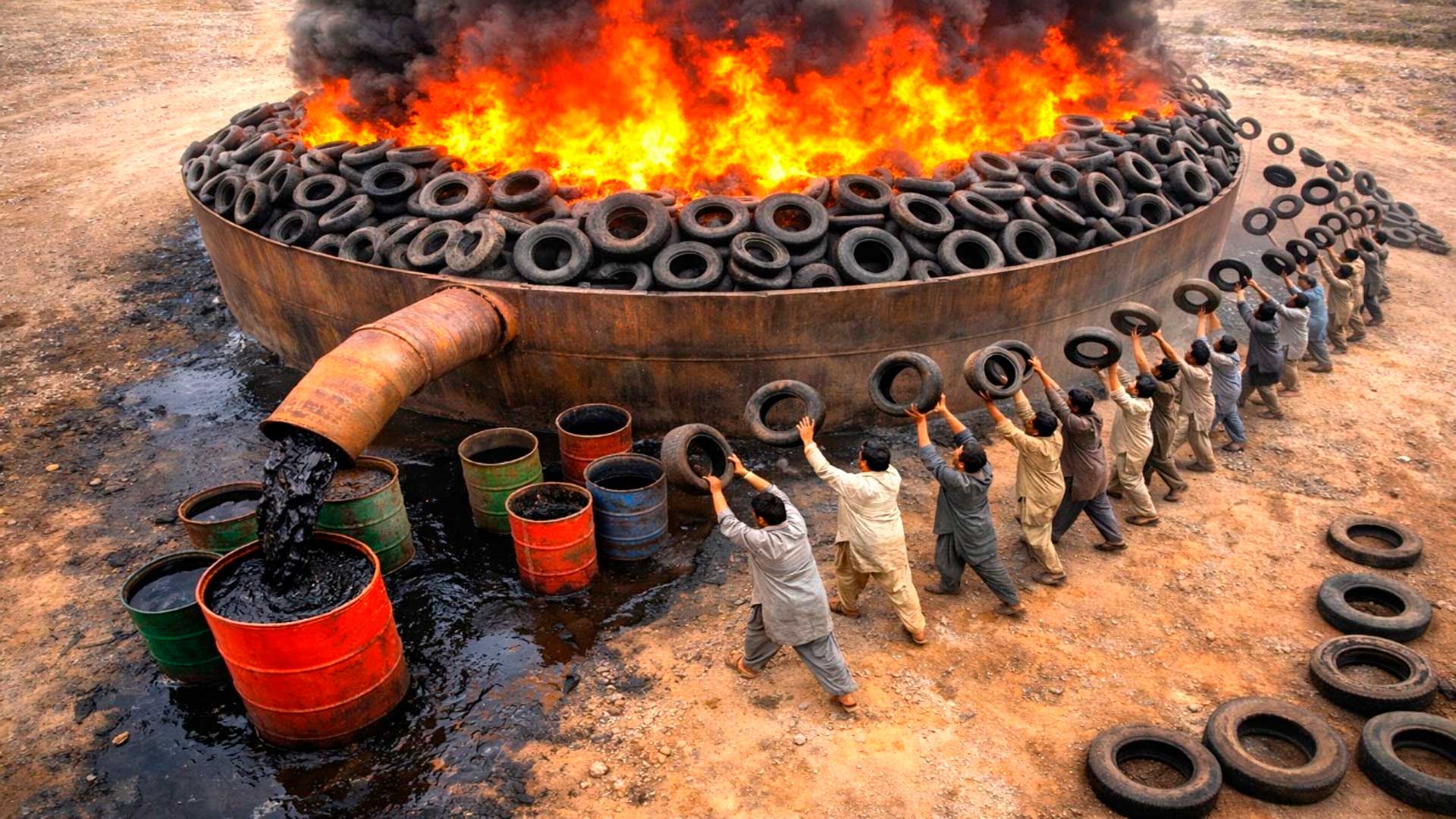


Videos From Production Lines in Pakistan Show How Used Tires Become Fuel and Bones Become Buttons, Using Simple Techniques and High Added Value. The Contrast Between Economic Opportunity and Pollution Risk Is Driving Oversight and Debate About Regulation.
Amid mountains of waste and lack of proper disposal, part of the Pakistani industry has transformed recycling into a business of survival and scale. The most impactful scene is found in tire pyrolysis lines and workshops that utilize animal bones to manufacture clothing items like buttons.
A popular video on YouTube brings together these processes and points to a recurring trait in many productive hubs in the country: the ability to convert waste into raw materials with market value, using basic equipment and a lot of labor.
At the same time, what seems like a solution for tire disposal and remains from slaughter also exposes a lesser-seen side, with occupational and environmental risks when recycling occurs without effective control. Research on recycling in the country describes a sector that is largely informal and with low standardization, which expands the challenges of oversight.
-
Scientists have excavated a giant cave beneath the snow of Antarctica to create a natural refrigerator at minus 50 degrees that operates without electricity and can preserve the Earth’s climate memory for centuries.
-
Scientists detect a rare and frightening phenomenon in the Pacific Ocean that could trigger a devastating Super El Niño as early as 2026, and American experts say it is one of the strongest ever recorded in history.

-
Researchers from Embrapa have discovered how to transform the saline water found in 140,000 wells in the Brazilian Semi-Arid region into a tool for producing food in an area where agriculture has always relied solely on rainfall.
-
China inaugurates a ghost factory that operates in the dark 24 hours a day without any human workers and produces 10 million smartphones a year using 97% of equipment developed by the company itself.


The consequence is a growing debate in South Asia: how to maintain income and a circular economy without turning recycling into another source of toxic smoke, contamination, and disease.
What The Video Reveals About Extreme Recycling in Pakistan and Why It Attracts Global Attention

The video captures two examples that repeat in different regions of the country: tires turning into oil through controlled heating and bones becoming small parts for the textile industry. The narrative is straightforward, showing workers operating simple machines and manual steps in sequence.
This type of content goes viral because it delivers an easily understandable promise: waste becomes product, and product becomes income. In economies with irregular collection and little infrastructure, informal recycling tends to fill the gap left by the public sector, including well-organized buying and resale chains.
But there is a critical point that the video only hints at: economic efficiency does not guarantee safety. Studies on informal recycling and electronic waste in Pakistan indicate exposure to contaminants and environmental impacts when processing occurs without protection and emission control.
Tire Pyrolysis in Pakistan and Fuel Oil Production That Divides Opinions
Pyrolysis is a thermochemical process that decomposes organic materials in the absence of oxygen, generating a liquid fraction similar to oil, as well as gas and a solid residue rich in carbon. Technical reviews describe the conversion of tires into oil, char, and syngas as one of the most used methods to recover value from waste tires.
In industrial practice, variables like temperature, residence time, and type of reactor alter the outcome. Studies compiled in the literature indicate typical ranges where tire pyrolysis begins around 300 °C and completes near 550 °C, with yields that can vary widely between oil, char, and gas.
In Pakistan, the technology has gained traction for a simple reason: it transforms a difficult-to-dispose-of liability into an energy input, something valuable in countries with pressure on fuels and industrial costs. A study on tire pyrolysis oil estimated the potential production in the country to be in the range of hundreds of thousands of tons annually from 2015 to 2019, depending on the volume of available tires and installed capacity.
The problem is that pyrolysis is only “clean” when there is engineering, filters, and monitoring. Local news and official documents describe that pyrolysis plants have been associated with emissions and have been targets of operations against smog in Punjab, with demolition and shutdown actions in Lahore occurring at different times.
This history has strengthened the perception that part of the sector operates outside standards. The very provincial rule on smog control in Punjab has begun to impose explicit restrictions on the operation of tire pyrolysis plants, with provisions for sanctions in case of violations.
Buttons Made From Bones and The Logic of Added Value in Animal Waste Recycling
The other axis of the video is the transformation of bones into small components for clothing, with cutting, polishing, and drilling until reaching the final shape. The production of buttons from natural materials such as bone and horn has been known for decades in the industry and is described as a process that involves softening, shaping, and finishing to achieve a uniform surface.
In the case of Pakistan, in addition to the video content, there are indications of a commercial chain linked to bone and horn items, including exporters of blanks and related products based in the country. This suggests that the activity exists beyond the video and may cater to niche fashion and crafts that pay more for “natural” materials.
Informal Sector, Income, and The Hidden Cost for Workers and Cities
Recycling in Pakistan has a peculiarity pointed out by research: a large part of the collection, sorting, and reuse routes involve informal agents, with little structural support and low standardization. A study on formal and informal recycling processes in the country describes a sector that is largely unregulated and with limitations on the formal system’s capacity to handle the generated volume.
This arrangement creates opportunities. In chains like those of tires and scrap, each stage adds value, from the collected material to oil, char, and final products, which keeps thousands of people working even when the state fails in collection and disposal.
However, informality comes at a price. Reports and studies on recycling hazardous waste, such as electronics, highlight exposure to metals and contaminants and reinforce that the lack of protective equipment and environmental control increases risks for workers and nearby communities.
In the specific case of pyrolysis, the tension becomes more visible because air pollution is already a central issue in the country. Public policy documents on air quality treat smog as a recurring crisis and justify harsher actions on industrial sources, which include operations and regional rules focused on emissions.
Oversight in Punjab and The Dilemma Between Banning or Regulating Tire Pyrolysis
The harshest response appears in Punjab, where the rules for smog prevention and control have begun to prohibit the operation of tire pyrolysis plants, and local media have reported demolition and repression operations in Lahore.
At the same time, part of the public debate questions whether the path should be only to ban or whether it would be more effective to require emission abatement technology, oil traceability, and proper disposal of char. Recent reports show this argument being raised amid operations against installations linked to smoke and smog.
In practice, the sector is caught between two extremes: maintaining the income from a recycling process that “works” in the market while preventing that same recycling from becoming a shortcut to toxic emissions and environmental degradation. This is the point where the circular economy stops being a slogan and turns into a real regulatory dispute.
Whether this extreme recycling is an example of industrial creativity or disguised precariousness depends on the angle. Do you think Pakistan should regulate and modernize these factories, or ban them altogether because of smog and risks? Leave your comment and tell us which side you take in this discussion.





Isso é o que acontece, quando seres humanos e a natureza são transformados em simples engrenagens do capitalismo de consumo.
Degradante !
Tecnologias baratas pra esses países aproveitarem seus passivos,porém,com o mínimo de poluição.O mal atacará a todos,nao5 só os poluidores.
Menos poluição no planeta,porém, tecnologias aos que buscam trabalhar.
Es mejor moler los neumáticos y utilizarlos para asfaltar carreteras
Proibir terminantemente e inovar novas técnicas que não venha agredir a atmosfera.