





 Portuguese
  English
  Spanish
  11 min of reading
  3 comments


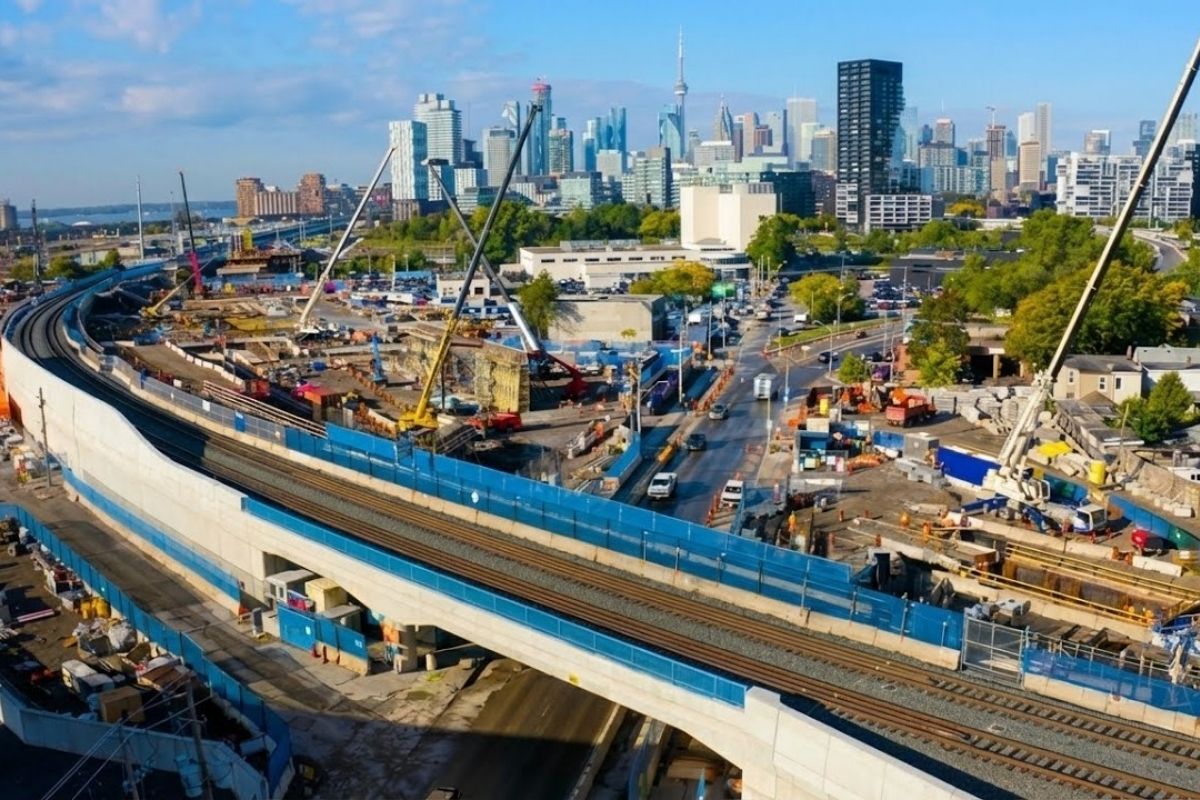


Toronto Builds the Ontario Line with 15 Stations and 15.6 km, Connecting Exhibition Place to the Don Mills Road Corridor, with Connections to More Than 40 Options. The Goal is to Reduce the Crossing Time from 70 to 30 Minutes, Serve 388,000 Boardings Operating Every 90 Seconds, and Remove 28,000 Cars.
Toronto, Canada, is literally being excavated from beneath in a megaproject worth US$ 27.2 billion that goes down to 40 meters underground to open a new transportation artery: the Ontario Line.
The work, already underway, mixes giant machines, deep pits, tunnels lined with concrete rings, and above-ground interventions that seem surgical, because the city needs to keep functioning while stations, bridges, corridors, and connections are reconstructed in phases.
Toronto Grows Faster Than Mobility Can Absorb
Toronto is described as a city that is rapidly expanding, faster than its transportation system can support. It is from this imbalance that the Ontario Line is born, presented as a defining project for the city’s future, with a continuous corridor that traverses central areas and creates new connections.
-
New CCR concrete paving technology promises roads up to 3x more durable, less maintenance, and cost reduction in Brazil.
-
Made from recycled plastic, plastic wood is gaining space in the construction industry because it does not rot, resists moisture, and reduces maintenance costs over the years.

-
Florianópolis will receive a million-dollar BRT that will begin construction in 2026 with nearly 400 million in funding from the federal government and the Inter-American Development Bank, and the map already shows the routes for the exclusive bus corridors.
-
Without a blueprint, without an engineer, and using scrap from the dump, a father spends 15 years building an 18-room castle for his daughter, featuring tram tracks, 13 fireplaces, and over 700 m², which may now be demolished.

The plan is explicit in the time savings: a crossing that currently takes 70 minutes on public transport should drop to 30 minutes or less.
In a metropolis where commuting determines work, study, and service routines, this number becomes the central promise of the project.
Where It Happens: Toronto Becomes a Living Construction Site Above Ground and a Laboratory Below

The transformation occurs within Toronto and is revealed by construction points that emerge and disappear as the fronts advance.
The section begins at the Exhibition Station, in Exhibition Place, where the aim is not just to renovate: it is to rebuild the entire transportation center, creating the foundation for the new flow.
Along the way, the material describes interventions in areas such as King, Queen, Spadina, Osgoode, Moss Park, Corktown, Riverside Leslieville, Gerrard, Pape, Thorncliffe Park, and Flemington Park, as well as the terminal to the north at the Science Centre, where the line meets a crossing point and connection with other corridors.

In practical terms, Toronto comes to have two overlapping worlds: above, streets, streetcars, pedestrians, and commerce; below, launch pits, excavated caverns, new tunnels, and systems installed with precision.
Before Excavating, Toronto Needs to “Map the Hidden Veins” of the City
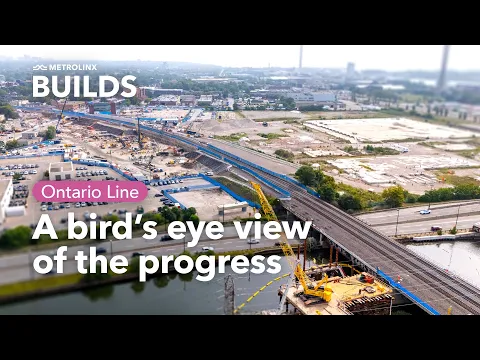

Deep excavation in Toronto does not begin with the machine biting into rock. The first challenge is to locate existing infrastructure.
Gas, water, and electricity are cited as the hidden veins of the city, and the project requires finding them before any more aggressive cutting takes place.
This stage sets the tone: every cut is calculated. The old infrastructure needs to make way for the new, but without interrupting urban life.
This explains why security perimeters grow and why construction preparation may seem slow, even when the work is already underway.
Pits, Piles, and Walls: The Engineering That Supports the Weight of Toronto
To allow the tunnel boring machine to descend, Toronto creates a launch shaft. The text describes deep pile drilling to stabilize the ground and the building of retaining walls that support the city’s weight.
Concrete appears as a structural element from the start: it flows and hardens into a retaining wall capable of supporting the surroundings while the core is excavated.
Only after that does the pit become the “portal” to the underground, where the journey truly begins.
This logic is repeated at different points: first build the walls, then remove the core, keeping everything stabilized, because excavating in a living metropolis requires that the void be constructed before it exists.
At 40 Meters Deep, the Tunnel Boring Machine Advances Like a Factory That Builds the Tunnel While Excavating
The heart of the project in Toronto is the tunnel boring machine described as a titan, a factory on wheels designed to build the tunnel while excavating.
The assembly is presented as a continuous task, with thousands of parts needing to operate in harmony.
When the cutting head spins, a relentless and repetitive effort begins: drilling rock, turning stone into rubble, and advancing centimeter by centimeter.
The routine is excavate, build, repeat. As it moves, the machine coats the tunnel with concrete rings, forming the permanent body of the underground structure.
The depth of 40 meters reinforces a decisive aspect: the displacement occurs in relative silence for those on the surface, even when tons of material are being removed every day.
The “Muck” and Invisible Logistics: How Toronto Removes Tons of Rock Without Stopping the City
The material mentions the excavated earth, called muck, returning to the “original” state from an urban point of view: the construction site can be closed, the street can reopen, but the operation of material removal continues as a constant flow.
This is one of the project’s paradoxes in Toronto: there are moments when the surface appears normalized, but the volume of rock removed daily indicates that the underground remains intensely active.
Maintenance is treated as part of the rhythm. When the tunnel boring machine reaches a construction site, teeth are replaced before it “eats” again. There is no time to rest, because the machine needs to move on to the next stretch and repeat the cycle.
Stations in Limited Space: Queen and Spadina and the Slurry Walls in Toronto
Not every point in Toronto allows for big open trenches. Where space is limited, like at the mentioned corner of Queen and Spadina, the technique described is controlled vertical excavation with slurry walls.
Bentonite emerges as the protagonist in this phase, keeping the soil under control until the concrete assumes the definitive structural function. Then, steel structures enter to ensure concrete walls, turning the station into an underground fortress.
The message is clear: in Toronto, urban geography dictates the technique. Where there is no space, the solution is to dig downwards with immediate stabilization, preventing the surroundings from suffering from soil displacement.
Cut and Cover Stations: Moss Park as an Example of Scale and Robustness
In other areas, Toronto adopts cut and cover, described as efficient and massive. In Moss Park, the earth is opened and the excavation gains visibility, requiring shoring to keep walls apart and prevent collapse.
Tons of steel descend to form the station’s skeleton. The structural base is described as a slab thick enough to support a skyscraper, a way to translate the robustness required when the underground needs to withstand urban loads.
This method also shows why the project can “shake” the surroundings. When a station is excavated in great volume, the neighborhood feels the physical presence of the work, even if part of the operation is below.
Excavating Under Operating Structures: The Delicacy of the Osgoode Segment in Toronto
There is a point described as particularly sensitive in Toronto: Osgoode, where excavation occurs directly beneath an operating structure, cited as the university line.
In this scenario, mining is done manually and with small machines, with precision in the dark. Sensors monitor old tunnels while the new one is excavated, because every millimeter counts.
The logic is surgical: working underground without interrupting what already functions, monitoring deformations, and ensuring safety.
This is one of the strongest images of the project in Toronto: a new tunnel literally being born beneath another active system, requiring fine control of vibration, advance, and support.
How Toronto Maintains Traffic: “Decorated” Streets and Submerged Construction Under Tires
To keep Toronto moving, the material describes streets being “decorated”, a way of saying that the surface is reconstructed and the construction site is submerged, allowing vehicles to circulate while excavation continues below.
An example cited is Queen Street, where there is a “hidden world” beneath the street, with excavation of a cavern while the streetcar passes overhead.
The rock is rough, so it is smoothed and cleaned to seal water. The shotcrete secures the rock like a temporary shell before the permanent lining.
It is a sequence that shows how Toronto manages two demands at the same time: keeping the city running while simultaneously building a new underground system.
History and Soil: Corktown, Searches for Artifacts, and Preservation in Toronto
The project is not just technical, it is also urban. In Corktown, the material describes the need to explore the soil for artifacts before the heavy iron enters.
This indicates care for historical layers, even in a project that relies on aggressive excavation.
Another element cited is the preservation of facades in areas like King and Bathurst, maintaining the history apparent while the rest is released for reconstruction.
Toronto tries to preserve memory while reconfiguring the future, a difficult reconciliation when the construction site needs space and access.
Bridges and Rivers: Toronto Crosses the Don River with Nighttime Work and Engineering Against the Clock
The Ontario Line is not limited to the underground. To cross the Don River, the material describes constructing dry workspaces within the water, in addition to a bridge built first on solid ground, with steel arches taking shape.
There is a nighttime operation described as decisive: a midnight change implements the bridge while Toronto sleeps.
Ironworkers ensure support of the span with steel tendons, and the work continues to widen the corridor and create space for new lanes alongside the old ones.
An instance of extreme timing appears on Queen Street, where an old bridge is demolished because it has already served its purpose and, in just 48 hours, a new bridge is positioned with precision engineering.
Tracks, Sleepers, and Continuous Welding: Toronto Builds the Perfect Path for Trains
When the raw structure is ready, the project enters the phase where there is no room for error. A stone bed is laid down because the railbase needs to be perfect.
Sleeper units drop in by the thousands, spaced with precision, and the steel is welded continuously to eliminate the snapping of the old times.
This stage represents an important turn in Toronto: the tunnel ceases to be an excavated void and becomes a transport infrastructure, with geometry, alignment, and stability designed for intense operation.
Pape as a Major Interchange: Toronto Excaves Below While Keeping the Old Station Active
The Pape station is described as the main interchange. The challenge is dual: excavating beneath the old station to connect them and keeping the old station functioning while earth is removed below.
The material describes vertical shafts that plunge deep, creating a shorter path for daily commuters.
It is an exercise in balance because Toronto needs operational continuity while creating new underground passages and connections.
North Terminal and the Underground “Handshake”: Toronto Connects Lines and Corridors
At the north terminal, at the Science Centre, the text describes the point where the line meets the city and there is an underground “handshake”, with excavation to connect Line 3 to Line 5.
This image reinforces a network objective. Toronto is not building an isolated corridor, but a system that interacts with what already exists and redistributes flow, creating route alternatives.
Yard, Maintenance, and the Fleet: Thorncliffe Park and the Infrastructure That No One Sees
A subway system does not live on tracks and stations alone. The material describes the core prepared as a leveled space for maintenance and storage facilities, with acres of concrete creating a home for the fleet.
Steel beams rise where the trains will sleep and receive maintenance. A maze of switches is installed to guide trains to the resting points, and a network of wires takes shape to power the whole.
In Thorncliffe Park, the station is described above, high above traffic, while the elevated corridor continues in Flemington Park, where modular construction allows the entire platforms to rise and glass and steel seal the station.
Safety, Signaling, and Ventilation: The “Nervous System” of the Ontario Line in Toronto
The text describes kilometers of cables as the nervous system that powers the trains and signaling systems as the brain that ensures safety and punctuality.
Safety appears in layers: glass walls separate platform and tracks, there is high voltage to power motors, and gigantic fans work as the lungs of the subway, keeping the air in motion.
Fire and emergency system tests, lights, and procedures to prevent faults are also mentioned, in addition to detailed inspections of bolts, brakes, and sensors.
Numerical Goals: What Toronto Wants to Gain in Time, Capacity, Jobs, and Fuel
The Ontario Line is presented with a list of quantified goals that explain why Toronto is betting on the project as a redefinition of mobility.
- Main Numbers of the Project in Toronto
- 15 new stations along the route
- 15.6 km of total length
- End-to-end journey in 30 minutes or less, down from 70 minutes today on public transport
- 388,000 boardings expected daily
- Frequency of up to 90 seconds at peak times
- More than 40 connections along the way, including TTC Lines 1 and 2, three GO Transit lines, Eglinton Line 5, streetcars at 10 stations, and buses at 12 stations
- More 227,500 people within walking distance of public transport
- Up to 47,000 additional parking spaces accessible in 45 minutes or less
- 28,000 fewer car trips per day
- Annual reduction of 7.2 million liters in fuel consumption
At the most sensitive point of capacity, the projection cites drops in specific stations: at Bloor Yonge, up to 22% less, equivalent to 14,000 fewer people at peak; at Eglinton, up to 16% less, with 5,000 fewer people; at Union Station, up to 14% less, with 14,000 fewer people.
Together, these numbers show the ambition: Toronto wants to exchange bottlenecks for redundancy, creating options and reducing pressure at the most crowded nodes.
Testing and Commissioning: Toronto Prepares a Line to Operate Before the First Passenger
The material describes a finalization sequence that includes final polishing of the stations, installation of gates and readers, technical validations, and a test run without passengers, called a ghost run.
The control center comes into operation to observe every inch of the line. The team trains for safety before the first boarding, and reliability is proven with a full schedule in simulated operation.
This stage translates a reality: in Toronto, it is not enough to excavate and build. It is necessary to deliver a system that operates with high frequency, with precise stops, door synchronization, ventilation, integrated power, and signaling.
Toronto Below Today to Change Toronto Above Tomorrow
What stands out in the project is the combination of scale and discretion.
Toronto is being rebuilt in phases: sometimes opening trenches and assembling stations as fortresses, sometimes returning streets and maintaining traffic while the underground remains alive.
The city is being excavated as if writing a second layer of Toronto, 40 meters below, with lined tunnels, connected stations and infrastructure designed to reduce times, redistribute capacity, and remove cars from daily life.
The total inauguration is expected in 2030, with parts being delivered progressively.
If the Ontario Line meets the announced goals, do you think Toronto will feel the change first in travel time or in the relief of the most crowded stations?









And all the soil ends up at the Edenvale airport near Stayner where are the soil tests. Drainage into the Nottawasaga River and Minesing Swamp. Both fragile ecosystems.
My grand child wiĺl be retired by the time it is completed at ten times the original cost. Same as Eglinton line. Metrolinks at its best. They have to maintain their bottom rock shameless infamy.
This is Canada. It is 13.4 km not 13,4. And it is 3,000 people, not 3.000. Put the decimals as ‘.’ and the ‘,’ as the breaks between every third digit in whole numbers.