





 Portuguese
  English
  Spanish
  5 min of reading
  0 comments


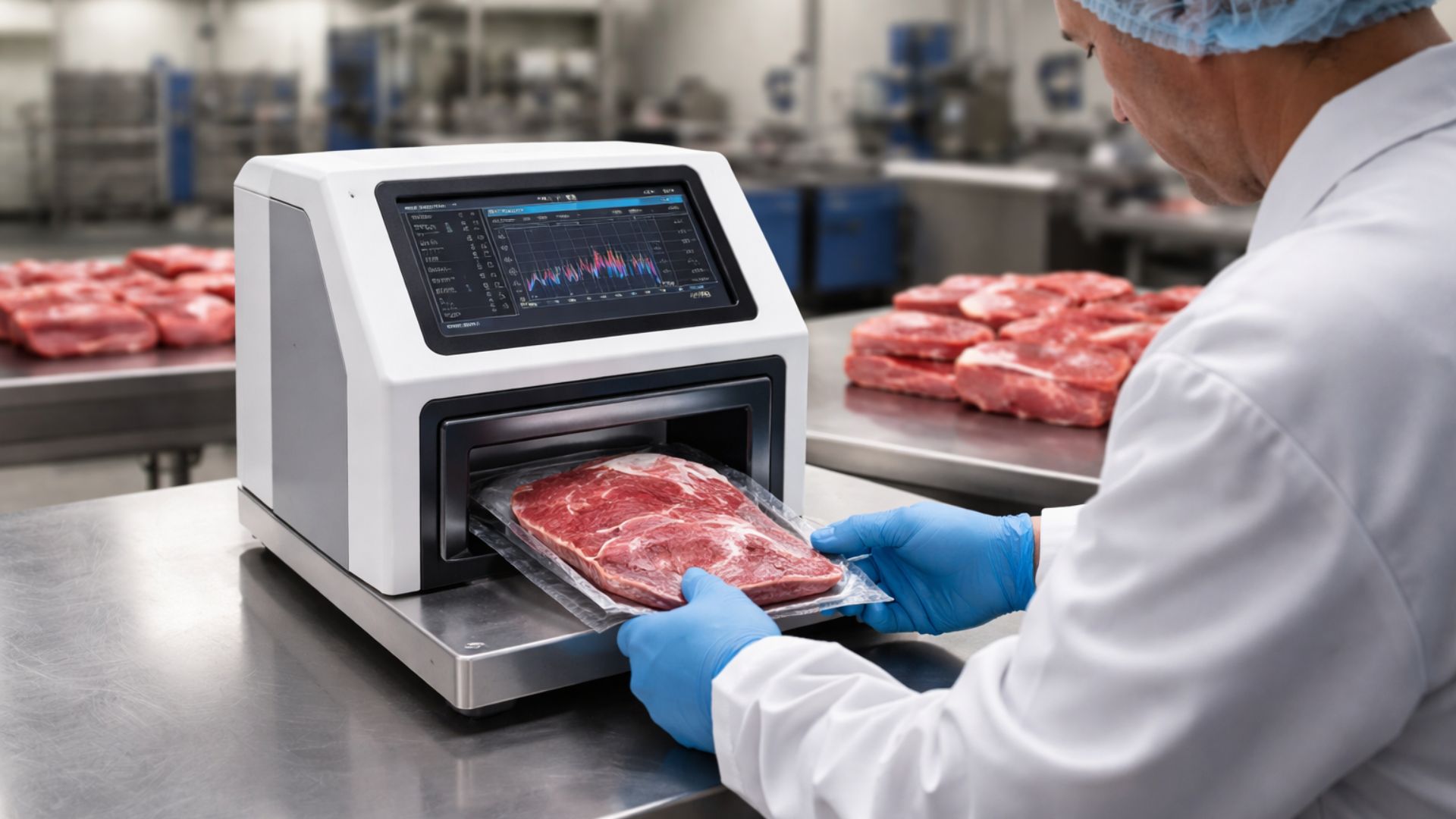
National technology uses magnetic resonance to measure meat tenderness in seconds and can change standards in the meat industry, with direct impact on quality perceived by consumers and how cuts are classified, sold, and valued in the market.
A technology created in Brazil has begun to be presented to the meat industry with the proposal to measure beef tenderness in 12 seconds, without cutting, cooking, or damaging the piece.
Named SpecFit Meat, the equipment uses low-field nuclear magnetic resonance to capture signals from the food and convert them into objective indicators, even in cuts that are already packaged, which paves the way to bring this information to consumers as well.
The advancement aims to solve one of the most sensitive points in the meat market: the difficulty of directly measuring an attribute that weighs in the purchase decision and the product’s value.
-
Alone, the producer applies 7,400 hectares with the T100 drone in an optimized structure, replaces the generator with a silent battery, and demonstrates how technology reduces costs, increases productivity, and even challenges the uniport in the field.

-
China banned the export of 22 tons of meat from Argentina.

-
JBS, founded by the Batista brothers, continues to conquer the world: entrepreneurs built a ‘factory in the desert’ creating 3,000 jobs.

-
With only 1% of Brazil’s territory, Santa Catarina has built one of the most competitive industrial parks in the country, with 64,000 companies, nearly 1 million jobs, and a growth rate of 5.3% while the national industry is practically stagnant.


Today, the supply chain usually relies on indirect references, such as breed, age of the animal, type of cut, and aging time, while traditional laboratory tests require sample preparation and destruction of part of the analyzed material.
How tenderness measurement works with magnetic resonance
The technological basis is similar, in principle, to the magnetic resonance used in other areas, but with an industrial application focused on quality control.
Instead of producing images, the system records physical responses of the product subjected to the magnetic field and, from that, estimates parameters related to the texture of the meat.
The company states that the method is non-destructive, requires minimal sample preparation, and can be adapted to the routine industrial environment.
This format alters the logic of the evaluation available until now.
In conventional procedures, measuring tenderness depends on steps that make it impossible to market the same tested piece.
With the new approach, the analysis can occur on the whole product, allowing for batch separation, category definition, and, in the future, identifying on packaging which cuts meet specific standards defined by each company.
Impact on meat packing plants and valuation of premium cuts
For meat packing plants, the most immediate impact is on commercial segmentation.
By knowing more precisely which cuts deliver greater tenderness, the industry gains the margin to direct these pieces to premium lines and higher value-added markets, instead of working only with estimates built by herd profile or processing history.
Moreover, the tool can change the management of refrigerated aging, a process used to improve meat texture.
According to information released about the technology, this period can reach 28 days in cold chambers.
With an objective reading of the piece’s stage, the company claims it will be possible to better adjust the time needed for each cut, reducing storage, energy consumption, and part of the operational cost.
This possibility is especially interesting for plants that work with a wide diversity of animals, cuts, and markets.
Instead of applying a uniform rule to all products, the meat packing plant could decide based on the individual response of the meat, calibrating its own standards for different lines.
The expectation presented by the developer is that technical data can be translated to retail through seals, classification bands, or other simpler forms of communication on the packaging.
Zebu meat and paradigm shift in tenderness
In the Brazilian case, the proposal also engages with an old discussion in beef cattle farming: the perception that zebu animals would generally deliver tougher meat.
Commenting on the potential use of the equipment, researcher Fabiane Costa from FIT stated that the technology could identify and certify tender zebu meats, helping to dispel this uniform reading and allowing the industry to better differentiate its products.
The relevance of the topic is not small in a country whose livestock base is heavily supported by zebu breeds and their crosses.
Studies from Embrapa indicate that the lower tenderness observed in some of these animals is a historical challenge for certain markets, reinforcing the interest in tools capable of measuring this attribute objectively, batch by batch, rather than treating it merely as a presumed characteristic of the breed.
Investment, research, and development of the technology
The SpecFit Meat was developed over five years by the startup Fine Instrument Technology, based in São Carlos, in the interior of São Paulo.
The investment exceeded R$ 3 million and received support from the São Paulo Research Foundation, within a research trajectory already linked to the commercial use of nuclear magnetic resonance for non-destructive evaluation of beef tenderness.
According to the company and information associated with the project, the work brought together engineers, physicists, chemists, and specialists in animal production.
FIT had already been working with applications of magnetic resonance in agribusiness and other segments, which helped transfer the technology to a very specific demand in the meat chain: quickly measuring a sensory attribute with direct commercial impact.
This is not the company’s first venture with animal proteins.
Institutional materials from FIT show that the SpecFIT line had already been used for rapid analyses of fat, moisture, and protein in meat products, including in processed, packaged, or fresh samples.
The new stage focuses the effort on tenderness, precisely the parameter most difficult to measure without destroying the product and one of the most valued by consumers and professional buyers.
Initial adoption and expansion to other proteins
Despite the potential, commercial insertion is still in its early stages.
The most recent reports about the launch indicate that the equipment was recently finalized and is now beginning to be presented to the meat industries.
This means that large-scale adoption, as well as the arrival of visible classifications to consumers, will still depend on operational tests, integration into the flow of plants, and the definition of standards for each company.
The initial focus is on beef, where tenderness variability is greater and more sensitive for the Brazilian market.
Still, the developer itself states that the technology can also be applied to pork and chicken proteins, broadening the scope of use for other animal protein chains.
FIT also reports that it already operates in more than 20 countries and on four continents, with magnetic resonance solutions for food, textiles, and other industrial fronts.
In this context, the bet on Brazilian agribusiness appears as an extension of a platform already consolidated in different applications, now directed at a concrete problem in the meat sector: transforming the subjective perception of tenderness into measurable, comparable, and marketable data.








Seja o primeiro a reagir!