





 Portuguese
  English
  Spanish
  5 min of reading
  0 comments



New Facility in Toyota, Japan, Promises to Modernize Production, Preserve Jobs and Reinforce Annual Goal of 3 Million Vehicles, but Details About Models, Investments, and Timeline Still Have Not Been Revealed by the Company.
Toyota Motor announced on Thursday (07) that it will build a new assembly facility in Toyota, in Aichi Prefecture, with operations expected to start at the beginning of the next decade.
The plan reinforces the company’s strategy to maintain production capacity of 3 million vehicles per year in Japan, even in the face of external pressures and changes in the domestic market.
The type of vehicle that will come off the production lines is still under study.
-
Unemployment rises again to 5.8% at the beginning of 2026, raising alarms about the end of temporary positions and its impact on the Brazilian job market.

-
Document organization can cut invisible costs in small businesses, a simple step that prevents waste, rework, and losses in daily operations.

-
Chinese giant worth nearly R$ 4 billion that manufactures cables for electric cars, solar energy, and robotics wants to open a factory in SC.
-
Many employers do not know, but the law guarantees domestic workers a 25% increase in salary during trips, 50% for overtime, 20% for night shifts, and 17 additional benefits that can lead to labor lawsuits if not paid.

What Was Announced
According to the company, the new facility will be located in the Teiho area, classified by the municipality as an industrial attraction zone.
The company did not disclose investment values, number of jobs, constructed area, nominal capacity of the plant, or detailed construction timeline.
The official statement from the chief financial officer — Takatoshi Azuma, Chief Financial Officer (CFO) — emphasized the commitment to domestic production and the renewal of the manufacturing park.
“The current factories are aging, but we want to ensure that the production capacity of 3 million units remains in Japan in the future.
We announced this plan as a first step in that direction,” the executive stated at a press conference.
Where the Facility Will Be Located

The city of Toyota, the industrial heart of the company, concentrates plants, suppliers, research centers, and a well-established logistics network.
By establishing the new Toyota factory in Toyota (Aichi), the company remains close to its engineering base and key auto parts partners located in the Chubu region.
This arrangement tends to facilitate productive integration, quality testing, and component supply, but the manufacturer has not yet presented details on layout, welding lines, painting, stamping, or internal logistics of the facility.
As previously reported by local management, Teiho is a neighborhood focused on industrial ventures, with specific urban guidelines to receive large-scale installations.
Even so, the automaker has not disclosed stages of environmental licensing, urban compensation, or construction and ramp-up timelines.
When these data are presented, it will be possible to better estimate the impact on road networks, energy consumption, and planning for first and second-tier suppliers.
Why the Decision Matters
The last time the group built a vehicle factory in Japan was in 2009, when Central Motors — then part of the group — completed a facility in Ohira, Miyagi Prefecture.
By resuming an investment of this magnitude in domestic territory, the company signals its intention to sustain the production of 3 million vehicles per year in the country, preserve skilled jobs, and protect essential technological capabilities such as process engineering, lean manufacturing, and quality control.
The announcement comes at a time when global manufacturers are recalibrating their supply chains, reassessing exposure to geopolitical risks, and facing cycles of renewal of their industrial parks.
In the case of Toyota, the new Toyota factory acts as a pillar for updating facilities, accommodating future product programs, and reinforcing operational resilience.
The company mentioned that part of the current plants is aging, making it necessary to open a unit with a more modern and flexible design.
Scope and Limits of the Project So Far
Toyota stated that the profile of the vehicle to be produced is still under study.
Without this data, it is not possible to infer the engine mix, initial production volume, supplier participation, or composition of the production lines.
There is also no public confirmation about exports from the facility, annual goals by product program, or the plant’s participation in global brand projects.
Timeline and Next Steps
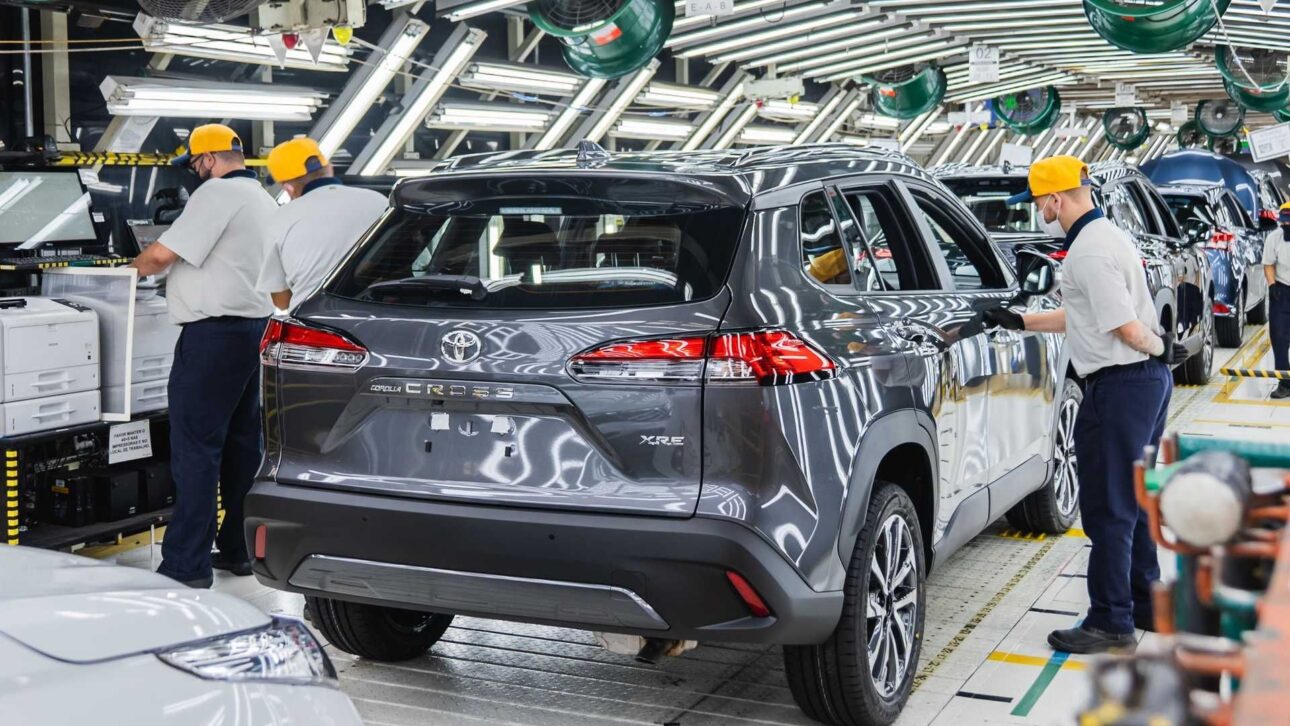
The expectation is that the Toyota plant in Japan will begin operations in the early 2030s.
Until then, the company will need to complete land acquisition, regulatory approvals, and civil construction stages, as well as the installation of machinery, testing, and validations.
No intermediate dates have been disclosed, such as the start of construction, commissioning phase, or SOP (start of production) date.
The company has also not communicated when it will finalize the models to be manufactured.
Relationship with the International Scenario
The announcement cites, as a backdrop, tariff measures imposed by the United States on cars manufactured in Japan.
Even in this context, the company stated that it will maintain robust domestic production.
The new Toyota factory is presented as a tool to ensure that the brand preserves critical competencies in its home country and maintains flexibility to adjust export flows when necessary.
So far, however, no details have been provided on how external trade policy will impact the industrial planning of this particular unit.
History and Capacity Reference
The goal of producing 3 million vehicles per year in Japan has been reiterated by Toyota over time as a way to maintain jobs, preserve the engineering base, and sustain industrial competitiveness.
In 2009, when the Ohira plant was completed by a group company, the strategy also pointed to risk decentralization and the maintenance of productive know-how.
This time, the new Toyota factory emerges supported by a discourse of renewal, with a focus on more modern plants adaptable to different programs.
By announcing the investment, the company reinforced its intention to safeguard its domestic structure to respond to technological and demand changes.
The declared objective is simple and ambitious: to maintain 3 million units per year produced in Japan sustainably.
It remains to be seen which models will inaugurate the production lines and how the Toyota plant in Japan will integrate into the global production network.






-

-

-

-

-

-

230 pessoas reagiram a isso.