





 Portuguese
  English
  Spanish
  5 min of reading
  0 comments



Toyota, Fiat, and Volkswagen Pressure Government After BYD Maneuver: Expert Analyzes How Electric Vehicles Already Painted, with Tires and Seats, Avoid National Production
Debate on Electric Vehicles Exposes Conflicts Between Domestic and Foreign Automakers, Highlighting Import Strategies, Taxes, and the Challenges Facing the Brazilian Automotive Sector in Light of New Technologies and Global Competitors.
In episode 239 of the Market Makers channel, businessman and executive Sergio Habib raised the growing impasse involving major automakers like Toyota, Fiat, and Volkswagen against the aggressive entry of BYD into the Brazilian electric vehicle market.
According to Habib, the central debate revolves around BYD’s recent request for a reduction in import taxes for electric cars, which triggered immediate reactions from traditional competitors and the National Association of Motor Vehicle Manufacturers (Anfavea).
The expert noted that while automakers operating in Brazil follow strict production processes, including the purchase of domestic steel, painting, assembly, and sourcing local auto parts — practices that lead to high costs and job creation — foreign brands have adopted strategies to bypass these requirements.
-
Brazilian city gains industrial hub for 85 companies that is equivalent to 55 football fields.

-
Peugeot and Citroën factory in Argentina cuts production by half and opens a layoff program for more than 2,000 employees after Brazil drastically reduced purchases of Argentine vehicles.

-
A Brazilian city gains a factory worth R$ 300 million with the capacity to process 200 thousand tons of wheat per year, a mill of 660 tons/day, silos for 42 thousand tons, and an industrial area of 276 thousand m².

-
Havan will leave the shopping mall in Blumenau to inaugurate something that the chain has never done before: a megastore in half-timbered style in the Historic Center of the city, which is expected to be completed in May and change the landscape of local retail.


“Today, we see electric cars arriving in the country practically ready: already painted, with tires, installed seats, and even air conditioning coming directly from China”, Habib stated in the video.
According to him, this dynamic places national production at a disadvantage and threatens jobs.
The Impact of Brazil’s Cost on the Automotive Sector
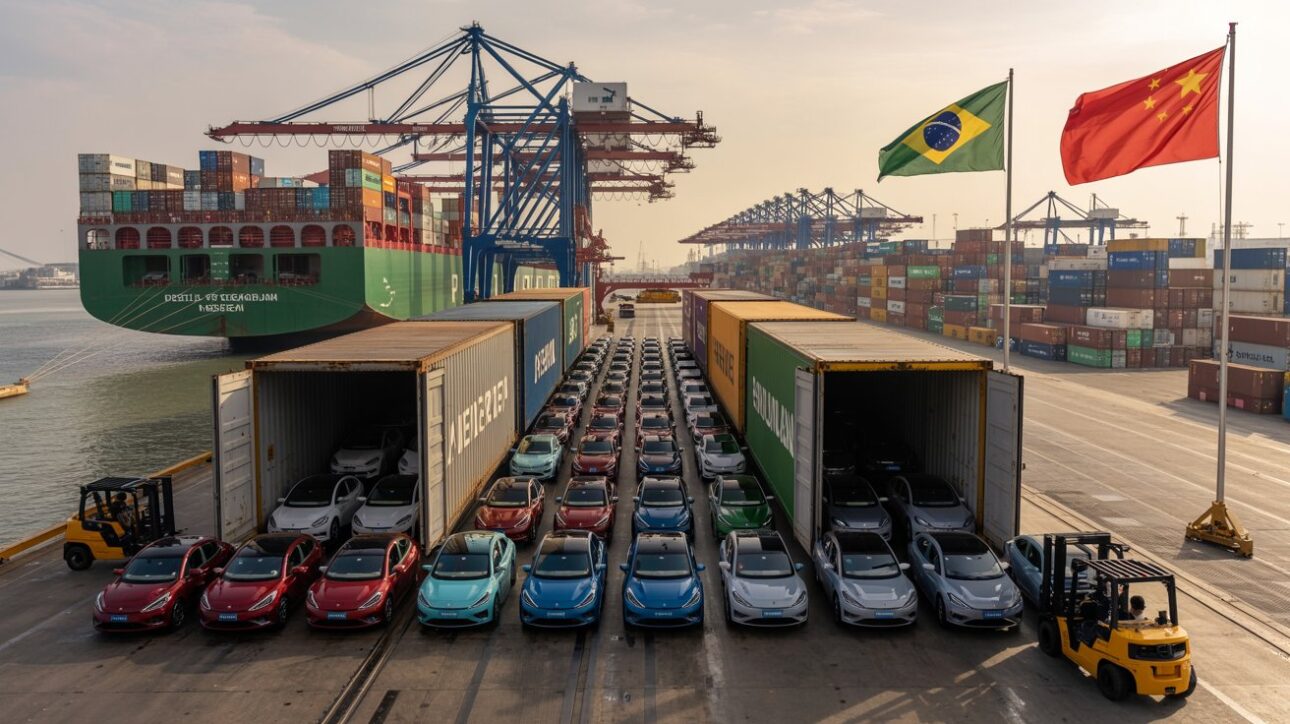
Habib further detailed that the so-called “Brazil cost” is one of the main obstacles to the competitiveness of the national automotive sector.
“We pay more for steel than in China. While Brazil produces about 30 million tons of steel annually, China reaches an impressive 1.25 billion tons, which naturally lowers the product cost there”, he explained.
The executive emphasized that, even with the rising wages in China, the tax environment in Brazil remains much more burdensome.
“In China, the income tax is 10%. Here, it reaches 60%. This directly impacts the cost structure of factories”, he added.
Fiscal Strategies, Importation, and National Production
In the context of tax warfare, Sergio Habib was categorical in supporting Anfavea’s position in defense of applying the import tax rate for electric vehicles.
“It doesn’t make sense to allow disassembled vehicles, but practically ready, to enter Brazil with reduced taxes. This discourages any initiative for local production and jeopardizes job generation”, he emphasized during the interview.
According to the businessman, the current 35% import tax rate for electric cars, which is set to come into effect in the coming months, is an appropriate response to the uneven competitive landscape.
Furthermore, Habib noted that there are deep differences between the production process required in Brazil — known as the Basic Production Process (PPB) — and the practices of some foreign automakers.
“The PPB requires stamping, welding, painting, and assembling the vehicle on national territory, with quality control at all stages”, he explained.
As the executive pointed out, when companies import practically the entire car, “including seats, windows, and tires,” the local economy fails to benefit.
International Comparison and Market Policies
The businessman used international examples to illustrate market disparities.
“The Toyota Corolla sold in Japan costs the equivalent of R$ 120 thousand without taxes, the same price practiced here, but there steel, auto parts, and logistics are much cheaper, and there are no taxes on the final product”, he stated.


In Brazil, according to Habib, the heavy tax burden raises the car price to about R$ 190 thousand, making internal and external competition difficult.
When comparing the Brazilian situation with other major markets, such as the United States, Europe, and India, Habib pointed out that the success of automakers is directly related to tax policy and economies of scale.
“In the United States, the Corolla costs almost the same selling price as here, but the automakers’ profit margins are significantly higher”, he said.
As he highlighted, Fiat is one of the few companies that can operate profitably in Brazil, precisely because it bets on high-volume production of 1.0 turbo flex engines — a model adapted to local tax realities.
He further commented that in India, legislation favors cars less than four meters long, which reduces taxes and benefits the national industry.
“The Suzuki Maruti, for example, has dominated the Indian market for decades, with cars adapted to local regulations. The same thing happens with Fiat in Brazil”, Habib emphasized, reinforcing that public policies and taxation shape automakers’ behavior and consumer access.
The Role of Management and Operational Efficiency
According to the expert, another crucial point for companies’ performance is the quality of the executive team assigned to each country.
“Global automakers like Toyota and Volkswagen tend to reserve their best executives for larger markets, such as Japan, the United States, and China. In Brazil, it is usually not the top management of these companies”, he observed.
In contrast, according to Habib, Fiat retains high-level professionals in Brazil, which contributes to its operational efficiency and market leadership.
Given this scenario, the episode conducted by Sergio Habib on the Market Makers channel highlights how tax issues, the production model, and import strategies shape the future of the Brazilian automotive sector, especially in the electric vehicle segment.
The expert advocates that to ensure fair competition, preserve jobs, and strengthen the local industry, it is essential to maintain clear rules and a tax policy that encourages national production.
Considering the rapid changes in the market and the advancement of electric vehicles, what should be the Brazilian government’s priority: protecting the local industry with taxes or facilitating the entry of new technologies and global players?








-

Uma pessoa reagiu a isso.