





 Português
  Inglês
  Espanhol
  4 min de leitura
  0 comentários


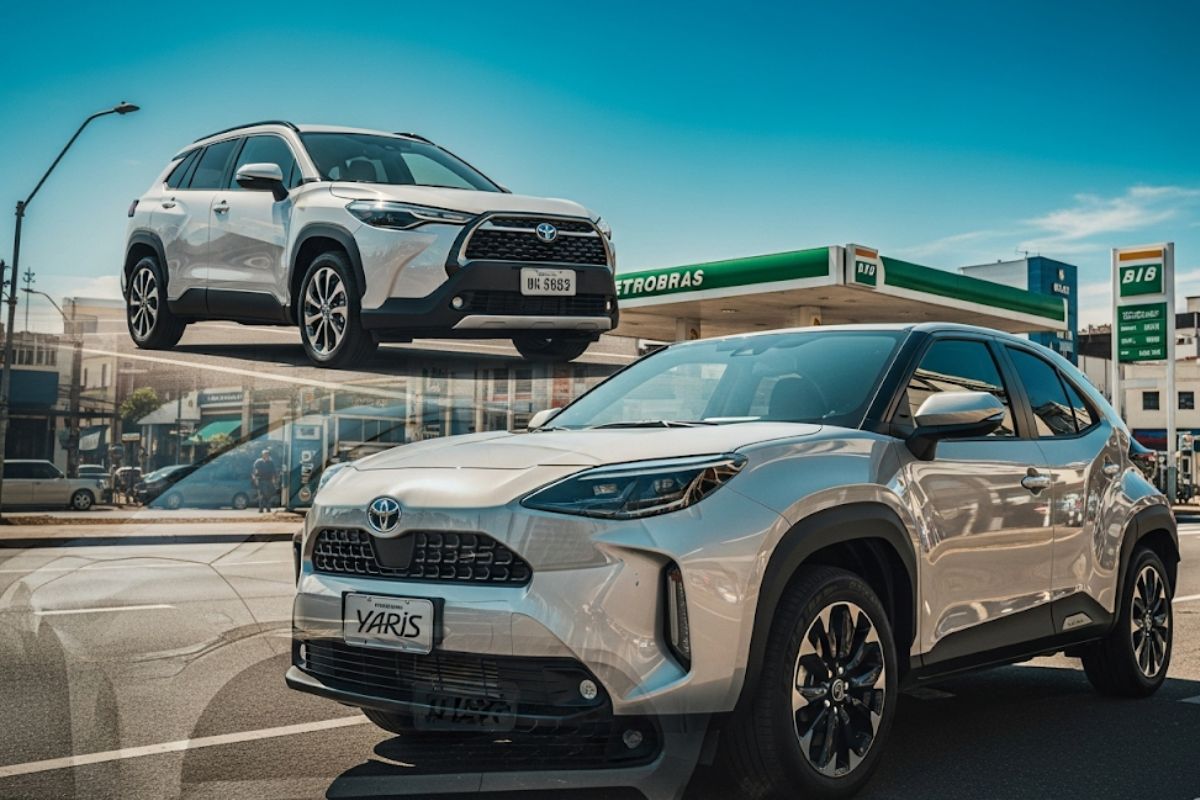
Complete Analysis of Design, Dimensions, Engine, Space, Technology, and Price of the New Toyota Yaris Cross Compared to the Established Corolla Cross.
The Brazilian SUV market is increasingly heated, and Toyota stands out with the Corolla Cross. Now, the brand prepares for the arrival of the Toyota Yaris Cross, a compact SUV that promises to shake up the segment. Both focus on hybrid technology, but they have distinct proposals.
Discover all the differences between the Toyota Corolla Cross and the upcoming Toyota Yaris Cross. We will analyze design, dimensions, engine options, interior space, technology, and prices. The goal is to help you understand which one fits your needs and expectations better.
Toyota’s Strategy with the Yaris Cross and Corolla Cross
Toyota adopts a clear strategy with its SUVs. The Corolla Cross operates in the medium SUV segment (C-SUV). It is recognized as a family, robust option with a certain degree of sophistication. Its audience values comfort, space, and brand reliability, with growing interest in hybrid engines.
-
OMODA & JAECOO grows in Europe in 2026 with an integrated strategy of sales, innovation, local production, and technological advancement in the United Kingdom, Italy, and Spain.

-
OMODA & JAECOO expands after-sales service in Brazil with competitive maintenance, a 7-year warranty, and high availability of parts for technological SUVs.

-
OMODA & JAECOO appoints Alessandra Souza as executive marketing director in Brazil and accelerates brand expansion with a focus on innovation, networking, and hybrid portfolio.

-
Jaecoo 7 with super hybrid SHS system exceeds 1,200 km of combined range with a 1.5 turbo engine, high-density battery, and intelligent energy management.


The Toyota Yaris Cross will compete among compact SUVs (B-SUV). It will be the brand’s entry-level SUV in Brazil. Its target audience is diverse: young people, couples, small families, or those looking for their first SUV. Priorities include urban agility, fuel economy, and affordability. The Toyota Yaris Cross is expected to be the cheapest hybrid in Brazil.
Design and Dimensions: The Style and Size of Each Toyota SUV
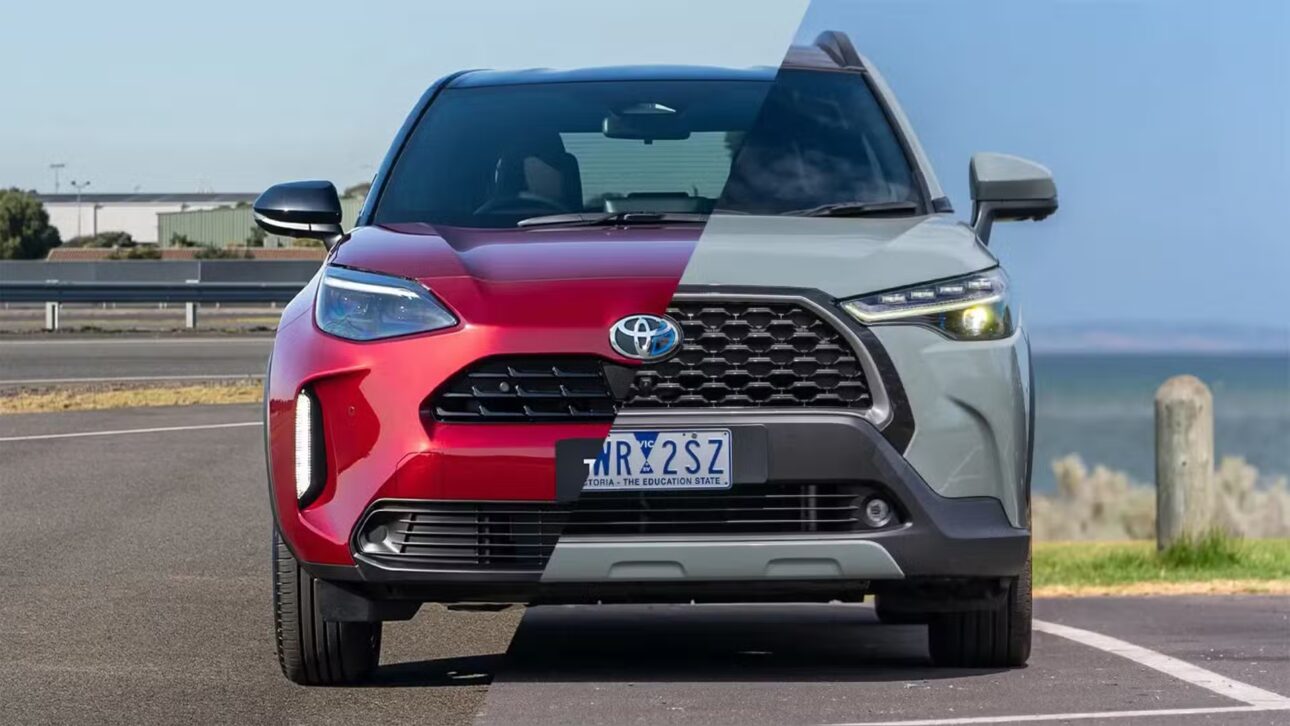
Visually, the two Toyota SUVs take different paths. The Corolla Cross has a more conservative and robust design. Its front features a prominent grille and sharp LED headlights. The rear is sober. In the 2025 lineup, the grille has a new pattern, and the higher trims have received sequential turn signals.
The Toyota Yaris Cross is expected to have a more youthful and dynamic design. Inspirations come from models like the RAV4 and Highlander. A trapezoidal grille, angular full-LED headlights, and marked side creases are anticipated.
In dimensions, the Corolla Cross is larger. It measures 4.46m in length, 1.825m in width, 1.62m in height, and 2.64m in wheelbase. The Toyota Yaris Cross is more compact: 4.31m in length, 1.77m in width, a height between 1.615m and 1.655m, and a 2.62m wheelbase. The ground clearance of the Corolla Cross is 161mm, while the Brazilian Yaris Cross is estimated to be 170mm.
Interior, Comfort, and Trunk: What to Expect from Each Model?
Inside, the Corolla Cross seeks sobriety and functionality. The 2025 lineup received a 12.3-inch digital dashboard starting from the XRE version. The materials vary, with leather in the more expensive versions. Space is good, comfortably accommodating two adults in the back. The trunk has a capacity of 440 liters.
For the Toyota Yaris Cross, a modern design is expected. A digital dashboard of up to 7 inches and a 10.1-inch multimedia center are awaited. Due to the cost focus, the finish will likely use more rigid plastics. Rear legroom may surprise, given the 2.62m wheelbase. The trunk capacity of the Toyota Yaris Cross still varies in information: from 390L to 471L. If a high value is confirmed, it will be a significant differentiator.
Engine, Performance, and Consumption: Corolla Cross and the Expected Toyota Yaris Cross
The engine options are a key point of difference. The Corolla Cross offers two engines:
- 2.0L Dynamic Force Flex: 175 hp (ethanol) and 167 hp (gasoline), with torque of 20.8 kgf.m. Direct Shift CVT with 10 simulated gears. Accelerates from 0-100 km/h in about 9.8 seconds.
- 1.8L Hybrid Flex System: Combined power of 122 hp. Hybrid Transaxle (e-CVT). Accelerates from 0-100 km/h in approximately 13 seconds.
For the Toyota Yaris Cross, the expected options are:
- 1.5L Flex Engine: Power around 106-110 hp. CVT transmission.
- 1.5L Hybrid Flex System: Expected combined power of 113 hp. e-CVT transmission. Acceleration from 0-100 km/h estimated between 10.5 and 11 seconds.
In terms of consumption, hybrid versions stand out. The Corolla Cross Hybrid achieves 17.8 km/l (gasoline) in the city. For the Toyota Yaris Cross Hybrid, estimates are even better. International tests indicate up to 30-32 km/l with gasoline. In Brazil, around 21.5 km/l (gasoline) in the city is expected. This would make it one of the most fuel-efficient cars in the country.
Expert Opinion: Toyota Yaris Cross or Corolla Cross, Which to Choose?
Experts analyze that the choice between the two Toyota SUVs will depend on the consumer’s priorities. The Corolla Cross is ideal for those who need more interior space and trunk (440L). Its 2.0 Flex engine offers superior performance. The TNGA-C platform generally provides better dynamics, although the rear suspension with a torsion beam is a point of criticism. It is more expensive but offers more refinement in top-of-the-line versions.
The Toyota Yaris Cross has as advantages its more affordable price and the exceptional fuel economy of the hybrid version. Its urban agility, due to its compact dimensions, is an advantage. It aims to democratize hybrid technology in Brazil. The interior finish may be simpler. Performance will be more restrained, focused on economy. Experts believe that the Toyota Yaris Cross has the potential to redefine the economy paradigm in the B-SUV segment and pressure the competition to accelerate electrification.










-

-

2 pessoas reagiram a isso.