





 Portuguese
  English
  Spanish
  4 min of reading
  18 comments


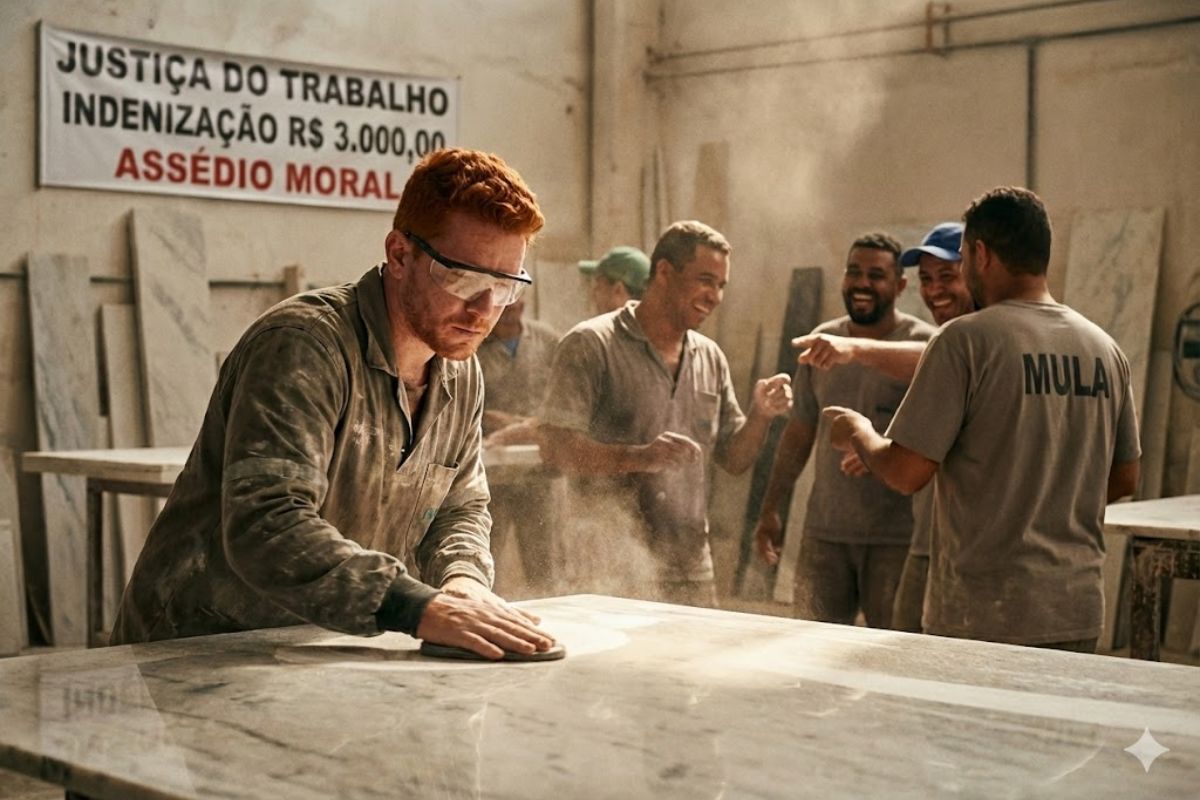


Recent Decision of the Labor Court in 2025 Reformed the Sentence That Had Denied Reparation, Recognized That Offensive Nicknames Linked to Appearance Constitute Reiterated Moral Harassment in a Marble Environment and Determined Payment of 3 Thousand Reais for Damage to the Dignity of the Worker, Reinforcing Limits for Jokes Considered Discriminatory in Companies.
A worker who worked for almost four years in a marble shop obtained from the Labor Court, in a collegial decision of 2025, the recognition that he was a victim of moral harassment due to nicknames linked to his physical appearance. The ruling set a compensation of R$ 3,000, after reversing the understanding that had denied moral damages in the first instance.
Throughout the entire contractual period, he claimed to have been called redhead, mule, and tea goat sucker by coworkers, in addition to dealing with offensive inscriptions made on marble stones within the workplace itself. Photographs of the environment and testimonies collected during the hearing were crucial to demonstrate the repetition of the offenses until the final judgment in 2025.
What Happened Inside the Marble Shop
The employee worked in cutting and finishing pieces of marble in a predominantly male sector.
-
The Senate approves a bill that criminalizes misogyny, hatred, or aversion towards women, and includes the crime in the Racism Law with a penalty of up to 5 years.

-
Chamber Approves Bill That Allows Pepper Spray for Women Over 16 and Imposes Strict Rules for Purchase, Possession, and Use as Self-Defense

-
Chamber Approves Law to Combat Leucaena, Fast-Growing Plant That Dominates Land and Threatens Native Species in Various Regions of the Country

-
Asset Division: Know What Cannot Be Divided in Case of Divorce


According to the lawsuit, the environment was marked by jokes that went beyond the acceptable limit and were directed specifically at his appearance: fair skin, beard, and red hair.
The evidence submitted to the case included photos of stones with words written in chalk, displaying nicknames such as “redhead,” “mule,” and “tea goat sucker.”
Witnesses confirmed that the worker was frequently called “redhead,” even after making it clear that he did not feel comfortable with the nickname.
The conduct, according to the reports, was not isolated but repeated throughout the employment, characterizing persecution and humiliation.
How the First Decision Treated the Claim for Moral Damages
In the first-instance ruling, the labor judge understood that the evidence presented was not sufficient to establish compensable moral damages.
Despite the photographs and testimonies, the prevailing argument was that the facts did not exceed the realm of common jokes in the workplace.
With that understanding, the claim for compensation was deemed unwarranted.
In practice, the worker left the first phase of the process without any financial compensation, even after reporting continuous embarrassment and discrimination related to his physical appearance.
Why the Labor Court Reversed the Case in the TRT
Dissatisfied, the plaintiff appealed to the Regional Labor Court.
In the judgment of the appeal, the judges highlighted that the company has a duty to ensure a respectful work environment and cannot remain passive in the face of reiterative nicknames and jokes that affect an employee’s dignity.
The collegiate considered that, in this specific case, the “jokes” took on a clearly discriminatory character, as they were connected to the color of the hair, the beard, and the appearance of the worker.
The Labor Court understood that the company’s tolerance of the offenses, combined with their repetition over the years, constituted moral harassment.
Based on this analysis, the TRT set a compensation of R$ 3,000 for moral damages, taking into account the severity of the conduct, the economic size of the company, and the pedagogical nature of the ruling, without turning the amount into undue enrichment for the worker.
What Could Have Been the Legal Basis for the Recognition of Harassment
Although the ruling does not specify, in the news, all the provisions used, the decision aligns with already established foundations in the Labor Court regarding moral harassment and employer responsibility.
Among them, the following stand out:
The principle of dignity of the human person, provided for in Article 1, item III, of the Federal Constitution, which requires respect for the moral integrity of the worker.
The right to compensation for moral damages, assured in Article 5, item X, of the Federal Constitution, when there is harm to honor and image.
The employer’s responsibility for acts practiced in the workplace, provided for in Article 932, item III, of the Civil Code, which links them to the conduct of their representatives.
The configuration of an unlawful act, according to Article 186 of the Civil Code, whenever a culpable or willful conduct causes damage to another.
The jurisprudence of the Superior Labor Court has recognized that pejorative nicknames, constant offenses, and employer omission form a typical framework of moral harassment, especially when directed at immutable or sensitive personal characteristics, such as appearance, gender, skin color, or religious orientation.
What This Decision Indicates for Companies and Workers
The case reinforces that the Labor Court does not consider “jokes” that, in practice, expose someone to ridicule as neutral or harmless.
When nicknames touch on aspects of physical appearance and are repeated daily, the prevailing understanding is that there is a violation of dignity and the minimum respect due to any worker.
For companies, the decision serves as a warning: it is not enough to say that the facts were “jokes among colleagues.”
It is necessary to actively act to curb offenses, guide teams, document warnings, and, if necessary, apply disciplinary sanctions.
Omission can be interpreted as tacit agreement with the conduct and lead to legal rulings.
For employees, the process shows that documenting situations of humiliation, preserving evidence, recording nicknames in messages or photos, and seeking witnesses can be decisive in demonstrating that it is not an isolated episode, but rather ongoing moral harassment.
In your opinion, are decisions like this enough to discourage offensive nicknames in workplaces, or is it still common to see companies treating this type of harassment as mere jokes?










Esse mundo tá de cabeça pra baixo,hoje a caroça tá puxando o ****,no meu tempo de todos tinham apelido,negão era beiçola,me ina da **** grande,tanajura,e por aí ia, ninguém se ofendia,hoje tá uma frescura danada.
Mundo do mi-mi-mi. Tomá no kool.
Em pleno século 21 existem **** que acham lindo rir das diferenças e criar apelidos pejorativos. Esse tipo de gente é aquela que jura ser cristã e de bem, mas é um demô nio