





 Portuguese
  English
  Spanish
  6 min of reading
  0 comments


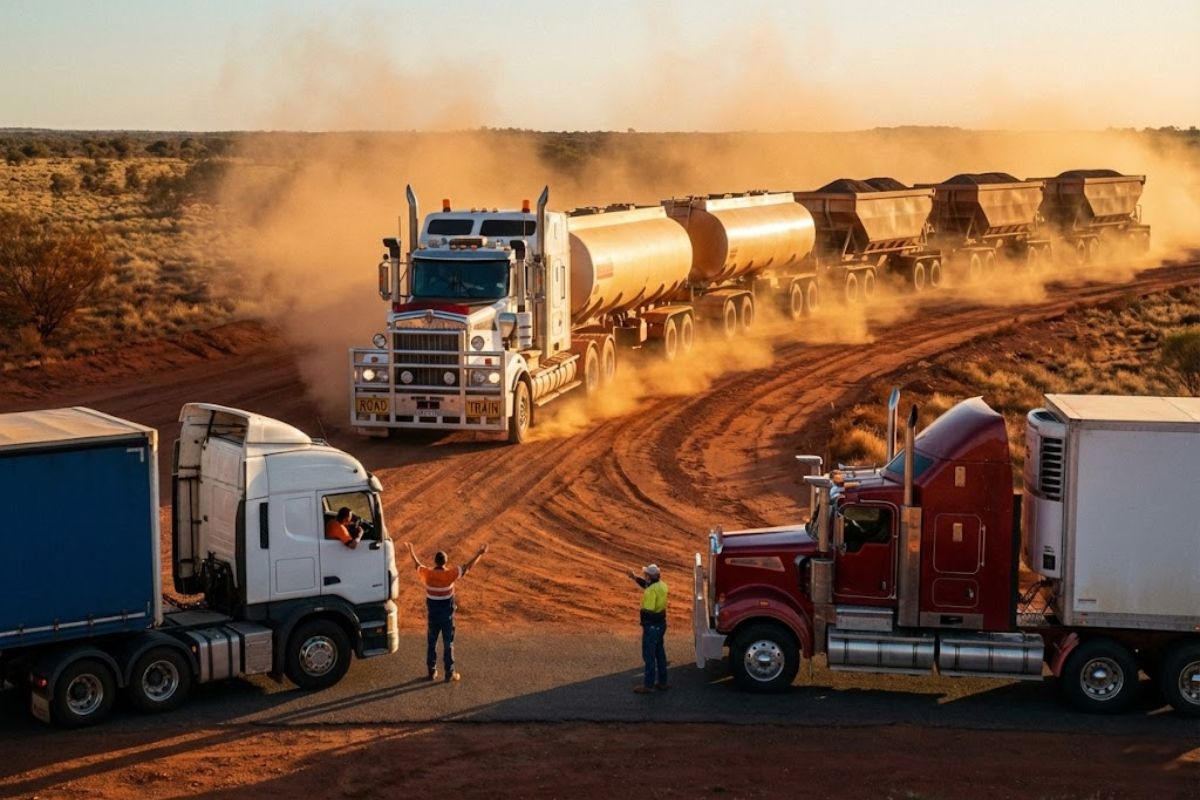
In The Heart Of Australia, Monster Trucks Up To 53 Meters And About 200 Tons Operate Like Real Trains On The Road, Facing Extreme Heat, Lack Of Rail, Connecting Farms, Mines, And Isolated Towns, And Operating Under Impossible Conditions For Congested European And American Highways With Few Logistical Transport Alternatives
In The Heart Of The Australian Outback, monster trucks longer than 50 meters have become the backbone of regions where more than 80% of the territory is virtually empty and less than 5% of the population lives. Since the 1930s, when the government began replacing camel caravans with motor vehicles, these giant convoys have ensured the supply of isolated communities, cattle farms, and mines far from any major city.
In 2006, one of these road trains broke the world record by pulling 113 trailers on private road, traveling almost 500 meters long as if it were a train on wheels. Today, combinations up to 53.5 m and about 200 tons circulate legally on specific routes, crossing a desert with temperatures above 40 ºC, dirt roads, long stretches without support, and almost no rail alternative, in a setting that simply has no parallel in Europe and the United States.
Extreme Outback Creates The Need For Monster Trucks

The logic behind monster trucks arises from a harsh equation: vast territorial expanse, extreme climate, low population, and almost no railway in the interior.
-
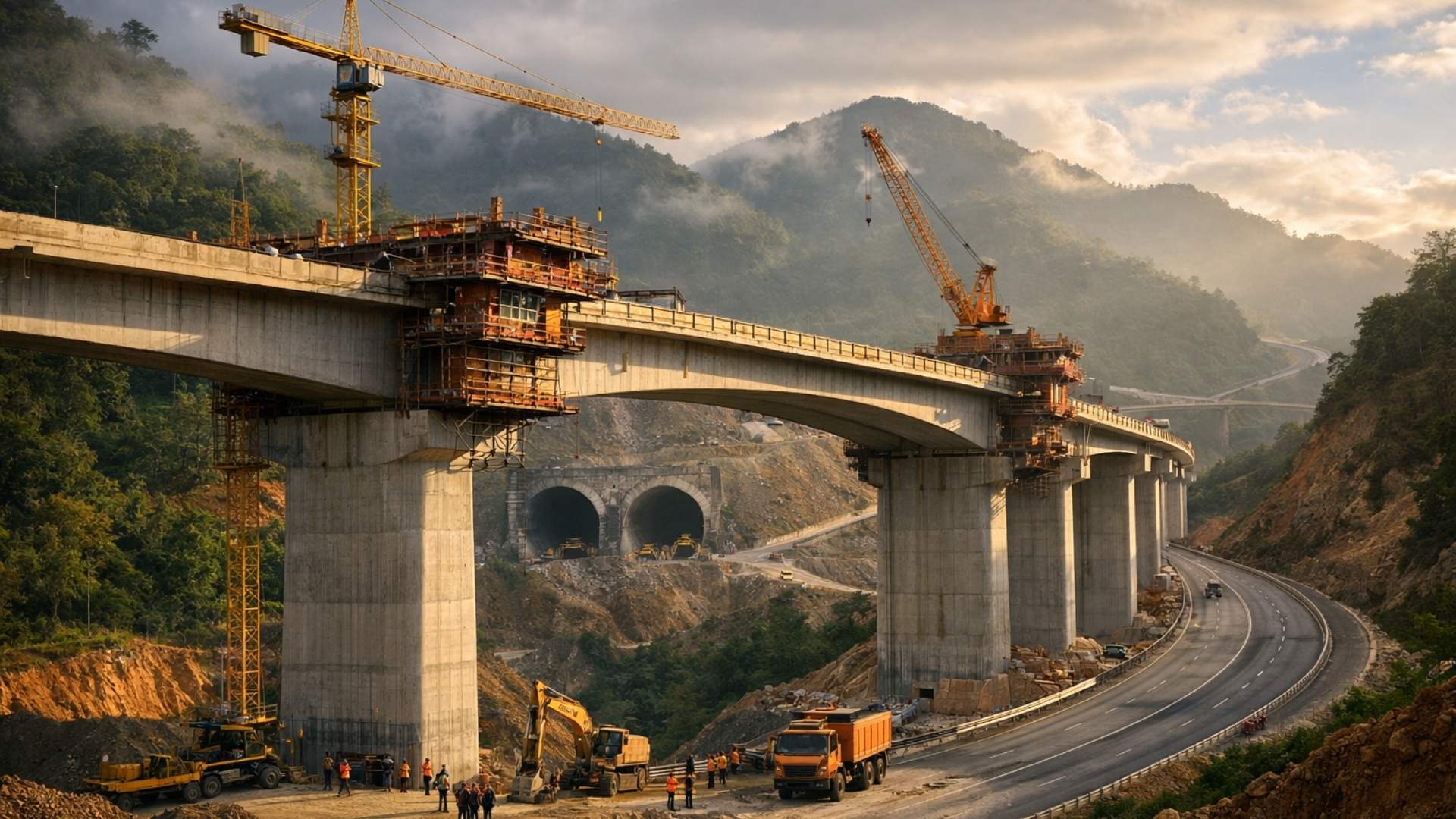
The government puts R$ 8.6 billion on the table to change the highway (BR) with 50 overpasses, 28 bridges, 4 tunnels, and 40 km of bike lanes in 180 km of historic duplication.
-
BRL 20.1 Million Bridge Project Kicks Off: 200-Meter Construction to Improve Access in Three Cities in Minas Gerais

-
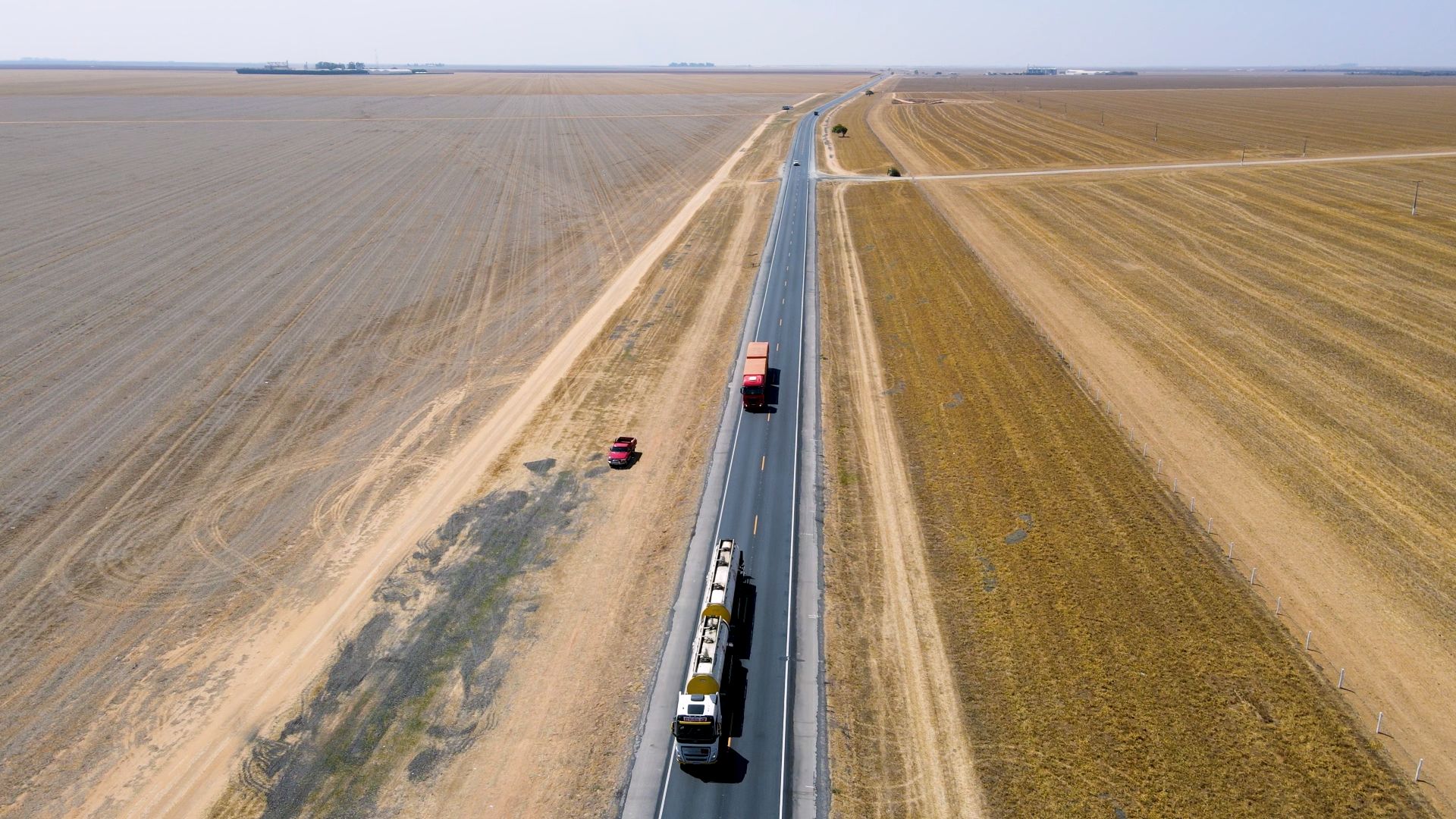
‘Endless Road’ In Brazil Is One of The Largest In The World: 145 Km Stretch On An Important Highway (BR) Crosses The West Of Bahia And Had 135.9 Km Revitalized With R$ 35.3 Million
-
Engineer From ITA Who Worked at Embraer Leads Free Flow Expansion With National Artificial Intelligence and Technology for Toll Without Barriers in Brazil


The Outback combines arid deserts, sun-scorched savannas, and rock formations sculpted over millennia, with stretches where temperatures exceed 40 ºC and others subject to intense tropical rains that leave roads impassable for days.
While much of the railway network is concentrated in coastal regions, the center and west of the country depend on long road routes.
Many roads are dirt, poorly marked, and vulnerable to heat that warps asphalt.
In areas where there is no even pavement, monster trucks follow improvised paths, guided by GPS and the experience of drivers, carrying fuel, food, equipment, and essential supplies to locations that lack ports, navigable rivers, or economically viable cargo aviation.
From Camels To The First Modern Road Train

Before the arrival of diesel engines, cargo transport in the Australian interior relied on camel caravans led by Afghan cameleers.
This system began to be replaced in the 1930s when the government decided to modernize logistics and invest in trucks.
In this context, Kurt Johannsen, a mechanic from the Northern Territory, was challenged to create a vehicle capable of transporting up to 100 head of cattle, about five times more than the standard of the time.
He adapted an American military truck, the Diamond T, and developed trailers with self-steering wheels, capable of navigating the narrow paths and tight turns of the desert.
The prototype, named Bertha, became a reference for future road trains and paved the way for generations of monster trucks custom-designed for extreme operations.
How Giant Combinations Work In Practice
Over the decades, Australian engineering has refined the configurations of the so-called road trains, creating different arrangements of trailers to balance load capacity, stability, and safety.
Among the main formats operating with monster trucks, the following stand out:
B-double: tractor truck pulling two semi-trailers connected by a fifth wheel, forming a more stable combination than traditional combinations with dolly
B-triple: direct extension of the B-double, now with three semi-trailers connected in sequence, reducing lateral sway and improving control over long distances
A-triple: three full trailers linked by movable dollies, a more flexible solution, but more challenging to drive and requiring even more power from the prime mover
AB-triple: mixed combination that joins two large trailers and one semi-trailer at the end, designed for operations where part of the route requires maximum stability and another part demands more maneuverability
On public highways, these combinations can reach 53.5 m and up to 200 tons, always on authorized routes and with strict rules regarding speed and qualifications.
On private mining roads, where there are no legal length limits, experimental combos with more than 100 trailers in line have been organized, used to demonstrate technical capacity and break records.
Power, Comfort, And Drivers’ Routine In The Desert
To move monster trucks with dozens of trailers, the solution involves prime movers designed exclusively for the Outback.
One of the icons is the Mack Titan, prepared to operate under extreme heat, constant dust, and long distances without support.
With engines reaching around 780 horsepower and torque in the hundreds of kilogram-force meters, these vehicles push convoys that weigh more than two fully loaded Boeing 737 commercial airplanes.
At the same time, the cabin needs to function like a small home on wheels.
Drivers can spend days or weeks on the road, with stretches of over 1000 km between fuel stations or urban centers.
Therefore, modern models offer a bed, reinforced air conditioning, air suspension, digital dashboard, driving assistants, and multimedia systems.
It’s Not Luxury: It’s Operational And Safety Necessity, as fatigue and disorientation in remote areas can be fatal.
Monster Trucks As A Pillar Of The Australian Interior Economy
The monster trucks sustain entire economic chains in the interior of Australia.
They transport cattle, iron ore, grains, fuels, and heavy equipment in volumes that would make the use of conventional trucks unfeasible.
A single driver can carry the equivalent of two, three, or even four standard cargo vehicles, reducing costs for personnel, fuel, and maintenance in regions with little labor and poor infrastructure.
In many communities, these convoys are literally the only link with the rest of the country.
If a road closes due to heavy rain or pavement damage, the effect is immediate: markets run out of supplies, schools cease normal functioning, and hospitals are on alert due to lack of supplies.
Road trains have indeed become the backbone of logistics in places where there are no trains, boats, or airplanes capable of fulfilling the role regularly and at an acceptable cost.
Why Monster Trucks Don’t Fit In Europe And The United States
The inevitable question is why the solution of monster trucks is not replicated on a large scale in Europe or the United States, two countries with long distances and high cargo circulation.
The answer mixes legislation, urban geography, and infrastructure conditions that are completely different from the Australian scenario.
In the United States, federal rule limits the size and weight of most combinations, generally allowing only two trailers of about 8.5 m, totaling approximately 19 m in most states.
The so-called triples exist in some specific locations, but with much lower capacity and strong geographical restrictions.
In Europe, the typical maximum length hovers around 25.25 m and 60 tons, with some exceptions in Scandinavia, where Sweden and Finland already accept combinations around 34.5 m, still very far from the Outback standards.
The design of European cities, with narrow streets, tight roundabouts, and old bridges, makes the circulation of a 50 m convoy practically unfeasible.
Even in rural areas, snow, ice, and frequent congestion increase the risk of accidents with such long vehicles.
Outside Australia, monster trucks do not fit on the roads, in the laws, or in the urban mesh, which makes road trains a highly specific solution for a country with vast desert areas, low population density, and infrastructure concentrated on the coast.
An Extreme Solution For An Extreme Territory
Monster trucks are more than mechanical curiosities: they represent the logistical response of a country that has had to face isolation, hostile climate, and lack of rail alternatives in the interior.
They emerged out of necessity, grew due to efficiency, and today symbolize the economic resilience of entire regions dependent on a single highway for survival.
While the rest of the world discusses how to reduce fleet sizes, electrify vehicles, and streamline operations, Australia continues in the opposite direction with increasingly long, heavy, and extreme convoys.
In practice, they are trains on the road designed for a scenario that few countries face.
Would you dare to face hours of travel sharing the road with such large monster trucks if they ever reached Brazilian highways?







Seja o primeiro a reagir!