





 Portuguese
  English
  Spanish
  4 min of reading
  0 comments


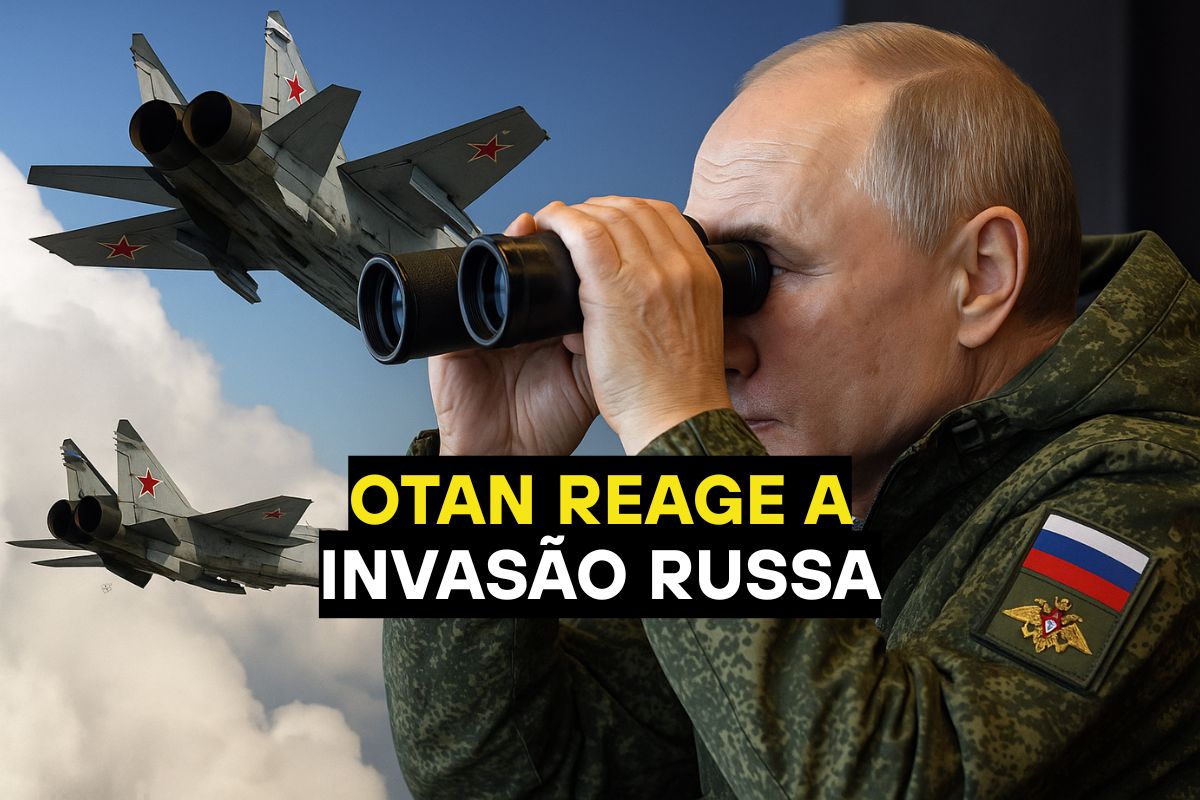
Three Russian Fighters Crossed the Territory of Estonia Without a Flight Plan, Transponder or Communication, Being Quickly Intercepted by Jets from Italy, Finland and Sweden in Coordinated Response from NATO
A incursion of three Russian MiG-31s into Estonia’s airspace this week led NATO to activate its maximum alert protocol. The Russian fighters flew over Estonian territory for about 12 minutes, without any communication with local air traffic control, forcing forces from Italy, Finland, and Sweden to scramble in immediate response.
The episode, described by Baltic authorities as a “blatant provocation”, escalates tensions on the northeastern flank of the alliance. The aerial violation was not accompanied by official statements from Russia, but the gesture was interpreted as a deliberate test of NATO’s limits amid a security crisis in Eastern Europe.
Incursion Without Warning and Jets on Alert
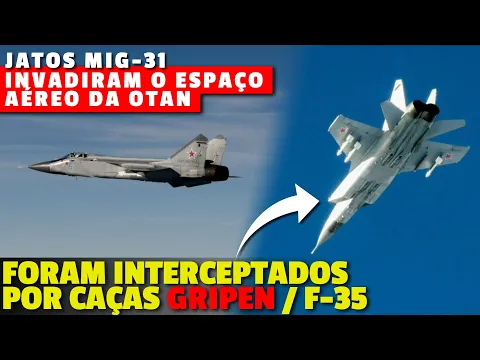
According to information from Estonia, the three Russian MiG-31 Foxhounds invaded the airspace 24 km off the country’s northern coast and about 96 km from Russia.
-
If the USA were to go to war with Brazil, Washington’s greatest fear would not be the attack itself, but facing a vast territory, prolonged resistance, and a costly, chaotic, and unpredictable occupation.

-
In 2013, Nicaragua sold the concession for a canal to rival Panama to a Chinese billionaire who lost 85% of his fortune, disappeared, and was declared bankrupt. Now the project resurfaces with a new route, a new Chinese partner, and a cost of $64.5 billion.

-
The USA announces a mysterious billion-dollar vault project to store critical minerals, but what intrigues experts is not just the plan itself, but why Latin America, including Brazil, has entered the center of this global dispute against China.

-
Trump Announces Bombing of U.S. Military Targets on Iranian Island Responsible for About 90% of Iran’s Oil Exports, Warns of Further Attacks if Navigation in Strategic Strait of Hormuz Is Threatened

Without presenting a flight plan, with transponders turned off and no bilateral communication with Estonian air traffic, the aircraft were detected by NATO’s air policing mission.
Italian F-35 jets, Swedish Gripen fighters, and Finnish aircraft were immediately scrambled, intercepting the MiG-31s in tense flight, but without direct confrontation.
Images captured by Gripen fighters show that the Russians were carrying three short-range R-73 missiles, which drew attention due to being an unusual configuration — and lacking the feared long-range R-37M missiles.
NATO interpreted the absence of longer-range missiles as a sign of controlled provocation, avoiding immediate escalation but sending a clear message of presence in the Baltic.
The air policing mission in the Baltic is permanent and rotates among the alliance member countries.
Severe Reactions from Diplomats and Threat of Retaliation
The diplomatic response was firm. The Estonian Foreign Minister classified the episode as “an unprecedented and blatant intrusion”, accusing Russia of intentionally escalating regional tension.
For him, the action demands immediate political and economic pressure from the international community.
Even more incisive was the Lithuanian Defense Minister, who subtly suggested shooting down future invading aircraft, recalling the 2015 incident when Turkey shot down a Russian Su-24 jet at the Syrian border.
“NATO’s border is being tested for a reason. We need to be serious,” he stated.
The absence of an official Russian stance so far increases uncertainty.
For analysts from the Steel Eagles platform, which monitors aerial operations in Eastern Europe, the gesture may have been a calculated message from Moscow, especially after recent overflights of Russian drones over Poland, also interpreted as deliberate violations.
Increasing Tension and NATO’s Role in the Baltic
Estonia has been a NATO member since 2004 and has been one of the most active countries in defending the alliance against Russian threats.
The region’s airspace has become a frequent stage for incursions and “response tests”, further pressuring interception protocols and defense strategies.
The presence of MiG-31s, one of the fastest platforms in the Russian Air Force, makes the episode even more sensitive.
With the ability to reach Mach 2.8 and long-range armaments, the MiG-31 is designed for strategic interception missions at high altitude — reinforcing the theory of planned provocation.
NATO military authorities are considering revising engagement rules and accelerating air reinforcements in the region.
Sweden, still in the formal process of full accession to the alliance, actively participated in the interception, demonstrating practical alignment with NATO protocols even before final ratification.
Provocation or Navigation Error?

It is still unclear whether the incursion was intentional or the result of operational failure, but the recent pattern of Russian aviation behavior on NATO’s eastern flank leaves little doubt about intentions.
Without a flight plan, without a transponder and without contact with air traffic control, the MiG-31s violated all international aviation norms in foreign airspace.
For experts from Steel Eagles, if it was a mistake, Russia should have quickly clarified — which did not happen.
The Russian silence may be strategic, allowing for maintaining ambiguity and fueling psychological wear in the bordering countries of the alliance.
Do you think NATO should respond more firmly? Do you believe Russia is deliberately testing the West’s limits? Share your opinion in the comments — we want to hear from those closely following the developments of tension in Eastern Europe.










Seja o primeiro a reagir!