





 Portuguese
  English
  Spanish
  7 min of reading
  0 comments


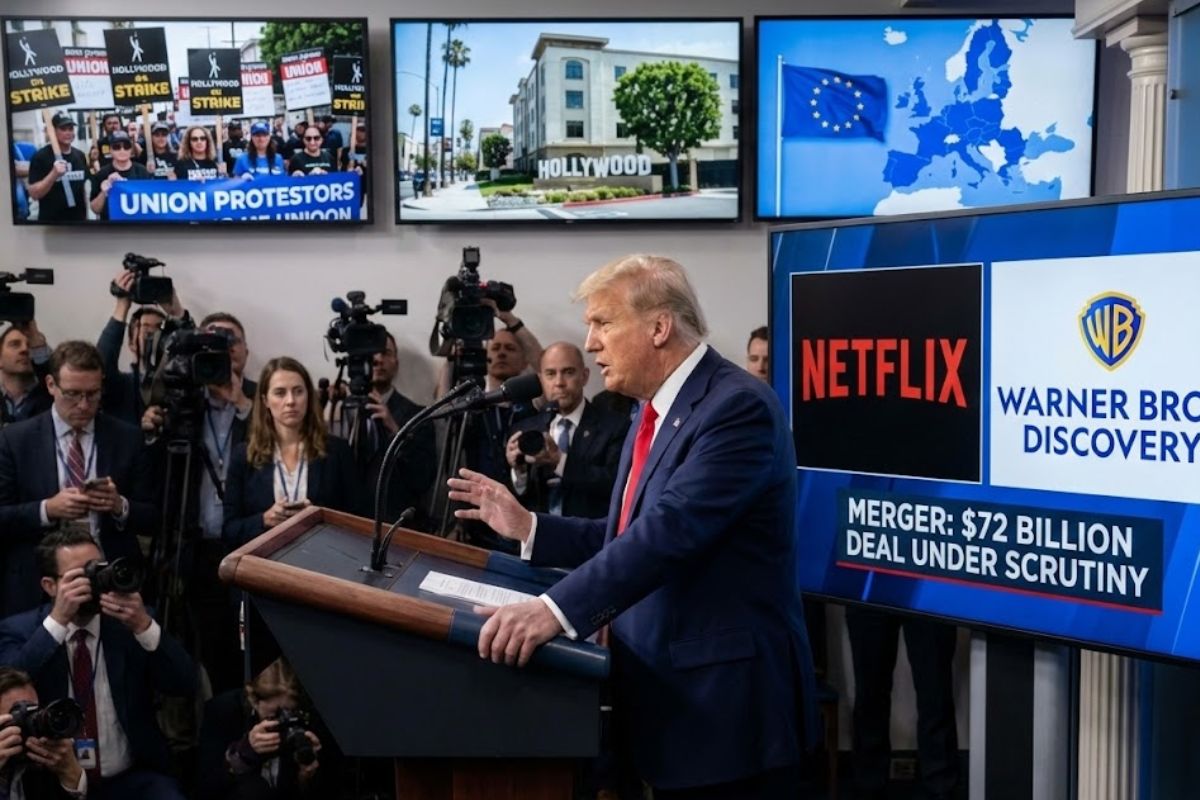
While Trump Promises To Personally Participate In The Decision On The Netflix And Warner Deal, Unions Speak Of An Antitrust Nightmare, Hollywood Fears Job Losses, Europe Prepares For Strict Scrutiny And Filmmakers Warn Of A Real Risk To Movie Theaters And Streaming Competition With Impact On Salaries, Subscribers And Studios
Trump raised tensions in the entertainment market by stating on Sunday, December 7, 2025, that he plans to interfere in the analysis of the Warner Bros. Discovery purchase by Netflix, a deal estimated at about US$ 72 billion and already treated by unions as a possible antitrust nightmare. According to the president, the deal represents a “large chunk” of the entertainment market, and “could be a problem” for competition.
The deal had been announced on Friday, December 5, 2025, and since then has triggered a chain reaction in Hollywood, among politicians in the United States and European countries, who see the transaction as posing the risk of an unprecedented domination by Netflix in streaming, with a direct impact on jobs, salaries, subscription prices, and the future of movie theaters. By promising to get involved, Trump adds an explosive political component to an operation already considered highly sensitive by regulators and the industry.
Trump, Hollywood And The Fear Of Power Concentration
By stating that he intends to participate in the decision on the Warner purchase by Netflix, Trump signals that the deal will not be treated merely as a private transaction between companies. The president’s statement places the White House at the center of a dispute involving billions of dollars, thousands of jobs, and the control of one of the largest content catalogs on the planet.
-
Brazilian city gains industrial hub for 85 companies that is equivalent to 55 football fields.

-
Peugeot and Citroën factory in Argentina cuts production by half and opens a layoff program for more than 2,000 employees after Brazil drastically reduced purchases of Argentine vehicles.

-
A Brazilian city gains a factory worth R$ 300 million with the capacity to process 200 thousand tons of wheat per year, a mill of 660 tons/day, silos for 42 thousand tons, and an industrial area of 276 thousand m².

-
Havan will leave the shopping mall in Blumenau to inaugurate something that the chain has never done before: a megastore in half-timbered style in the Historic Center of the city, which is expected to be completed in May and change the landscape of local retail.


Since the announcement, executives, artists, and theater owners have been repeating the same argument: the union between Netflix and Warner would create a giant with exceptional power to dictate how much is produced, where it is screened, and how much the public pays.
For critics of the operation, the purchase concentrates too much content in a single media group and threatens to reconfigure the balance of streaming and cinema on a global scale.
Filmmakers And Exhibitors Defend The Experience Of Going To The Movies
At the forefront of Hollywood’s reaction are prominent names in directing. James Cameron, creator of films like “Avatar” and “Titanic,” labeled the acquisition of Warner by Netflix as a “disaster” in an interview with a podcast specializing in the industry.
He reiterated his criticism of Netflix co-CEO Ted Sarandos, who previously suggested that theater exhibition was an outdated idea. For the director, the promise to maintain releases in theaters would sound like “bait” if it were limited to minimal premieres merely for Oscar qualification.
Outside the United States, Brazilian Kleber Mendonça Filho, director of “Aquilo que Perdemos,” chosen to represent Brazil at the 2026 Oscars, also spoke out on social media. He defended cinema as an irreplaceable space in a film’s journey and argued that streaming is a powerful form of exhibition but should not have the power to “end” the culture of the cinema.
For filmmakers and exhibitors, the merger between Netflix and Warner is not just a business matter but a potential attack on the collective experience of watching films in theaters.
Hollywood producers, in turn, sent an email to the U.S. Congress urging lawmakers to examine the operation with maximum scrutiny. According to Variety magazine, the group fears that the new company would have the power to control release windows and condition the market, “tightening the noose” around traditional cinema.
European exhibitors, gathered in the Unic group, spoke of a “double risk”: fewer films produced and even fewer titles coming to screens.
Unions See Direct Threat To Jobs, Salaries, And Diversity
The main unions in the entertainment industry reacted in unison to the news. The Writers Guild of America (WGA) stated that the merger “should be blocked.”
In their view, the purchase of Warner by Netflix would eliminate thousands of jobs, reduce salaries, worsen working conditions throughout the audiovisual chain, increase consumer prices, and diminish the volume and diversity of available productions.
The Directors Guild of America (DGA) expressed “significant concerns” about the transaction. The entity emphasizes that a vibrant and competitive industry is essential to protect careers, creative rights, and the ability of directors and crews to negotiate fairly with large media conglomerates.
The Producers Guild of America (PGA) stated that producers are “certainly concerned” about the change of control of one of the industry’s most historic studios. The PGA demanded that any approval of the deal be conditioned on concrete guarantees that there will be opportunities for workers and artists, as well as ample choices for the public.
In the unions’ view, the merger would represent a decisive step toward a market dominated by a few giants, with less space for independent voices.
Bipartisan Political Pressure And Prolonged Regulatory Battle
Trump’s entry deepens a scenario that was already characterized by strong skepticism in the U.S. government. A senior administration official told CNBC that the White House views the US$ 72 billion deal with great suspicion. By signaling that he wants to “participate in the decision,” Trump suggests that the Executive may directly pressure competition authorities.
In Congress, the reaction is also tough. Republican Senator Mike Lee, chair of the Antitrust Subcommittee of the Judiciary Committee, stated that the operation raises “serious issues” about competition, perhaps more than any other transaction he has seen in about a decade.
The message is that the merger could face prolonged scrutiny, with public hearings and attempts to impose remedies before any possible approval.
On the Democratic side, Senator Elizabeth Warren branded the deal as an “antitrust nightmare.”
According to her, the combination of Netflix and Warner would create a media giant with control of nearly half of the global streaming market, which could mean higher subscriptions, fewer options for consumers, and greater vulnerability for American workers in the sector.
In the European Union, competition experts see it as unlikely that the operation will simply be blocked, but they expect a long and detailed investigation.
The assessment is that Brussels might impose tough conditions, including requiring Netflix to honor existing licensing contracts and, in a more extreme scenario, even demanding the sale of Warner’s streaming platform, HBO Max. If this occurs, the deal would shift from a historic merger to a complex regulatory puzzle across multiple continents.
Competitors Denounce Netflix’s Global Dominance In Streaming
Paramount, which until recently was seen as the favorite to acquire Warner, reacted strongly after Netflix’s selection. In a letter sent to Warner’s board, attorneys for the company, now controlled by David Ellison, argued that the transaction would “consolidate and expand Netflix’s global dominance” at a level incompatible with U.S. competition laws.
According to calculations presented by Paramount, the new company resulting from the merger would have about 43 percent market share among global streaming service subscribers.
In the studio’s view, this level would make the operation “presumptively illegal” under U.S. antitrust law. For rivals, a group with this weight would have the power to dictate prices, pressure suppliers, and negotiate under much more favorable conditions, suffocating smaller competitors.
The possibility of Trump’s direct intervention adds uncertainty to the scenario, but it may also strengthen competitors’ offensive.
If the president maintains the narrative that the deal “could be a problem,” companies like Paramount are likely to intensify their lobbying in Congress and with regulatory agencies, seeking to block or at least redesign the transaction.
Analysts Speak Of Risk Of Value Destruction And Strategic Leap For Netflix
Among market analysts, there is no consensus on the final impact of Netflix’s acquisition of Warner. François Godard, a media and telecommunications expert at Enders Analysis, sees a high risk of value destruction, recalling that the previous merger between Warner and Discovery had already been deemed problematic.
He questions whether brands like HBO would be able to preserve their identity under Netflix’s command, given the pressure for scale and volume of content.
Conversely, Guy Bisson, executive director of Ampere Analysis, considers the deal to be “great news but not surprising” within the logic of streaming consolidation. In his view, the transaction would propel Netflix to a new level by incorporating one of the largest libraries of intellectual properties in the market, something that would take decades to build from scratch.
For this group of analysts, the deal is risky but consistent with the platform’s strategy to become the main global entertainment hub.
Trump’s presence, however, makes the board more unpredictable. On one hand, the president seeks to position himself as a defender of competition and consumers.
On the other hand, he faces an industry that fears job cuts, salary reductions, and a weakening of movie theaters should the merger advance. The future of the US$ 72 billion deal will depend on the balance between political interests, union pressure, regulatory opinions, and Netflix’s ability to convince governments that it will not become too big to be contained.
Given so much pressure and a president willing to intervene directly, do you think Trump should try to block the purchase of Warner by Netflix, or should the streaming market adjust without government intervention?










-

Uma pessoa reagiu a isso.