





 Portuguese
  English
  Spanish
  5 min of reading
  0 comments


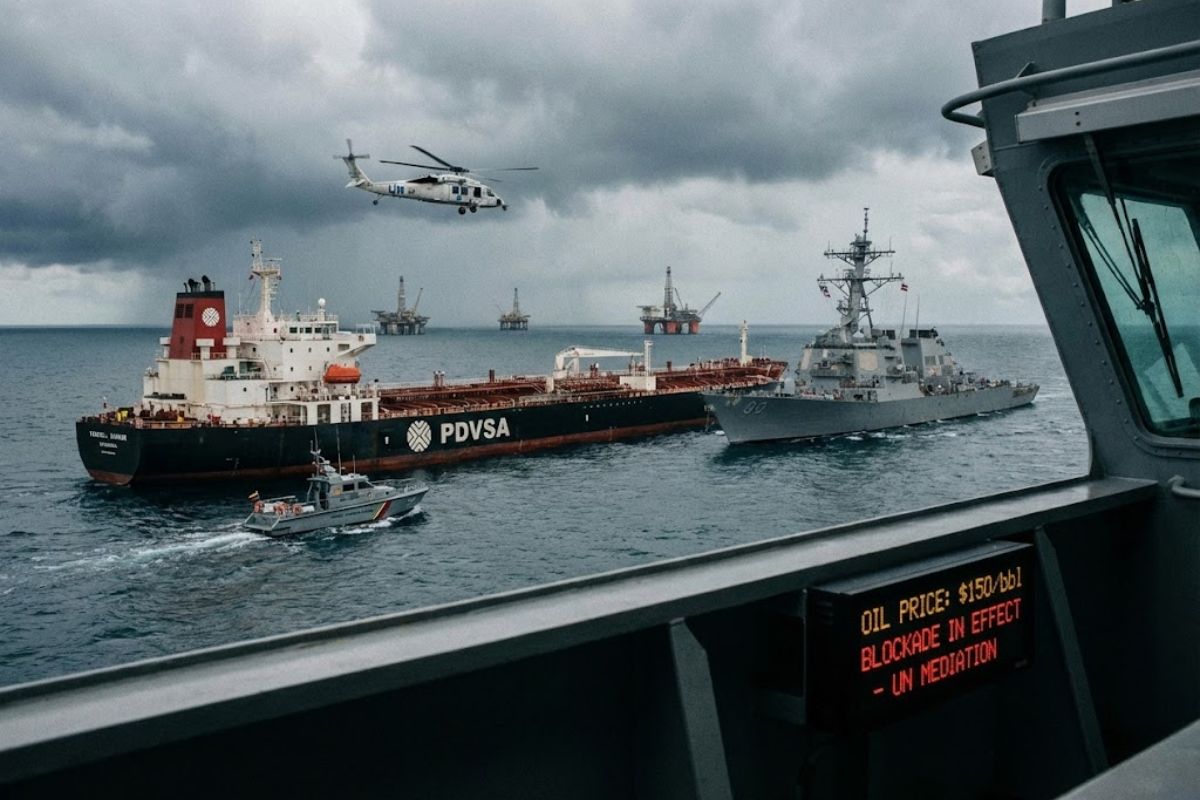
Announced by Trump on December 16, 2025, Venezuela’s Tanker Blockade Targets Sanctioned Ships, Provokes Maduro’s Naval Escort, Brings the Case to the UN Security Council, and Already Fuels Fears of Blocked Exports, Closed Wells, and Higher Oil Prices Worldwide for Investors
On December 16, 2025, President Donald Trump announced a “total and complete blockade” aimed at tankers under sanctions entering or leaving Venezuela, defining the blockade of tankers by Venezuela as a central piece of a strategy to strangle the oil revenues of the Nicolás Maduro government and increase political and economic pressure on Caracas. Hours later, maritime monitoring already indicated sanctioned ships slowing down, changing routes, or remaining anchored offshore to avoid searches and seizures.
On December 17, 2025, Venezuela formally requested a meeting of the UN Security Council, and Secretary-General António Guterres publicly called for restraint and immediate de-escalation of tensions. Between December 17 and 18, reports of logistical disarray, the risk of storage tank saturation, and rising prices for Brent and WTI reinforced the perception that the blockade of tankers by Venezuela was already beginning to affect exports, diplomacy, and global oil prices.
What’s Behind Venezuela’s Tanker Blockade

Despite the “total blockade” rhetoric, the released design shows that the measure does not close off the sea to any vessel operating in the region.
-
Offshore industrial demand in Macaé skyrockets with the recovery of oil and gas and could grow by up to 396% by 2026 in the Campos Basin.
-
Offshore industrial demand in Macaé surges with the recovery of oil and gas and could grow by up to 396% by 2026 in the Campos Basin.
-
Brazilian giant expands borders in the Southeast: Petrobras confirms new oil discovery in ultra-deep waters in the pre-salt of the Campos Basin.

-
Alert in the global energy market: Severe tropical cyclone hits the coast and disrupts gas production at major plants in Australia, threatening global supply.


The primary target of Venezuela’s tanker blockade is vessels already listed under sanctions and linked to the so-called shadow fleet, used to transport Venezuelan oil mainly to Asia.
The idea is to make it operationally risky and expensive to operate with these tankers, without having to announce a classic naval blockade to the entire global fleet.
In practice, the central instrument is increasing the risk of interdiction, inspection, and seizure of sanctioned ships, combined with pressure on insurers, flags, ports, and maritime service providers.
By making insurance more expensive, restricting access to terminals, and discouraging transportation contracts, Venezuela’s tanker blockade aims to drastically reduce the export capacity of state-owned PDVSA and, consequently, the inflow of foreign currency into Maduro’s regime.
Maduro’s Reaction and Risk of Incidents at Sea
In response, the Maduro government embarked on a two-pronged strategy.
At sea, it ordered the Venezuelan Navy to escort ships transporting oil and derivatives, increasing military presence on routes of entry and exit for tankers affected by Venezuela’s tanker blockade.
On the diplomatic front, Caracas brought the issue to the UN Security Council and characterized US measures as aggression and a threat to national sovereignty.
The naval escort carries significant symbolic weight but also practical effects.
By placing military vessels alongside sanctioned merchant ships, Venezuela raises the cost of any attempt at inspection or seizure by the United States in international waters.
An incident involving warships and tankers, even if limited, could quickly escalate into a regional crisis, further increasing the risk premium embedded in the oil price.
How Venezuela’s Tanker Blockade Tightens Oil Logistics
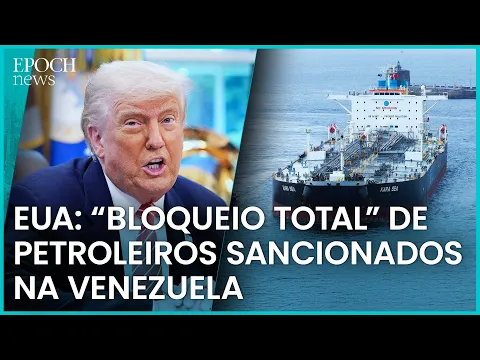

Venezuela currently produces around 900,000 barrels of oil per day and relies heavily on exports to generate cash.
A significant portion of these shipments is made precisely by sanctioned tankers, the direct target of the tanker blockade by Venezuela announced by Trump.
By restricting the operational scope of this fleet, the measure creates a bottleneck in the logistical chain of Venezuelan oil.
With the risk of seizure and secondary sanctions, ships avoid docking, change routes, slow down, or wait for instructions far from high-surveillance areas.
This pressures onshore storage infrastructure in Venezuela and pushes already loaded vessels into a sort of operational limbo.
If tanks on land and anchored ships reach capacity limits, the government may be forced to reduce or even temporarily suspend production in some fields due to a lack of space to store the oil.
The Role of the UN and the Reaction of the International Community
The day after the announcement, Caracas submitted a request for a UN Security Council meeting, trying to frame Venezuela’s tanker blockade as a violation of international law and a threat to regional peace and security.
António Guterres, through his spokesperson, called for moderation and dialogue, making it clear that the escalation between Washington and Caracas concerns the organization.
Countries allied with Venezuela criticized unilateral measures and warned of the risk of destabilization in South America.
International law experts recall that complete naval blockades tend to be considered illegal, but the way Venezuela’s tanker blockade was announced, focused on sanctioned ships, leaves room for legal dispute over the actual scope of the measure.
A Security Council meeting was scheduled for December 23, 2025, with expectations of strong rhetorical clashes and few concrete short-term decisions.
Immediate Effect on Oil Prices and Market Sentiment
The impact on the international market was swift.
On December 17, 2025, February WTI contracts rose about 1.2% and February Brent advanced by a similar proportion, reflecting the perception of risk surrounding Venezuela’s tanker blockade and the possibility of reduced exports from the country in the short term.
More than the exact volume of Venezuelan barrels, what matters is the signal that a relevant regional producer may see its tankers under direct pressure from Washington.
This uncertainty leads investors to recalculate supply scenarios, risk premiums, and volatility for the global oil market.
Energy companies, governments, and central banks are now monitoring the developments of the crisis more closely, aware of the potential impact on domestic fuel prices and inflation in economies dependent on imported derivatives.
In neighboring Latin American countries, the issue has gained traction in discussions around energy security and stability of supply contracts.
What’s Still Uncertain About Venezuela’s Tanker Blockade
Even with the announcement of maximum tone, several doubts remain regarding the practical execution of Venezuela’s tanker blockade.
The rules of engagement at sea, the geographical extent of the areas in which the United States intends to operate, and the specific criteria to be used to intercept, inspect, or seize sanctioned ships are not entirely clear.
There is also no transparent definition regarding how operations linked to special licenses, humanitarian exceptions, or mediation by third countries will be treated.
So far, a significant part of the effect seems to be linked more to the fears of ship owners, insurers, and logistics operators than to a high number of effective seizures.
If Venezuela’s tanker blockade remains in this gray area between hard financial sanction and actual naval blockade, the line separating economic pressure and military risk tends to become increasingly thin.
In your opinion, does Venezuela’s tanker blockade tend to be limited to economic pressure on the Maduro government, or can it evolve into a direct confrontation at sea that could further drive global oil prices?







Seja o primeiro a reagir!